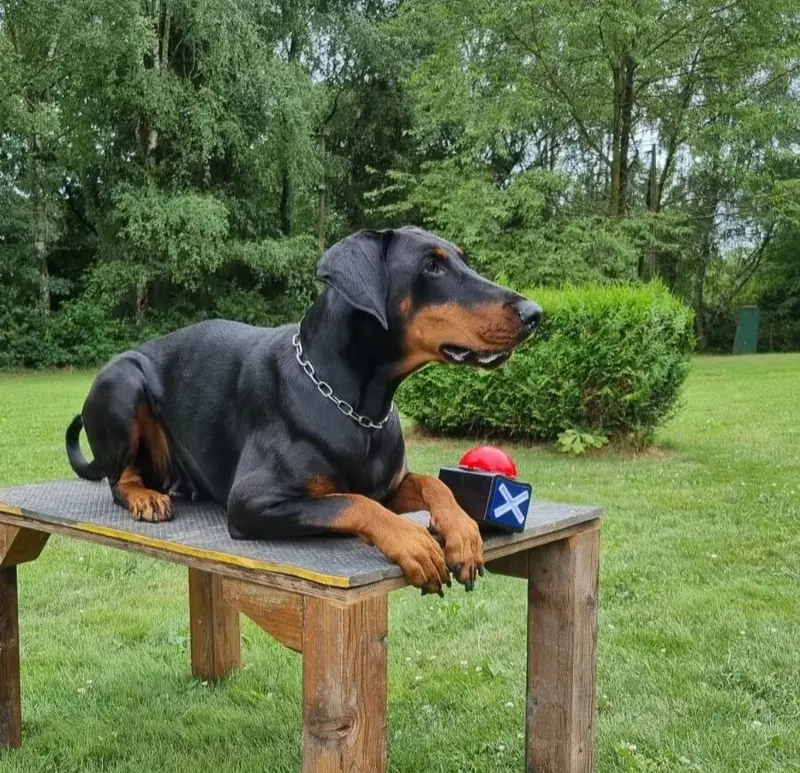
When you think of a Doberman, you probably picture a watchful, proud, and incorruptible protector. Their posture, piercing gaze, and athletic build command respect. Yet behind this imposing facade lies a dog that is far more complex than common stereotypes suggest. The Doberman temperament is defined by deep sensitivity, an enormous willingness to bond, and an almost comical urge for physical closeness.
Deciding on this breed should never be based solely on its striking appearance. A dog of this size—males reach a shoulder height of up to 72 centimeters (approx. 28 inches) and weigh between 40 and 45 kilograms (88 to 99 lbs)—requires leadership, time, and an understanding of its breed-specific traits. Let's take a closer look at the true face of this working dog.
Core character: The Doberman disposition in everyday life
In the canine world, the Doberman is often jokingly referred to as a "velcro dog." This describes the Doberman temperament in a home environment remarkably well. They are extremely people-oriented and would prefer to spend every second of the day with their primary caregiver. In daily life, this means: when you leave the room, the Doberman stands up and follows you. Even a trip to the bathroom is often accompanied by an attentive shadow on four paws.
Furthermore, this breed is known for its pronounced physicality. A typical Doberman loves to rest their heavy head on your lap or lean their full weight against your legs while standing. This search for contact shows how sensitive and affectionate these dogs are within their family circle.
At the same time, their genetics bring a high degree of alertness. The Doberman registers every change in their environment. An unfamiliar sound in the stairwell or an unusual silhouette on an evening walk is immediately noticed and reported. They act loyally and fearlessly, tending to place themselves protectively in front of their family if they assess a situation as threatening. You can find out more about their physical characteristics and history in the detailed Doberman breed profile.
A watchful disposition: Guard dog with a soft core
To understand the Doberman temperament, a brief look into history is helpful. In the late 19th century, tax collector and dog catcher Karl Friedrich Louis Dobermann bred a dog in Apolda, Thuringia, designed to protect him on his dangerous rounds. The goal was a courageous, resilient, and loyal companion. These attributes remain firmly anchored in the breed's DNA to this day.
The breed belongs to FCI Group 2 (Pinschers and Schnauzers, Molossoids, and Swiss Mountain and Cattledogs). According to the standards of the VDH (German Kennel Club), a medium temperament and medium sharpness are desired, paired with a solid stimulus threshold. In practice, this means: a balanced Doberman may get excited quickly, but can be calmed down just as fast through clear leadership. They are suspicious of strangers, but should never react aggressively without cause.
Is the Doberman right for you? An honest assessment
Not every household provides the right environment for such a demanding and intelligent dog. Countless Doberman experiences from owners and trainers show that the breed needs clear boundaries to prevent behavioral issues.
For dog beginners
Generally speaking, the Doberman is not recommended for dog beginners. Their high intelligence (trainability 5/5) means they notice inconsistency immediately and take advantage of it. Beginners are often overwhelmed by the reaction speed and physical strength of an adult male. If a first-time dog owner still chooses this breed, they should work closely from day one with an experienced dog trainer who specializes in working dogs.
For families with children
The Doberman's child-friendliness is in the middle range (3/5). Within their own family, they are usually affectionate and protective. However, they are large, boisterous dogs. A 40-kilogram male spinning in circles with joy can easily knock over small children. Additionally, the strong guarding instinct must not be underestimated: if unfamiliar children visit and play gets too rough, the dog might misunderstand this as an attack on "their" kids and try to intervene. Constant supervision and clear retreat areas for the dog are mandatory.
For singles and couples
For active singles or couples who spend a lot of time in nature and enjoy dog training, the Doberman is often an ideal partner. They form an intense bond with one or two main caregivers and stick with them through thick and thin.
Coexistence and daily life: What to expect
Before a Doberman moves in, the practical realities of everyday life must be critically evaluated. Living arrangements and interactions with other animals play a major role.
The ideal living situation
The breed's suitability for city living is moderate (3/5). A Doberman can live in an apartment as long as it is large enough and they get sufficient physical and mental stimulation outdoors. However, a house with a securely fenced yard is significantly less stressful—for both dog and owner. Note that they have a short coat without an undercoat. The Doberman gets cold very quickly in wet and weather conditions. They are entirely unsuited for kennel or outdoor keeping and generally require a well-fitting dog coat during freezing winter temperatures.
Other dogs and pets
Compatibility with other dogs is generally good (4/5), but depends massively on socialization during puppyhood and adolescence. Same-sex aggression (especially among intact males) can occur in this breed. Living with cats or small pets in the same household can work if the Doberman is accustomed to them from an early age. However, their prey drive should never be underestimated; outdoors, they tend to chase movement triggers quickly.
Energy level 5/5: Exercise requirements and species-appropriate activities
A short walk around the block is not enough for a Doberman. These dogs are bursting with energy and have enormous endurance. If this high energy level (5/5) is not channeled constructively, the dog will find its own outlets—often resulting in destructive indoor behavior or uncontrolled guarding.
Physical exercise is important: jogging, cycling, or extended hikes are readily accepted by the Doberman. Yet mental stimulation is even more crucial. An intelligent working dog wants a job to do.
- Nosework: Mantrailing or tracking exhausts the dog mentally on a massive scale. 20 minutes of intensive search work tire a Doberman out more than two hours of simply running alongside a bicycle.
- Obedience: Obedience or rally obedience promote cooperation between human and dog while strengthening the bond.
- Draft dog sports: Canicross is ideal for channeling the dog's physical strength in a controlled manner.
Caution is advised with high-arousal games like excessive ball throwing. The Doberman already tends toward a high level of arousal. Such games release large amounts of adrenaline and foster a hyperactive, stressed dog that struggles to settle down.
Typical challenges: When genetics kick in
Anyone living with a Doberman will sooner or later confront specific breed-typical behaviors that require professional management.
Separation anxiety and loss of control
Due to their strong people-orientation, many Dobermans struggle with being left alone. Often it is less about genuine fear and more about a feeling of loss of control. The dog believes they must stay with their caregiver to watch over them. Being left alone must be practiced in tiny steps and with a great deal of patience starting from puppyhood, otherwise ongoing barking and ruined furniture await.
Resource guarding and territorial behavior
Guarding property, toys, food, or even their own caregiver is in their nature. If the dog learns that they decide who moves about the house or who sits next to their owner on the sofa, dangerous conflicts will arise. The Dobermann-Verein e.V. and experienced breeders consistently emphasize how important it is to take responsibility away from the dog right from the start.
Sensitive nervous system
Some breeding lines struggle with dogs that are very nervous, startle easily, or are sensitive to noise. A stable temperament is the single most important criterion when choosing a breeder. A weak-nerved dog in a 40-kilogram body, paired with a guarding instinct, can lead to serious bite incidents stemming from insecurity.
Training: Consistency meets sensitivity
Training a Doberman often resembles a balancing act. On the one hand, they require crystal-clear rules, unmistakable boundaries, and confident leadership. On the other hand, they are highly sensitive and will literally break under a heavy hand, unfair treatment, or loud shouting.
Authoritarian drills are the wrong approach for this breed. A Doberman does not submit because you force them to, but because they trust their human and respect their sovereignty. Training success is achieved through positive reinforcement, perfect timing, and absolute predictability in your actions.
When you say "No," it must mean "No" tomorrow and the day after as well. The intelligent Doberman constantly scans you for vulnerabilities. If you yield even once, they will ruthlessly exploit that inconsistency the next time. Exuding calmness is the most important tool in Doberman training. The more agitated the dog becomes, the calmer and slower the human should act.
Frequently asked questions (FAQ)
Are Dobermans dangerous?
No, a Doberman is not naturally vicious. Due to their size, strength, and protective drive, however, they have the potential to become dangerous if kept isolated, poorly socialized, or improperly trained. In the hands of a responsible owner, they are peaceful and reliable companions. In some states or regions, however, specific keeping regulations (restricted breed laws) may apply to the Doberman, which you should check beforehand.
Can a Doberman be kept outside in a kennel?
Absolutely not. The Doberman lacks an insulating undercoat, which is why they get cold quickly in wet and cold weather. Even more significant is the psychological aspect: the Doberman is extremely people-oriented. Isolation in a kennel or yard makes the dog unhappy, fosters behavioral disorders, and almost inevitably leads to aggression or massive anxiety problems.
How long can a Doberman stay alone?
After careful and gradual training, an adult, healthy, and well-exercised Doberman can stay alone for about four to a maximum of six hours. Eight hours a day (during a full-time job) is not species-appropriate for this heavily bonding-oriented breed. Dog daycare facilities or dog walkers are necessary support systems in such cases.
Does the Doberman have a strong prey drive?
Although they are not a classic hunting dog, the Doberman possesses a pronounced drive for prey that was originally desired for protection dog sports and holding attackers. Outdoors, this means: if a hare or deer jumps up, a Doberman will most likely want to chase after it. Reliable anti-hunting training and an excellent recall are essential from day one.
Your path to your own Doberman
The Doberman is a dog for enthusiasts who appreciate their quirks and edges and are willing to invest plenty of time, patience, and work into a harmonious partnership. They demand physical fitness, mental presence, and a deep understanding of canine communication. If you can offer them all that, they will reward you with unconditional loyalty and a deep bond.
Choosing a healthy and balanced dog always starts with the breeder. Look for parent animals that appear relaxed and open, and insist on official health evaluations. Take your time browsing HonestDog if you want to gather comprehensive information, contact reputable breeders, and find healthy Doberman puppies. With the right preparation, you lay the foundation for a long, happy life together with your new companion.