
German Shorthaired PointerSame FCI group
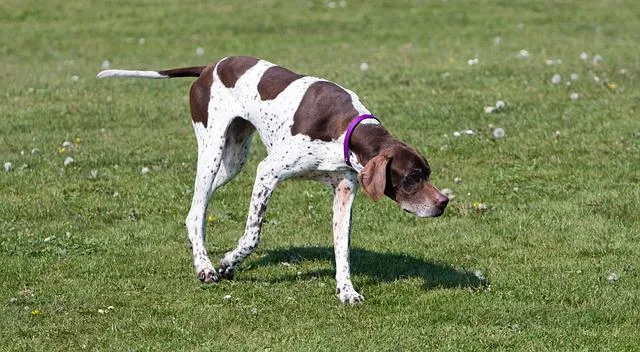
The English Pointer is a sensitive, extremely athletic pointing dog — bred to track down game birds at lightning speed in vast terrain and indicate them by standing perfectly still. A high-performance athlete that is gentle at home and pure adrenaline outdoors.
How the health grade is calculated
Sources for required breeding screenings. Verein für Pointer und Setter e.V.
Self-check
Answer 6 quick questions about your everyday life and see how well the English Pointer fits you — including an honest cost estimate per month, per year, and across the dog's lifetime.




At a glance
The essentials — key facts, traits, and health priorities — before you dive deeper.
Lifespan
12–15 yrs
Shoulder height
61–69 cm
Weight
20–36 kg
Practical
Temperament
Daily life
What matters most
Especially with a English Pointer, choosing the right breeder is the single most important decision you'll make. Serious breeders consistently test the parents for inherited conditions, prioritize healthy early socialization, and stay accountable long after handover. A cheap puppy without health screening tends to become the most expensive dog later on.
See HonestDog breeder standards →Colors & coat
The coat colors that occur in the English Pointer — including which ones fall outside the breed standard and which carry genetic risk.
Eye colors
 Brown
 Amber
Coat type
 Short
 Smooth
The real vibes check
An English Pointer is like a Formula 1 car: on the track, he needs maximum concentration, space, and speed, but in the pit lane – your living room – he is calm, affectionate, and almost invisible. If you give him the opportunity to live out his hunting instincts outdoors, you will get the gentlest shadow you can imagine indoors.
The English Pointer is a breed of dog known for its stunning posture and elegant physique. They have a distinct, noble appearance with a lean and muscular body structure that reflects their incredible speed and endurance. Their eponymous "Show" or "Pointing" pose, in which they point at the game with an outstretched foreleg and a rigid posture, is world-famous. They belong to FCI Group 7, the group of pointing dogs. A distinction is often made between performance and show lines, with performance lines often being slimmer and more athletic and showing stronger hunting instincts, while show lines are bred more for aesthetic appearance.
English Pointers are known for their friendly and even-tempered nature, which makes them good companion dogs. They are very people-oriented and build a close bond with their family. As active and energetic dogs, they need lots of exercise and mental stimulation. They love to play and romp around and are also very successful at various dog sports such as agility or flyball. However, with enough exercise, they can also be very calm and relaxed companions. In terms of the different lines, the English Pointer from the performance line often shows a stronger hunting instinct and more endurance, while the dogs from the show line tend to be calmer and show less hunting instinct. Nevertheless, all English Pointers should be well secured when not responding fenced areas, as their hunting instinct may lead them to pursue an interesting smell. They can learn to stay alone if they are trained to do so from an early age, but they are social and should not be left alone for long periods of time. When it comes to their alertness, English Pointers are not your typical watchdogs. They tend to be rather friendly and open towards strangers. However, they can keep a watchful eye on their territory and warn their family of potential threats. Their friendly and open nature makes them good family dogs and they can also get along well with other dogs and pets if properly socialized. Despite their hunting history, English Pointers are typically very good-natured and friendly dogs that go well with people of all ages. They are intelligent and capable of learning, which makes training easier. However, they are also known to be a bit stubborn at times, which requires patient and consistent training. They are very playful and love spending time outdoors, making them great companions for active people.
| Watchfulness Occasionally alerts but is fundamentally open. | Low |
| Openness to Strangers Warms up quickly and is generally welcoming. | Friendly |
| Hunting or Herding Drive This drive runs deep — no amount of training eliminates it. | Very strong |
Fun Fact!
Did you know that the English Pointer gets its name from its unique ability to "show" prey by pointing at it with its nose and holding its tail stiff?
The Pointer is the ultimate expression of canine power and grace. The name of the breed is its job description: Pointers are pointers for game birds, and have been for centuries. The energetic Pointer makes an excellent companion for runners.
English Pointers are suitable both as city dogs and for country life, provided they get enough exercise and mental stimulation. They are very family oriented and generally get along well with children. They also get along well with other dogs and can live with cats and other pets if properly socialized.
Loves family life and thrives in a group.
Takes boisterous and affectionate children in its stride.
Actively enjoys the company of other dogs.
City-appropriate with enough exercise and stimulation.
Owning a dog is a privilege, but it's also a real responsibility. Before you bring one into your life, be honest with yourself about the commitment it takes.
English Pointers are intelligent and willing to learn dogs that respond well to positive training. They are very active and are well suited to various dog sports such as agility or flyball. Because they were originally bred for hunting, they have a natural instinct to run and forage, which can be channeled into appropriate activities such as tracking or retrieving. It is important not to overstimulate the English Pointer. Although they are active dogs, they also need periods of rest. Furthermore, English Pointers can become "ball junkies". Therefore, ball games should not take over and instead a balanced mix of different activities should be offered. Topics such as impulse control and frustration tolerance should not be neglected in education. English Pointers can sometimes be a bit stubborn, so consistent but loving training is important. It is also important to socialize the dog early and introduce him to a variety of people, animals and environments to promote a well-balanced and confident dog.
English Pointers are active dogs that require a balanced diet to meet their energy needs. A mix of high-quality dry and wet food is ideal. When choosing food, you should pay attention to a sufficient supply of proteins, fats and carbohydrates. For puppies, it is particularly important to choose a food that is specifically designed for growth. Caring for the English Pointer is relatively straightforward. Their short coat has no undercoat and sheds very little. They cope well with the climate in Germany, but should be protected with a dog blanket in extremely cold temperatures.
| Care Level Minimal effort — occasional brushing and bathing. | Low-maintenance |
| Exercise Needs Working-dog energy that needs burning off every single day. | High-drive |
| Shedding No or minimal hair loss — suitable for allergy sufferers. | No shedding |
| Trainability Picks up commands quickly and wants to please. | Eager to learn |
Our experts are still reviewing this information. Spotted something wrong? Email us at info@honestdog.de.
Robust
Health grade
The English Pointer is considered a very robust breed, yet breed-typical problems such as hip dysplasia (HD) and hypothyroidism can still occur. The Verein für Pointer und Setter e.V. therefore mandatorily prescribes an HD X-ray with a limit of HD A–B as well as a dental and bite evaluation for breeding approval. A health-oriented breeder furthermore tests their parent animals for unremarkable thyroid function and ideally also has elbow dysplasia (ED) evaluated. Have the breeder show you the official HD findings and proof regarding hypothyroidism for both parent animals before purchasing a puppy.
Grade is relative to other breeds — AI-assisted and editorially reviewed.
Methodology and data: HonestDog Dog Breed Health Report 2026
What matters most for this breed
Tap any item to see details.
Ensure the dog is raised in a way that protects its joints and divide food portions well to keep the risk of bloat low for these active dogs.
Responsible breeders test parent animals for hip dysplasia (HD), hypothyroidism, and dental and bite evaluation, and additionally screen them for elbow dysplasia (ED).
Note: This health overview is AI-assisted and editorially reviewed. It is for orientation only and does not replace veterinary advice.
What matters most for this breed — what's common, how much it affects the dog's life, and how to protect yourself as a buyer.
Tap a body region to see the inherited conditions linked to it.
The three most important risks
Pick a region on the map to explore other areas.
Tier 1 is the core standard: the tests Verein für Pointer und Setter e.V. requires, plus further tests from the recommended health standard for this breed. Tiers 2 and 3 show how responsible breeders go beyond.
Core standard. Tests marked “Club standard” are required by Verein für Pointer und Setter e.V. for breeding approval; the others are part of the recommended health standard for this breed. Ask any reputable breeder for the results.
Not health tests, but required for breeding: the club asks for these results too. They don't count toward the risks or the rating.
DNA-Identitätsnachweis
Required by Verein für Pointer und Setter e.V.
Acceptable result: Probe von mindestens 5ml EDTA-Blut zur DNA-Biobank eingesendet
Wesensbeurteilung
Required by Verein für Pointer und Setter e.V.
Acceptable result: Verhaltenssicher (keine Aggressivität, Scheue oder Ängstlichkeit gegenüber Fremden, Scheue vor lebendem Wild)
Dental and bite evaluation
Required by Verein für Pointer und Setter e.V.
Acceptable result: Scheren- oder Zangengebiss (Zange bei POI, ES, GS, IRS führt zu Zuchtverbot, bei IRWS uneingeschränkt), vollständige Zahnanzahl oder bis zu 2 fehlende Prämolare
No entries in this tier.
Note: This health overview is AI-assisted and editorially reviewed. It is for orientation only and does not replace veterinary advice.
A English Pointer costs around ~€180 per month (€100 – €350, depending on your setup). The first year adds up to roughly ~€4,900 including purchase, equipment and puppy school; across the dog's life (13.5 years) it comes to about ~€32,610.
With surgery cover, running costs come to about ~€180 per month — in return, your share of a major operation drops from several thousand euros to around 20 percent.
Per month
~€180
In the first year
~€4,900
Across the dog's life
~€32,610
Estimated purchase price from a breeder: €1,200 – €2,500
Estimate at a mid-range setup (suburban, dry food, 1–2 hours of daily exercise), average German prices, as of July 2026.

 Illustrative image
 Illustrative image
 Illustrative image
 Illustrative image
The English Pointer breed is originally from Great Britain and was first documented in the late 17th century. They were bred by hunters to improve hunting methods and are known for their ability to find and point at birds to show the hunter the location of the game. They are believed to have been bred from a mix of dog breeds including the Bloodhound, Foxhound and Greyhound. This combination resulted in a dog with an excellent sense of smell, great speed and endurance, and a strong hunting instinct. The English Pointer was recognized as a separate breed by the American Kennel Club in 1878.
The English Pointer was bred to mark game by so-called "pointing" so hunters could easily find it.
Great Britain
1650
Owners consistently describe the English Pointer as a dog with two faces in daily and family life. Indoors, most owners find it very gentle, affectionate and almost catlike in its calm. It seeks close physical contact, loves comfortable resting spots and shows a very relaxed, cuddly side at home. Owners also often praise how well it gets along with children and other dogs; it is generally friendly to neutral with strangers, which makes it completely unsuitable as a watchdog.
As soon as it goes outside, though, almost every owner sees the dog switch into a completely different mode. Its high-spirited temperament and huge love of running take a lot of energy from owners. In owners' experience, simply trotting alongside in a city park is not enough for the breed. If a Pointer is underchallenged in daily life, it quickly becomes nervous, frustrated or overexcited indoors. Owners therefore stress again and again that the time needed for long outings and controlled off-leash running should not be underestimated.
Sources:einfachtierisch.dezoomalia.deforum.hundund.desabinemiddelhaufeshundundnatur.netreddit.com
The central topic in forums and owner reports is the breed's very strong hunting drive and urge to range far. Many owners describe the Pointer as a "horizon runner" that instinctively quarters large fields and open ground for scent on its own and locks onto the slightest stimulus, such as a flushing bird, in a split second. In most cases, relaxed off-leash time is only possible after years of intensive anti-hunting and recall training. Many owners admit frankly that in areas with lots of game, their dogs have to stay on a long line for good.
At the same time, experienced owners highlight how sensitive the breed is in training. Harshness, pressure or a raised voice get you little with a Pointer; it often responds with insecurity, avoidance or stubborn refusal. What works is calm, patient, partnership-based training with positive reinforcement. To redirect the breed's natural instincts outside of hunting, owners often turn to nose work, tracking or dummy work to keep this passionate pointing dog mentally satisfied.
Sources:einfachtierisch.dedogorama.appheyholy.comforum.hundund.de
A large share of the reports from German-speaking countries come from owners who adopted a Pointer or Pointer mix through southern European rescue. These dogs often bring a strong passion for hunting from performance-bred lines, but at first they are frequently shy, overwhelmed or reserved in their new home. Owners also report, however, how quickly and deeply these dogs come to trust people and how grateful and cooperative they become once they feel safe.
Physically, most owners consider the Pointer a robust, athletic breed. Even so, they repeatedly point out how vulnerable the very short coat is: without an insulating undercoat, many Pointers get cold quickly in wet, chilly weather and need a dog coat in winter. Owners also note with a smile that the short, bristly hairs shed heavily all year round and stubbornly work their way into blankets and clothes, even though actual coat care couldn't be simpler.
Sources:einfachtierisch.dereddit.comforum.hundund.dezooplus.de
Paraphrased from real owner reports · translated from German
The English Pointer is an active dog that needs plenty of exercise and mental stimulation. Research the temperament, grooming needs, and space requirements before deciding.
The average life expectancy of a English Pointer is 12-15 years. With proper care and regular vet visits, your dog can live a long, healthy life.
English Pointer grooming requirements include regular brushing, nail trimming, and dental care. HonestDog provides detailed grooming tips for every breed.
The English Pointer can be a great family dog. Proper training and socialization are key. HonestDog provides family suitability information for every breed.
The English Pointer comes in these colors: Black and white, Brown and white, Tricolor, Black, Liver.
Showcase your kennel on HonestDog and reach families searching for a responsibly bred English Pointer.