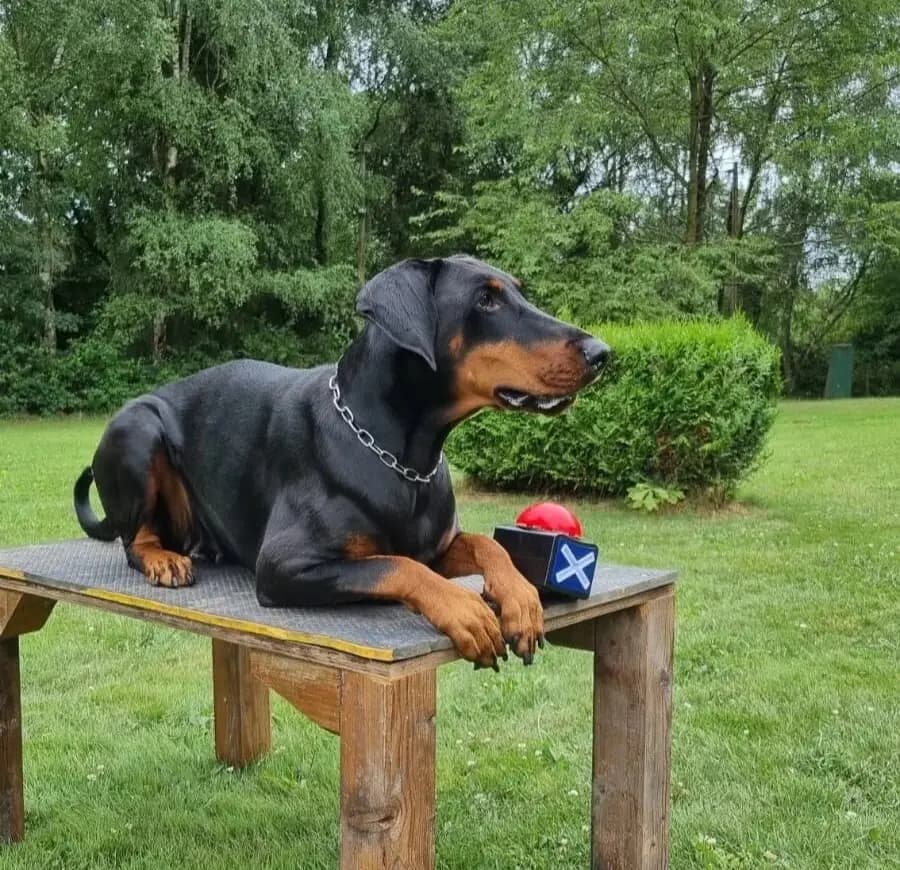
DobermannSame FCI group

The Rottweiler is a powerful, steady-nerved Molosser with a working background—bred as an incorruptible herding and guard dog that protected cattle herds and butcher's carts with sheer presence.
Self-check
Answer 6 quick questions about your everyday life and see how well the Rottweiler fits you — including an honest cost estimate per month, per year, and across the dog's lifetime.
At a glance
The essentials — key facts, traits, and health priorities — before you dive deeper.
Lifespan
8–10 yrs
Shoulder height
56–68 cm
Weight
35–50 kg
Practical
Temperament
Daily life
What matters most
Especially with a Rottweiler, choosing the right breeder is the single most important decision you'll make. Serious breeders consistently test the parents for inherited conditions, prioritize healthy early socialization, and stay accountable long after handover. A cheap puppy without health screening tends to become the most expensive dog later on.
See HonestDog breeder standards →Colors & coat
The coat colors that occur in the Rottweiler — including which ones fall outside the breed standard and which carry genetic risk.
Eye colors
 Brown
BrownCoat type
 Short
Short Double coat
The real vibes check
A Rottweiler is not a blind follower of commands, but a bodyguard that silently but constantly scans your leadership skills. If you prove to him that you have the world under control, he becomes the most relaxed family dog. However, if he believes you are overwhelmed, he will take control—and that is something you definitely do not want in your daily life.
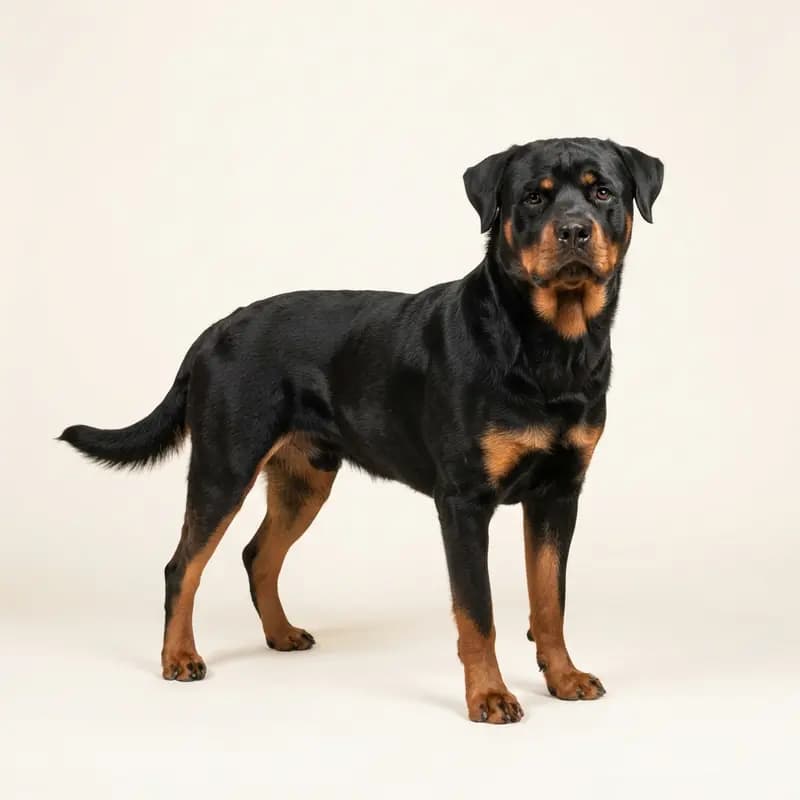
The Rottweiler is a strong and powerful dog whose imposing stature inspires both awe and admiration. With his muscular body and his confident walk, he exudes a natural authority. The Rottweiler belongs to FCI Group 2 and is classified as a Molosser dog. Breeders often focus on guarding and protective qualities as well as a balanced temperament. The Rottweiler has a distinctive head with a wide jaw and medium-sized, almond-shaped eyes.
People who are unfamiliar with Rottweilers sometimes tend to view them as intimidating. But beneath the muscular appearance lies a loving heart. Rottweilers are exceptionally loyal and affectionate. If you open your heart to a Rottweiler, you will receive a loyal companion who would protect you and your family with his life. This breed is very people-oriented and loves to be integrated into the family. They are often particularly affectionate and enjoy cuddle time as well as play time. As highly intelligent dogs, Rottweilers seek mental stimulation and are often enthusiastic when they have tasks to solve. They are very playful and enjoy a variety of activities, especially when done with their humans. When it comes to temperament, Rottweilers are usually calm and even-tempered as long as they get enough exercise and mental stimulation. Without adequate activity, they can become restless and develop behavioral problems. Having a Rottweiler as a pet also means having a natural guard dog. They are naturally alert and will usually react quickly to unusual noises or movements. This does not mean that they are aggressive, but rather that they have a natural tendency to protect their territory and family. Rottweilers can learn to stay alone, but they definitely enjoy the company of their people and can develop separation anxiety if left alone for long periods of time. It's important to teach them from puppyhood that it's okay to be alone sometimes, but this should be kept in moderation. When it comes to hunting or prey-catching behavior, Rottweilers can tend to chase or retrieve things, especially when they are under-challenged. This can be mitigated through training and social interaction.
| Watchfulness Strong territorial instinct — may actively confront intruders. | Very high |
| Openness to Strangers Careful around unfamiliar people — thaws slowly. | Cautious |
| Hunting or Herding Drive Powerful instinct that can override recall when triggered. | Strong |
Fun Fact!
As original butcher dogs, Rottweilers even used to pull carts.
Rottweilers are considered confident, intelligent and alert dogs. They are not suitable as beginner dogs. Problem behavior often occurs due to the dog owner's lack of experience. In order to develop into a pleasant companion, they need consistent training with a lot of expertise.
Rottweilers are versatile dogs, but their size and energy make them more suited to living in a house with a yard than an apartment. They need a lot of exercise and mental balance. It is important that they have enough space to let off steam. When it comes to children, Rottweilers are often affectionate and protective, but due to their size and strength, it is important that interactions between Rottweilers and young children be supervised. Rottweilers can get along with other pets, including cats, if properly socialized. It's important to start socialization early and encourage positive interactions with other animals.
Loves family life and thrives in a group.
Gets on well with children — with adult supervision.
Usually gets on fine with other dogs.
Can manage in the city, but only with very active owners.
Owning a dog is a privilege, but it's also a real responsibility. Before you bring one into your life, be honest with yourself about the commitment it takes.
Rottweilers are intelligent and hard-working dogs. They need consistent training and varied employment. It is advisable to involve them in dog sports such as agility and obedience. Due to its relatively low sensitivity, the Rottweiler is definitely suitable for beginner dog owners. However, it is important to teach him early not to be rude to his people or fight with them. Physically intensive games should be avoided so as not to encourage overly violent or ritualized behaviors. At the same time, the Rottweiler needs opportunities to express his energy. Intensive retrieval training, such as retrieving a dummy from a pile of heavy objects, is a suitable option. It is also important to teach the Rottweiler frustration tolerance and impulse control. A balanced mix of mental and physical activity is crucial for the Rottweiler to be a balanced and happy family member. A well-behaved Rottweiler is a loyal and reliable companion.
Rottweilers require a balanced diet to maintain their health and energy. A high-quality diet that is rich in proteins and balanced in fats and carbohydrates is often recommended. Rottweilers tend to be overweight, so it's important to monitor the amount of food they eat and ensure they get regular exercise. When it comes to grooming, Rottweilers have a short, dense coat with an undercoat. Their coat is relatively easy to care for, but they shed moderately throughout the year and more during the changing seasons. Regular brushing helps remove loose hair and keeps the coat clean and healthy. Rottweilers cope well with the German climate; their undercoat provides protection from the cold.
| Care Level Minimal effort — occasional brushing and bathing. | Low-maintenance |
| Exercise Needs Working-dog energy that needs burning off every single day. | High-drive |
| Shedding Hair everywhere, always — no white clothing survives. | Very heavy |
| Trainability Bred to work closely alongside humans. | Highly trainable |
Our experts are still reviewing this information. Spotted something wrong? Email us at info@honestdog.de.
Solid, watch carefully
Health grade
The Rottweiler has an above-average burden of severe hereditary diseases. While the dreaded neurological disorder JLPP (Juvenile Laryngeal Paralysis & Polyneuropathy) is now well under control thanks to mandatory genetic testing, hip dysplasia (HD) and elbow dysplasia (ED) remain a persistent risk despite strict selection. In addition, the occurrence of heart diseases such as aortic stenosis requires a very close look at the parents' health records when buying a puppy.
Grade is relative to other breeds — AI-assisted and editorially reviewed.
Methodology and data: HonestDog Dog Breed Health Report 2026
What matters most for this breed
Tap any item to see details.
Without conscious management of weight and exercise, as well as good preventative care—such as regular check-ups—joint problems and veterinary costs can rise significantly later on.
Reputable breeders have hips, elbows, and hearts checked and use DNA tests for nerve diseases to keep the dogs resilient for as long as possible.
Note: This health overview is AI-assisted and editorially reviewed. It is for orientation only and does not replace veterinary advice.
What matters most for this breed — what's common, how much it affects the dog's life, and how to protect yourself as a buyer.
Tap a body region to see the inherited conditions linked to it.
The three most important risks
Pick a region on the map to explore other areas.
We sort tests into three tiers — from the mandatory club standard to a fully exemplary program.
Club standard. Tests that the relevant breed club (VDH / FCI / AKC parent club) requires. Any serious breeder should be able to show you these.
No entries in this tier.
Note: This health overview is AI-assisted and editorially reviewed. It is for orientation only and does not replace veterinary advice.
A Rottweiler costs around ~€210 per month (€110 – €400, depending on your setup). The first year adds up to roughly ~€5,950 including purchase, equipment and puppy school; across the dog's life (9 years) it comes to about ~€25,750.
With surgery cover, running costs come to about ~€210 per month — in return, your share of a major operation drops from several thousand euros to around 20 percent.
Per month
~€210
In the first year
~€5,950
Across the dog's life
~€25,750
Estimated purchase price from a breeder: €1,800 – €3,500
Estimate at a mid-range setup (suburban, dry food, 1–2 hours of daily exercise), average German prices, as of July 2026.
Rottweiler is not treated uniformly throughout Germany and may be subject to specific regulations depending on the federal state or municipality. This may include a permit or other official requirements, restricted insurance options, or a higher dog tax. Always check with your local authorities.
Full guide to restricted-breed ownership in Germany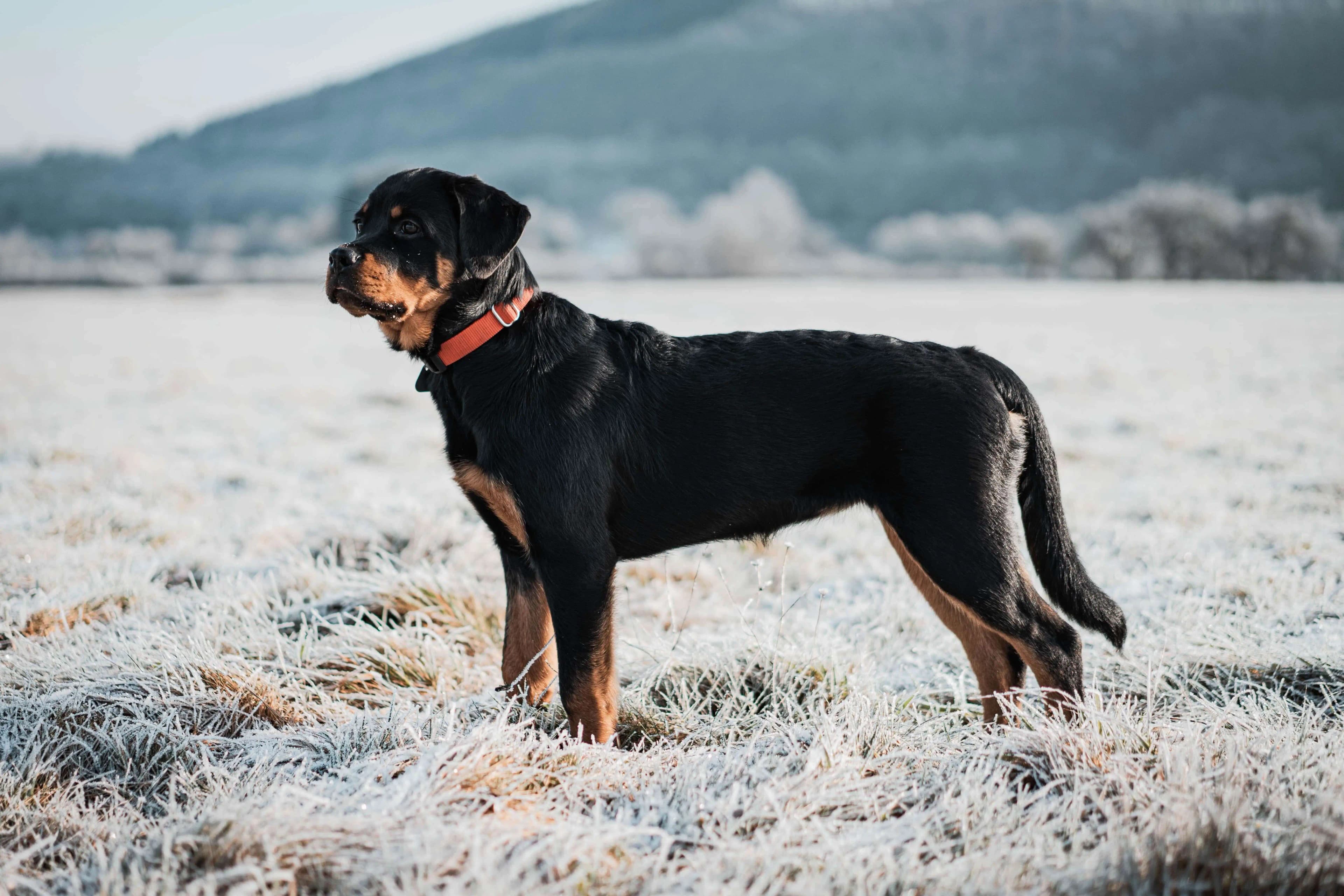
 Illustrative image
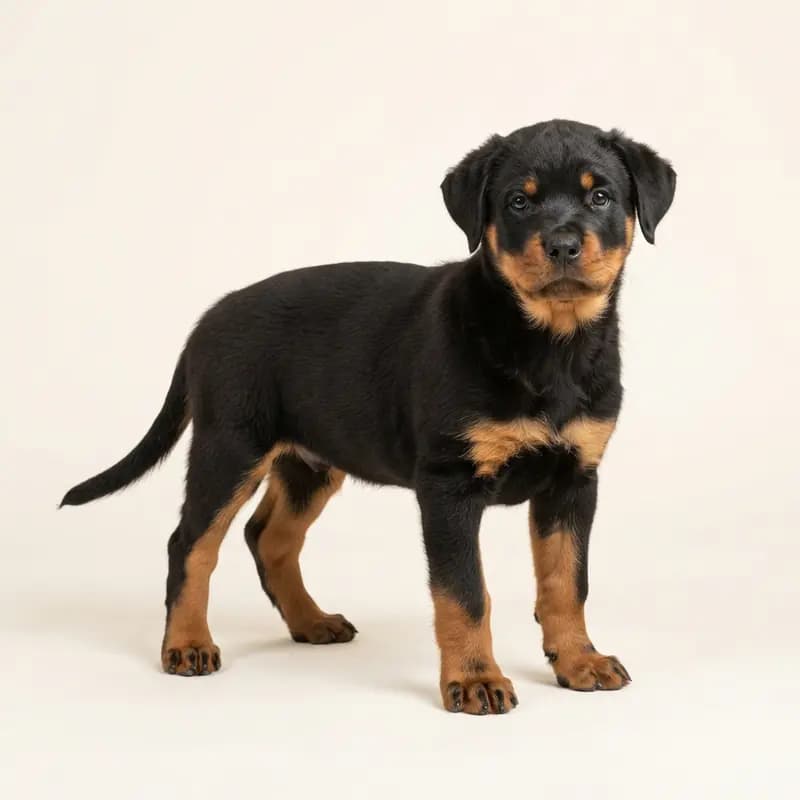 Illustrative image
The history of the Rottweiler goes back to the time of the Roman Empire, when the ancestors of this breed were used as livestock guard dogs. The Romans carried these powerful dogs with them to protect their flocks on their long journeys. Later, in the Middle Ages, the Rottweiler found its way to the southern German city of Rottweil. This is where he got his name and was known as the “butcher dog” because it was often used to herd and drive livestock as well as to protect the butcher and his goods. The Rottweiler was recognized as an independent breed at the beginning of the 20th century and has steadily gained in popularity ever since, including in the police service.
The Rottweiler was used as a driving and guard dog for herds of livestock and for pulling carts.
Germany
Antike
In their write-ups, many owners stress the big gap between how intimidating the Rottweiler often looks to outsiders and how it actually behaves at home. Within the close family circle, it comes up again and again as a deeply devoted, cuddly and loyal "big softie." With children it knows, the breed is usually patient and calm, with a high threshold before anything rattles it. For all that gentleness indoors, owners regularly point out that these dogs' size and strength can make them boisterous during play, so an adult always needs to supervise.
Life outside your own four walls is often the harder part. Many owners describe wariness or distrust from neighbors, plus official hurdles in several German states where the Rottweiler is on the restricted-breed list (temperament tests or higher dog taxes, for example). Owners also often note that a Rottweiler is naturally reserved and watchful around visitors and strangers. You have to think ahead and teach your dog early on that strangers on its home turf are nothing to worry about.
Sources:dogssupreme.dedogforum.dezoobedarf-hitzegrad.dehundeforum.comforum.hundund.de
On training, owners largely agree: the Rottweiler is a smart, eager-to-learn working dog that needs clear, completely reliable leadership. Experienced owners are explicit, though, that harshness is not the same as consistency. Many reports describe these dogs as sensitive at heart; unfair pressure tends to produce stubbornness or distrust, while calm, fair firmness and positive reinforcement get the best results. If the dog senses weak leadership, it tends to handle situations on its own and step into a protective or controlling role.
Young Rottweilers often test their people hard, especially during adolescence and until they mature at around three years old. Owners say solid loose-leash walking and a rock-solid recall have to be top priorities from puppyhood on. When forty or fifty kilograms of dog lunges into the leash at full force, whether from excitement, prey drive or territorial motives, it is almost impossible to hold. Early, well-grounded socialization at a dog school, along with deliberate work on frustration tolerance and settling down, is therefore considered essential.
Sources:dogssupreme.dedogforum.dehundeforum.comforum.hundund.debubeck-petfood.de
On exercise and health, many owners stress that the Rottweiler is a real working dog that needs mental challenges above all, not just physical activity. Walks alone rarely satisfy the more active dogs; they often come alive with scent work, tracking or obedience training. Without a job to do, owners report, they can get restless, chew things at home or become frustrated. At the same time, owners warn against artificially revving the dog up, since learning to relax matters just as much for this breed.
Physically, owners point to the typical risks of heavy, large-framed breeds. Joint problems such as hip or elbow dysplasia and cruciate ligament tears come up again and again, which is why gentle growth, avoiding stairs and strict weight control should be priorities from the first year. A tendency toward bloat (gastric torsion) and heart disease is also discussed among breeders and owners. Many owners feel the breed's life expectancy is relatively short, something you need to factor in consciously before getting one.
Sources:dogssupreme.dezoobedarf-hitzegrad.dedogforum.deforum.hundund.deflummisdiary.at
Paraphrased from real owner reports · translated from German
The Rottweiler is an active dog that needs plenty of exercise and mental stimulation. Research the temperament, grooming needs, and space requirements before deciding.
The average life expectancy of a Rottweiler is 8-10 years. With proper care and regular vet visits, your dog can live a long, healthy life.
Rottweiler grooming requirements include regular brushing, nail trimming, and dental care. HonestDog provides detailed grooming tips for every breed.
The Rottweiler can be a great family dog. Proper training and socialization are key. HonestDog provides family suitability information for every breed.
The Rottweiler comes in these colors: Black and tan.
Rottweiler or Doberman? Read our honest comparison of temperament, care, and costs to find out which powerful breed fits your home best.
German Shepherd or Rottweiler? Compare their temperament, care needs, and costs to see which of these protective breeds is right for your lifestyle.
Master your Rottweiler training with these expert tips. From puppy socialization to advanced obedience, build a respectful and confident companion.
Showcase your kennel on HonestDog and reach families searching for a responsibly bred Rottweiler.