Loading breed
Samoyed
Health grade C- Height51–59 cm
- Weight20–30 kg
- Life expectancy12–15 yrs
- Puppy price1,500–2,500 €
- Energy4/5
The Essentials at a Glance
The Samoyed is an extremely people-oriented, enduring sled dog—bred to pull heavy loads in icy cold, herd reindeer, and warm its family's tent at night. Its legendary smile often masks its enormous need for exercise and its stubborn independence.
- Health grade C: The Samoyed is considered a robust Nordic breed, yet it requires an above-average number of mandatory health tests, particularly regarding the eyes.
- You are looking for a robust companion for long hikes, sled dog sports, or long runs in cool weather.
- You work from home or can take your dog almost everywhere, as this original tent-dweller handles being alone very poorly.
- You expect them to turn around joyfully the moment you call—as a Nordic Spitz, they often decide for themselves whether a command makes sense at that moment.
Is the Samoyed right for you?
At a glance
Samoyed overview
The essentials — key facts, traits, and health priorities — before you dive deeper.
Health grade
Relative to other breeds
S
A
B
C
D
E
Very healthyHigher risk
Average — several important tests are expected.
See full health info & tests →
Note: This health overview is AI-assisted and editorially reviewed. It is for orientation only and does not replace veterinary advice.
Lifespan
12–15 yrs
Height
51–59 cm
Weight
20–30 kg
Practical
- Puppy price: 1,500 – 2,500 €
- Coat: Dense, long, with an undercoat
- Origin: Russia
Temperament
Energy
Trainability
Family fit
With kids
Daily life
Care effort
Shedding
Barking
City-friendly
Guard instinct
What matters most
Especially with a Samoyed, choosing the right breeder is the single most important decision you'll make. Serious breeders consistently test the parents for inherited conditions, prioritize healthy early socialization, and stay accountable long after handover. A cheap puppy without health screening tends to become the most expensive dog later on.
See HonestDog breeder standards →Colors & coat
What colors does the Samoyed come in?
The coat colors you will see in Samoyed litters — including which ones fall outside the breed standard and which carry genetic risk.
Eye colors
 Brown
Brown
Coat type
 Long
Long Double coat
Is the Samoyed right for you?
Perfect for you if:
- You are looking for a robust companion for long hikes, sled dog sports, or long runs in cool weather.
- You work from home or can take your dog almost everywhere, as this original tent-dweller handles being alone very poorly.
- You have a great sense of humor and patience for training and do not expect blind, unquestioning obedience.
- You live in a house with a secure, escape-proof garden and don't mind white dog hair on absolutely every piece of furniture.
Less ideal if:
- You expect them to turn around joyfully the moment you call—as a Nordic Spitz, they often decide for themselves whether a command makes sense at that moment.
- You live in an apartment with thin walls and have neighbors who won't tolerate loud, vocal barking.
- You are looking for an easygoing summer dog that will go jogging on the beach at 30 degrees Celsius.
- You are pedantically tidy and get stressed by a life full of daily grooming and piles of undercoat in the house.
The real vibes check
A Samoyed is like a beautiful, white snowstorm in your living room: breathtaking to look at, but full of wild energy that cannot simply be turned off. They love every human dearly, but out on the leash, it quickly becomes clear that beneath the plush 'Sammy smile' lies a tough, independently thinking sled dog. You won't get an obedient servant, but rather a humorous, vocal partner who is passionate about life in the pack.
Self-check
Would the Samoyed really fit your life?
Answer 6 quick questions about your everyday life and see how well the Samoyed fits you — including an honest cost estimate per month, per year, and across the dog's lifetime.
Fit checkCost estimateRisk dice
Takes about 1 minute · free & anonymous
Breed Profile
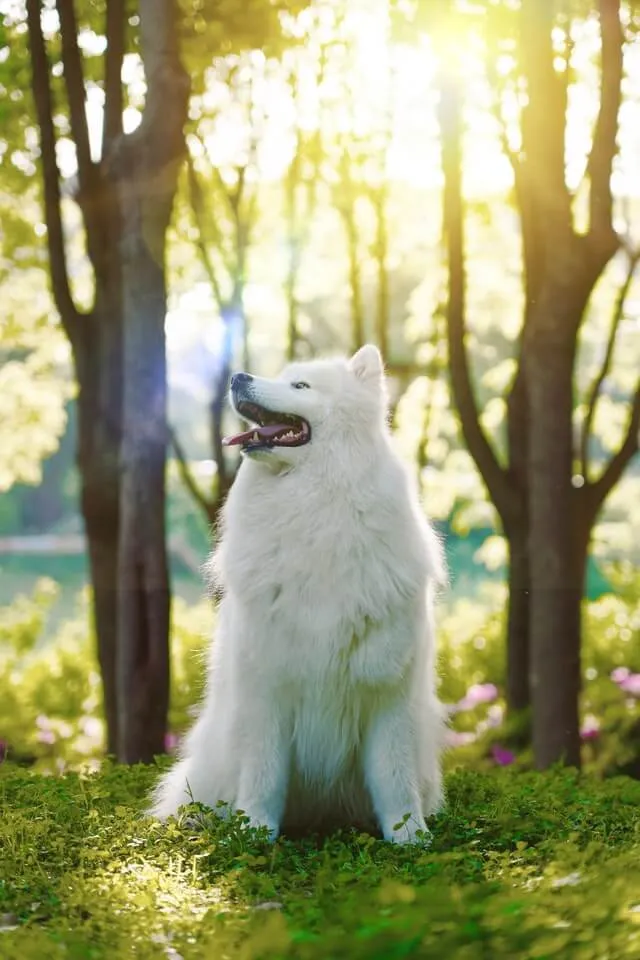
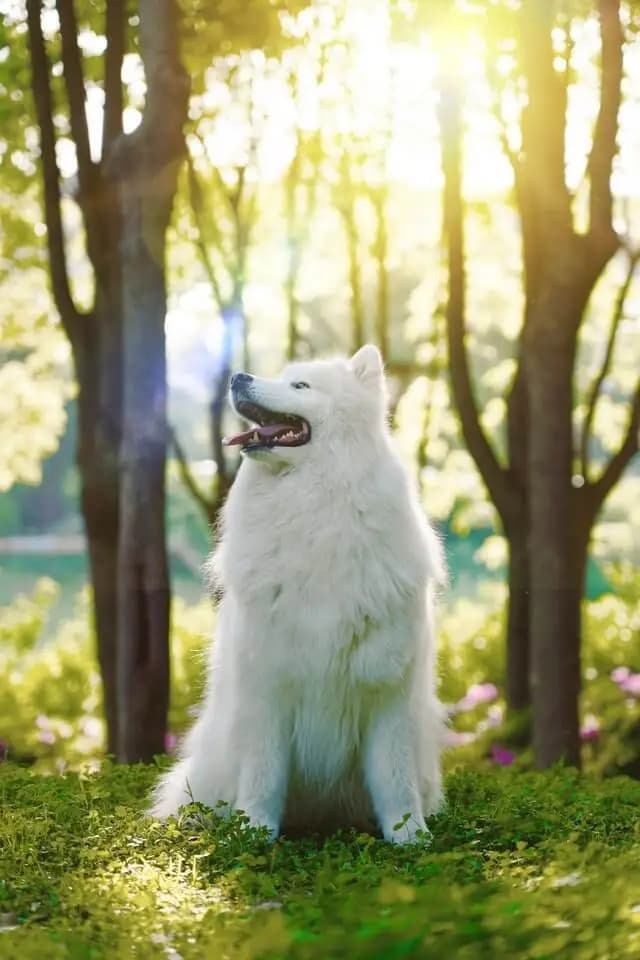
The Samoyed is an impressive presence, not least because of his thick, white fur and ever-shining smile, giving him the affectionate nickname "Smiling Sammie". has introduced. This breed belongs to FCI Group 5 of Spitz and Laika type dogs and is found in Section 1, Nordic Sled Dogs. This medium-sized breed has a robust constitution and is known for its endurance and strength. The Samoyed is characterized by its distinctive, wedge-shaped head shape with pronounced cheekbones. His eyes are almond-shaped, brown or blue, and radiate an intelligent and gentle expression. The ears are erect and slightly rounded, while the tail is carried over the back and is often covered with long, fluffy hair. Unlike many other breeds, Samoyeds have no distinction between performance and show lines, which contributes to a consistent appearance and characteristics.
All measurements in detail
- Height
- 51 - 55 cm (Female), 55 - 59 cm (Male)
- Weight
- 20 - 25 kg (Female), 25 - 30 kg (Male)
- Life Expectancy
- 12 - 15 yrs
- Character
- Friendly, adaptable, energetic
- Coat
- Dense, long, with an undercoat
- Coat Color
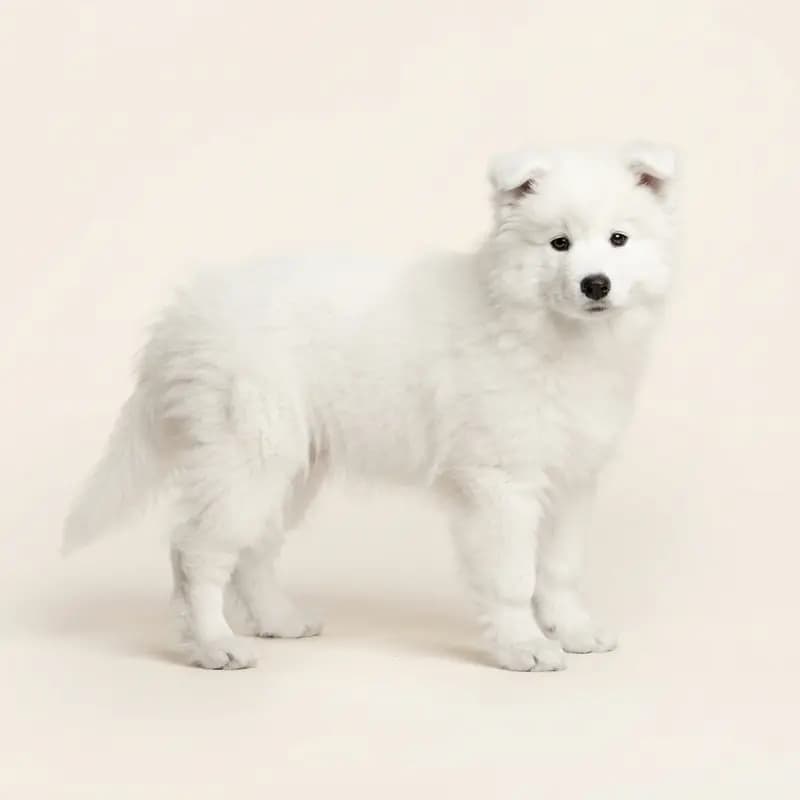
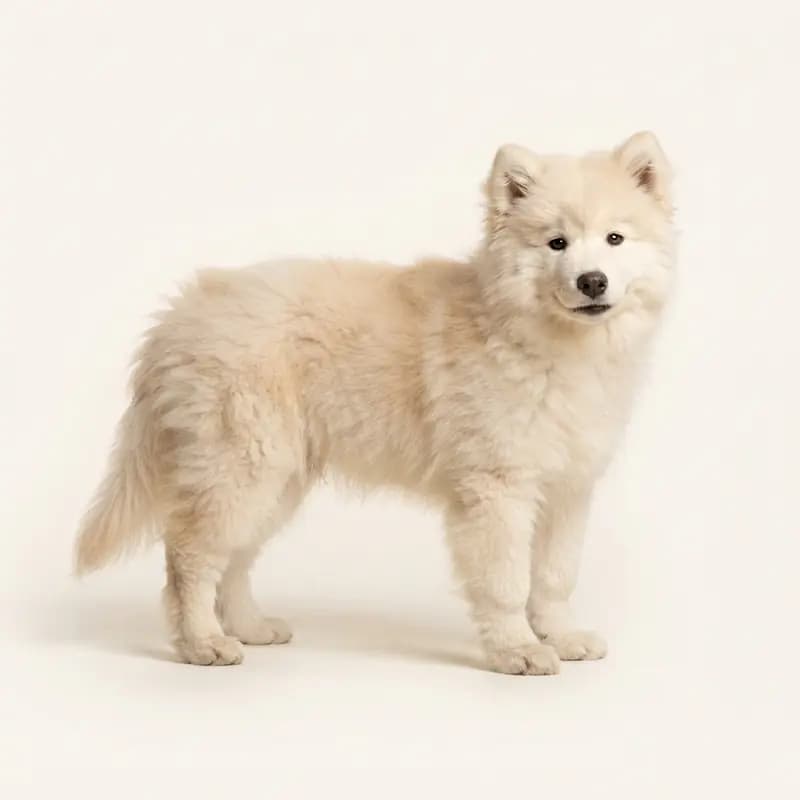
- White, cream, sponge cake
- Price
- 1500 - 2500 €
Character & Temperament
Samoyeds are known for their friendly and good-natured nature. They are extremely people-oriented and have a strong need for companionship and affection, making them great family dogs. They love children and are often very gentle and patient with them. In terms of temperament, Samoyeds are very active and energetic dogs. They love to move, play and learn new tasks. This makes them great partners for active families who enjoy hiking, jogging or simply spending a lot of time outdoors. Samoyeds are also very adaptable and do well in different environments as long as they receive enough exercise and mental stimulation. They can live well in apartments as long as they get enough exercise and playtime. They are not known for their prey or hunting instincts, which makes them good city dogs. Despite their friendly nature, Samoyeds can also be alert and are known to be protective of their family and home. They don't bark excessively, but can become loud when they perceive a threat or when they are bored or lonely. Samoyeds are intelligent and quick learners, but they also have an independent spirit and can be a bit stubborn at times. They require gentle but consistent training and respond best to positive reinforcement. They are not known to develop separation anxiety, but due to their social nature, they do not like spending long periods of time alone. Samoyeds are not dogs that display constant alertness or protective instincts. They are generally friendly towards strangers and do not tend to be aggressive. This, coupled with their strong need for companionship, means they are not the best choice for someone looking for a guard dog.
| Watchfulness Reports unusual activity but stays controlled. | Moderate |
| Openness to Strangers Warms up quickly and is generally welcoming. | Friendly |
| Hunting or Herding Drive Mild interest in movement and small animals — easily managed. | Low |
Fun Fact!
Did you know that the Samoyed was named after the nomadic Samoyed people who lived in Siberia and used these dogs for hunting and pulling sleds?
What Awaits You
Samoyeds are independent and intelligent dogs. Since they are also motivated by hunting, appropriate training with specialist knowledge is important. Samoyeds need a lot of exercise.
Housing & Care
Samoyeds are versatile dogs that thrive in both urban and rural environments. They get along well with children and other pets, but can sometimes be too boisterous for very small children or the elderly due to their size and energy level.
- Family Friendly
Lives for its family — the born family companion.
Ideal family dog - Child Friendly
Takes boisterous and affectionate children in its stride.
Patient with children - Dog Friendly
Actively enjoys the company of other dogs.
Dog-friendly - City Friendly
Can manage in the city, but only with very active owners.
Difficult in cities
Owning a dog is a privilege, but it's also a real responsibility. Before you bring one into your life, be honest with yourself about the commitment it takes.
Training & Education
Samoyeds are intelligent dogs that learn quickly and enjoy taking on new tasks. They respond well to positive reinforcement and require consistent but loving leadership . Because they were originally bred as working dogs, they need a lot of mental and physical stimulation to be happy and balanced. It is important that they learn to control their impulses and develop frustration tolerance to avoid problems with over-arousal or obsessive-compulsive disorder.
Nutrition & Care
Samoyeds have medium to high energy requirements and require a balanced diet that contains enough protein and fat to meet their needs. It is also important to keep an eye on their weight as they can be prone to obesity. In terms of grooming, the Samoyed has a dense, double coat with a thick undercoat that protects it from extremely cold temperatures. This also makes it well suited to the climate in Germany. They tend to shed heavily, especially during menopause, and require regular brushing sessions to keep their coat clean and tangle-free.
| Care Level Needs regular professional grooming — time-consuming and costly. | High-maintenance |
| Exercise Needs Needs several hours of serious exercise every day. | Very active |
| Shedding Hair everywhere, always — no white clothing survives. | Very heavy |
| Trainability Has its own ideas and will test limits. | Strong-willed |
Our experts are still reviewing this information. Spotted something wrong? Email us at info@honestdog.de.
Health & hereditary diseases
Health
C
Solid, watch carefully
Health grade
The Samoyed is considered a robust Nordic breed, yet it requires an above-average number of mandatory health tests, particularly regarding the eyes. Eye conditions such as glaucoma and cataracts necessitate consistent annual screenings for breeding dogs. Additionally, hip dysplasia (HD) is a significant concern, which is effectively managed through mandatory hip X-rays of the parent dogs.
Grade is relative to other breeds — AI-assisted and editorially reviewed.
In daily life this can mean
You should ensure joint-friendly development during puppyhood and schedule regular vet check-ups for eyes and kidneys so your dog stays active for a long time.
The breeder's role
Reputable breeders have the parents' hips, eyes, and kidneys tested to specifically reduce health risks in the lineage.
Note: This health overview is AI-assisted and editorially reviewed. It is for orientation only and does not replace veterinary advice.
No Health Tests Available
No specific health tests are currently available for this breed.
Costs & where to find one
How much does a Samoyed cost?
A Samoyed costs around ~€190 per month (€100 – €360, depending on your setup). The first year adds up to roughly ~€5,120 including purchase, equipment and puppy school; across the dog's life (13.5 years) it comes to about ~€33,720.
With surgery cover, running costs come to about ~€190 per month — in return, your share of a major operation drops from several thousand euros to around 20 percent.
Per month
~€190
In the first year
~€5,120
Across the dog's life
~€33,720
Purchase from a breeder: €1,500 – €2,500
Estimate at a mid-range setup (suburban, dry food, 1–2 hours of daily exercise), average German prices, as of July 2026.
Calculate your personal costs1-minute self-check with your own answers
Looking for a Samoyed?
Appearance, variants & origin
 Illustrative image
 Illustrative image
History
The full history
The Samoyed breed is one of the oldest dog breeds and was bred by the Samoyed peoples of Siberia, who specialized in reindeer hunting and herding. These dogs were invaluable to their peoples, serving as reindeer herders, sled dogs, and even to provide warmth in the cold Siberian nights. The exact history of the breed can be traced back to the 11th century, but it is believed to go back even further into the past. The Samoyed breed as we know it today was brought to Europe in the late 18th and early 19th centuries, where it became very popular, particularly in England. The breed was first recognized by the English Kennel Club in 1906 and then by the American Kennel Club in 1923.
Original Use
The Samoyed was used by the nomadic peoples of Siberia as a sled dog, hunting dog and reindeer herding dog. Its thick fur protected it from extreme cold conditions.
Origin
Russia
Date
1800
Owner experiences
What owners say about the Samoyed
Sabine B., Halterin aus Singen (Rüde Chandro, seit 2006)
Mein Rüde Chandro ist jetzt sieben Monate alt und stellt uns täglich vor neue Herausforderungen. Er ist ein absolutes Wuschelmonster, aber man darf sich von der Optik nicht täuschen lassen: Er hat einen extremen Dickkopf. Wenn er eine Entscheidung getroffen hat, nützt kein Locken mit Leckerlis oder gutes Zureden – er schaltet dann einfach auf stur.
Ein rassetypisches Thema bei uns ist der Jagdtrieb. Chandro fixiert sich unheimlich gern auf Vögel. Da muss man von Anfang an konsequent hinterher sein, damit sich kein Jagderfolg einstellt. Drinnen verhält er sich zwar wunderbar ruhig und verschläft den halben Tag, aber draußen dreht er richtig auf. Er braucht die Bewegung und die geistige Beschäftigung, sonst merkt man ihm die unausgelastete Energie sofort an.
Für die Erziehung kann ich jedem nur eine Hundeschule empfehlen, die Erfahrung mit nordischen Rassen hat. Die typischen, strengen 'Schäferhund-Methoden' funktionieren beim Samojeden überhaupt nicht. Druck führt nur dazu, dass der Hund komplett dichtmacht. Man muss kreativ bleiben und über positive Motivation arbeiten.
Sergej K., Halter aus Bayern (Rüde, seit 2022)
Ich werde oft gefragt, ob der Samojede als Anfängerhund geeignet ist. Meine ehrliche Antwort: nur, wenn man sich im Vorfeld wirklich intensiv mit der Rasse auseinandersetzt und weiß, worauf man sich einlässt. Samojeden sind extrem selbstständige, sture Hunde mit einem spürbaren Jagdtrieb, die sehr viel Auslauf und Beschäftigung fordern.
Sie hinterfragen im Alltag quasi jeden Befehl und sind nicht dafür gemacht, einfach blind zu gehorchen. Wer hier versucht, mit Härte oder strenger Erziehung durchzugreifen, erreicht genau das Gegenteil – der Hund wird nur noch sturer. Auch die Pflege darf man nicht unterschätzen: Zweimal im Jahr steht der Fellwechsel an, und die Mengen an Unterwolle, die sie dann verlieren, sind schlichtweg gigantisch.
Wer aber bereit ist, sich auf diese ganz besonderen Charaktereigenschaften einzulassen und konsequent, aber liebevoll mit dem Hund arbeitet, bekommt einen unfassbar treuen Begleiter. Ich liebe meinen Rüden über alles und würde mich trotz der Arbeit nie wieder für eine andere Rasse entscheiden.
Melanie S., Halterin aus Hessen (Rüde Arkin, seit 2023)
Unser Arkin ist jetzt etwas über sechs Monate alt und eigentlich eine absolute Seele von Hund. Er bellt und jault fast nie und hört im Alltag wirklich gut. Allerdings hat uns die einsetzende Pubertät eiskalt erwischt. Schon mit fünf Monaten fing sein extremes Interesse an läufigen Hündinnen an, und mittlerweile ist es kaum noch zu bändigen.
Wenn in der Nachbarschaft eine Hündin läufig ist oder nur den Weg gekreuzt hat, dreht er völlig durch. Er weint und jault nach dem Spaziergang ununterbrochen und sitzt stundenlang gestresst vor der Haustür. Wir hatten in der Familie schon mehrere Rüden anderer Rassen, aber so ein extremes, leidendes Verhalten in der Pubertät ist mir völlig neu.
Wir überlegen nun ernsthaft, ihm zur Entlastung erst einmal einen Kastrationschip setzen zu lassen, da er sichtlich unter dem Hormonstress leidet. Für eine richtige Kastration ist es uns wegen der Wachstumsfugen mit sechs Monaten natürlich noch viel zu früh.
Paraphrased from real owner reports
Loading owner stories
Community Posts
FAQ & more
Frequently asked questions about the Samoyed
Is a Samojede the right dog for me?
The Samojede is an active dog that needs plenty of exercise and mental stimulation. Research the temperament, grooming needs, and space requirements before deciding.
How long does a Samojede live?
The average life expectancy of a Samojede is 12-15 years. With proper care and regular vet visits, your dog can live a long, healthy life.
How much grooming does a Samojede need?
Samojede grooming requirements include regular brushing, nail trimming, and dental care. HonestDog provides detailed grooming tips for every breed.
Is a Samojede good for families with children?
The Samojede can be a great family dog. Proper training and socialization are key. HonestDog provides family suitability information for every breed.
What colors does the Samojede come in?
The Samojede comes in these colors: White, Cream.
Loading related articles
Are you a Samoyed breeder?
Showcase your kennel on HonestDog and reach families searching for a responsibly bred Samoyed.