
WeimaranerClose relative
 AI-generated image
The long-haired Weimaraner is an aristocratic, highly intelligent pointing dog — bred for endurance hunting and the uncompromising defense of its territory. It possesses the same hunting sharpness as its short-haired counterpart, wrapped in a slightly softer, but by no means less demanding, exterior.
How the health grade is calculated
Sources for required breeding screenings. Weimaraner Klub e.V.
Self-check
Answer 6 quick questions about your everyday life and see how well the Weimaraner (Long-haired) fits you — including an honest cost estimate per month, per year, and across the dog's lifetime.



At a glance
The essentials — key facts, traits, and health priorities — before you dive deeper.
Lifespan
10–12 yrs
Shoulder height
57–70 cm
Weight
25–40 kg
Practical
Temperament
Daily life
What matters most
Especially with a Weimaraner (Long-haired), choosing the right breeder is the single most important decision you'll make. Serious breeders consistently test the parents for inherited conditions, prioritize healthy early socialization, and stay accountable long after handover. A cheap puppy without health screening tends to become the most expensive dog later on.
See HonestDog breeder standards →Colors & coat
The coat colors that occur in the Weimaraner (Long-haired) — including which ones fall outside the breed standard and which carry genetic risk.
Eye colors
 Amber
Amber Blue
BlueCoat type
 Illustrative image
Long
 Illustrative image
Medium
 Double coat
The real vibes check
A long-haired Weimaraner is not a silver fashion accessory, but a highly specialized working partner in a tailored suit. If you keep it as a mere companion dog, it will find its own job — and that usually means it will guard you and your property according to its own very strict rules. However, if you give it a real task and clear guidance, you will get a loyal shadow who would walk through fire for you.
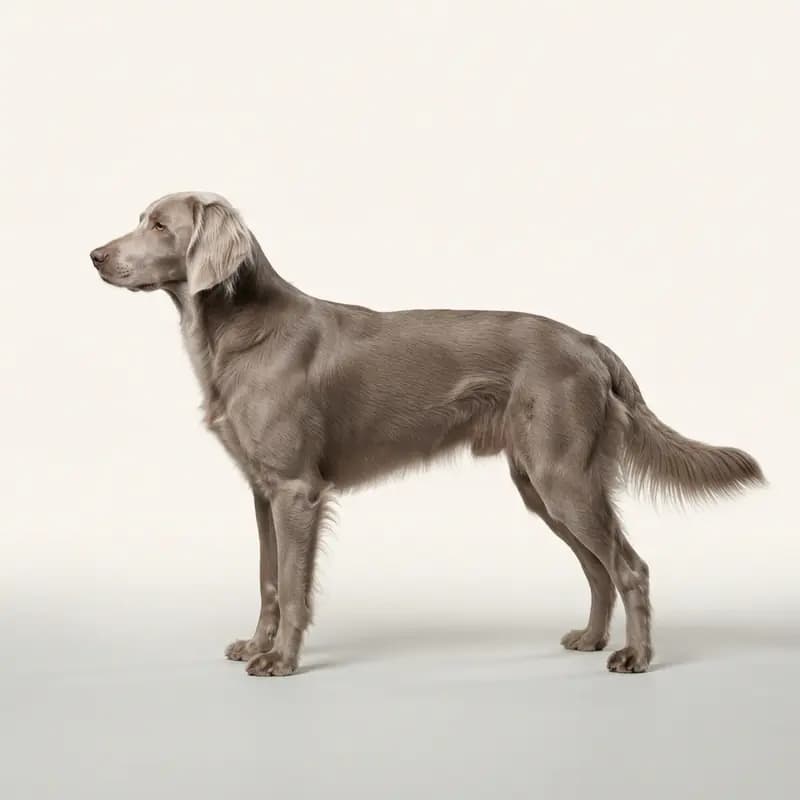
The Weimaraner (long-haired) is an elegant and versatile hunting dog breed that originally comes from Germany. It belongs to the group of pointing dogs and was specifically bred for hunting small game. Its striking, silver-gray coat is long and silky, giving it a noble appearance. The Weimaraner has a slender, muscular build that combines strength and endurance. Characteristic are its expressive amber-colored eyes and long, hanging ears. Within the breed, there are no distinct lines like in the Labrador or German Shepherd, but individual dogs vary in their hunting passion and temperament. The Weimaraner is an intelligent, eager-to-learn, and affectionate companion that requires a lot of exercise and mental stimulation.
The Weimaraner (long-haired) is an elegant and versatile hunting dog with a strong work drive and a close bond to its family. It is characterized by its high intelligence and willingness to learn, making it an excellent partner for demanding tasks such as hunting, tracking, or search services. At the same time, it is very people-oriented and enjoys being close to its caregivers. Its temperament is lively and energetic, which is why it needs a lot of exercise and mental stimulation. Without sufficient activity, the Weimaraner can become restless or destructive. It loves to play retrieving games and shows a strong prey drive, which can be well controlled through consistent training. The Weimaraner is alert and shows natural protective behavior without being aggressive. It is suitable both as an active family dog and as a reliable working partner but requires consistent training and a close bond with its owner to reach its full potential.
| Watchfulness A natural watchdog with real protective instinct. | High |
| Openness to Strangers Careful around unfamiliar people — thaws slowly. | Cautious |
| Hunting or Herding Drive This drive runs deep — no amount of training eliminates it. | Very strong |
Fun Fact!
Weimaraner (Long-haired): The long-haired Weimaraner impresses not only with its elegant, silky coat but also with its exceptional endurance and pronounced hunting instinct. Originally bred as a versatile hunting dog, it is now a loyal companion that delights with its intelligence and friendly nature.
The Weimaraner longhair is an elegant, intelligent hunting dog with a strong urge to move. He is affectionate and eager to learn but requires consistent training and plenty of exercise. These dogs are versatile, especially in hunting and dog sports, and are well suited for active families. The long-haired coat requires regular grooming.
Weimaraner (Long-haired): Weimaraners are lively and intelligent dogs that require a lot of exercise and mental stimulation. They are especially suitable for active people or families who spend a lot of time outdoors. Due to their strong hunting drive and endurance, they are ideal for sporting activities such as jogging, hiking, or retrieving games. Weimaraners are very affectionate and people-oriented, which is why they seek close contact with their family and do not like to be left alone for long periods. They are usually friendly and patient with children but should be well supervised because of their energy and size. Early socialization is important so that they can live harmoniously with other dogs and pets. Overall, Weimaraners are loyal and sensitive companions who need a lot of attention and activity.
Loves family life and thrives in a group.
Takes boisterous and affectionate children in its stride.
Usually gets on fine with other dogs.
Can manage in the city, but only with very active owners.
Owning a dog is a privilege, but it's also a real responsibility. Before you bring one into your life, be honest with yourself about the commitment it takes.
Weimaraner (Long-haired): Weimaraners are extremely intelligent and eager-to-learn dogs that require consistent and varied training. Similar to Labradors and German Shepherds, it is important to meet their natural urge for movement and work. Weimaraners were originally bred as hunting dogs, which is why retrieving and search games are ideal to challenge their nose and mind. Training should always be positive and reward-based to strengthen the close bond between you and your dog. Weimaraners are sensitive to harsh methods, so patience and consistency are crucial. They need clear rules and structured leadership to develop frustration tolerance and control impulses. Due to their high energy level, it is important to avoid overburdening them, as bored Weimaraners can tend to unwanted behavior. Besides hunting and retrieving work, they are also well suited for dog sports such as obedience, agility, or mantrailing. Overall, the Weimaraner requires time, commitment, and varied activities to be a balanced and happy companion. Those willing to make this investment will be rewarded with a loyal, intelligent, and versatile partner.
Weimaraner (Long-haired): The Weimaraner requires a balanced diet that is rich in high-quality proteins to support its active and muscular build. Make sure the food contains all essential nutrients and adjust the amount of food according to your dog's activity level to avoid overweight. Due to their energy, it is important to ensure regular exercise and mental stimulation. The long-haired coat of the Weimaraner is soft and silky but still requires regular care. Brushing once or twice a week is sufficient to keep the coat free of dirt and remove dead hair. During the shedding season in spring and autumn, increased shedding may occur, and more intensive brushing is recommended. The coat provides good protection against cold, but appropriate measures should be taken in extreme weather conditions. Weimaraners are well adapted to the Central European climate but need sufficient shade and water in extreme heat to avoid overheating. Regular exercise in the fresh air is essential for the well-being of this lively dog.
| Care Level Regular brushing and occasional professional grooming. | Moderate |
| Exercise Needs Working-dog energy that needs burning off every single day. | High-drive |
| Shedding Regular shedding — dog hair on clothes is now normal. | Moderate |
| Trainability Picks up commands quickly and wants to please. | Eager to learn |
Our experts are still reviewing this information. Spotted something wrong? Email us at info@honestdog.de.
Solid
Health grade
In the Weimaraner (long-haired), there are primarily risks of hip dysplasia (HD) and eye diseases such as cataracts, while hereditary neurological disorders like hypomyelination (HYM) or degenerative myelopathy can occur. The Weimaraner Klub e.V. prescribes mandatory screenings for breeding for hip dysplasia (HD) with a threshold of HD A–B, as well as for cataracts with a clear result. In addition, responsible breeders test their parent animals for hypomyelination (HYM) and elbow dysplasia (ED). Before buying a puppy, ask to see the official certificates for healthy hips and eyes, and ideally the additional test results of the parent animals.
Grade is relative to other breeds — AI-assisted and editorially reviewed.
Methodology and data: HonestDog Dog Breed Health Report 2026
What matters most for this breed
Tap any item to see details.
Ensure the dog is raised in a way that is gentle on the joints, check its eyes regularly, and maintain strict rest periods after meals to minimize the risk of gastric torsion.
Responsible breeders test parent animals as required for hip dysplasia (HD) and cataracts, and often voluntarily screen for hypomyelination (HYM) and elbow dysplasia (ED).
Note: This health overview is AI-assisted and editorially reviewed. It is for orientation only and does not replace veterinary advice.
What matters most for this breed — what's common, how much it affects the dog's life, and how to protect yourself as a buyer.
Tap a body region to see the inherited conditions linked to it.
The three most important risks
Pick a region on the map to explore other areas.
Tier 1 reflects the tests Weimaraner Klub e.V. actually mandates. Tiers 2 and 3 show how responsible breeders go beyond.
Club standard. Weimaraner Klub e.V. requires these tests for breeding approval. Ask any reputable breeder for the results.
No entries in this tier.
Note: This health overview is AI-assisted and editorially reviewed. It is for orientation only and does not replace veterinary advice.
A Weimaraner (Long-haired) costs around ~€200 per month (€100 – €380, depending on your setup). The first year adds up to roughly ~€5,190 including purchase, equipment and puppy school; across the dog's life (11 years) it comes to about ~€28,830.
With surgery cover, running costs come to about ~€200 per month — in return, your share of a major operation drops from several thousand euros to around 20 percent.
Per month
~€200
In the first year
~€5,190
Across the dog's life
~€28,830
Estimated purchase price from a breeder: €1,500 – €2,500
Estimate at a mid-range setup (suburban, dry food, 1–2 hours of daily exercise), average German prices, as of July 2026.
HonestDog Concierge
We currently have no breeders for this breed who have passed our verification. Create your short buyer profile: we'll set up your search alert, review a possible source and email you within 28 days.
 Illustrative imageIllustrative imageIllustrative image
 Illustrative image
 Illustrative image
The history of the Weimaraner (long-haired) begins in the early 19th century in Germany, more precisely in the region around Weimar. Originally, these dogs were bred by nobles and hunters to serve as versatile hunting dogs that could perform excellently both on the trail and in the water. The Weimaraner was characterized by its endurance, speed, and pronounced sense of smell. Over time, the breed was further refined to meet the demands of hunting. The Weimaraner was especially popular for big game hunting. Official recognition as an independent breed took place at the beginning of the 20th century, and since then the Weimaraner has established itself worldwide as a loyal companion and versatile hunting dog.
The long-haired Weimaraner was bred for hunting and is particularly suitable for working in the forest.
Germany
1800
Many owners describe the Longhaired Weimaraner at home as a very affectionate companion that's cuddly to the point of being pushy. It constantly seeks physical closeness to its people and forms a very strong bond with the family. With children in its own household, it's often patient and loving. Even so, experienced owners agree that it is not an easy, low-effort family dog.
Owners' reports regularly highlight the breed's typical protective and guarding instinct. While it loves its own family unconditionally, it often meets strangers with suspicion. In daily life this can cause problems, for example when guests come over or visiting children play wildly and the dog wants to control or correct them. Owners agree that thinking ahead and setting clear boundaries at home are essential.
Sources:forum.wildundhund.depetsdeli.demit-tier.deparents.atdogforum.de
In owners' accounts of training, the breed comes across as highly intelligent but by no means easy to handle in the classic sense. These dogs learn very quickly, but they question cues just as quickly when consistency is missing or they sense weak leadership. Owners warn against heavy-handed methods, since the Weimaraner is sensitive at heart and shuts down under the wrong kind of pressure. What it needs instead is calm, unwavering clarity.
A central topic on dog forums is the very strong hunting drive. The longhaired variety shows real passion for both sight and scent, so reliable off-leash time is often only possible after years of intensive anti-hunting and long-line training. Walks alone aren't enough: owners stress that without targeted scent work (such as tracking, dummy work or mantrailing), these dogs quickly find their own things to do, ranging from controlling behavior to destroying things at home.
Sources:hundeforum.comsantevet.demit-tier.dedogforum.deforum.wildundhund.de
Owners' experiences with grooming and overall health paint a picture of a fundamentally robust, weatherproof working dog. Compared with many other longhaired breeds, the medium-length, often soft coat with its typical feathering on the legs and tail is considered surprisingly easy to care for, but in woods and fields it reliably picks up burrs, mud and bits of undergrowth. Regular brushing and checking the hanging ears for dirt and inflammation are a fixed routine for owners.
On health, owners mainly talk about the risk of bloat (gastric torsion) typical of large, deep-chested dogs, which is why rest periods after feeding are strictly kept. Owners also point to the need to watch joint health (especially HD) and not to overload growing dogs in their first year with early running alongside a bike or uncontrolled stair climbing. A certain tendency toward skin sensitivities or ear problems also comes up on forums now and then.
Paraphrased from real owner reports · translated from German
The Weimaraner (Long-haired) is an active dog that needs plenty of exercise and mental stimulation. Research the temperament, grooming needs, and space requirements before deciding.
The average life expectancy of a Weimaraner (Long-haired) is 10-12 years. With proper care and regular vet visits, your dog can live a long, healthy life.
Weimaraner (Long-haired) grooming requirements include regular brushing, nail trimming, and dental care. HonestDog provides detailed grooming tips for every breed.
The Weimaraner (Long-haired) can be a great family dog. Proper training and socialization are key. HonestDog provides family suitability information for every breed.
The Weimaraner (Long-haired) comes in these colors: Grey, Silver, Blue. Colors that fall outside the breed standard are marked as such on the breed page.
Showcase your kennel on HonestDog and reach families searching for a responsibly bred Weimaraner (Long-haired).