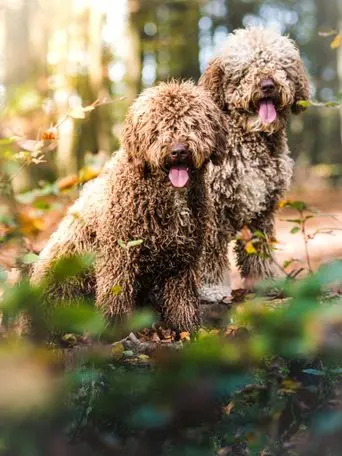
The Perro de Agua Español, as it's known in its homeland, immediately stands out with its rustic, curly coat. Yet anyone who lets themselves be guided purely by its charming looks quickly misjudges the true nature of this working dog. Originally bred as an indefatigable helper for fishermen, hunters, and herders in the rugged landscapes of Andalusia, this dog carries a heritage that profoundly shapes its daily life and needs to this day.
If you're wondering whether this breed fits your lifestyle, taking a close look at the Spanish Water Dog temperament is essential. It's not a pure companion dog that's content with short walks around the block. Instead, it seeks a job, clear structure, and a close bond with its humans. In this article, we take a detailed look at what life with this intelligent and versatile breed entails, what challenges might await you, and how you can provide it with a species-appropriate life.
The Basic Character: An Intelligent Worker in a Curly Coat
The typical Spanish Water Dog personality is characterized above all by an immense capacity to learn and a pronounced "will to please" — meaning the desire to work together with its human. Breed associations and experts generally rate the trainability of this breed as above average. A Perro learns at lightning speed, which can be both a blessing and a curse. It not only masters desired commands in record time, but it also immediately spots inconsistencies in its owner and uses them to its advantage.
Unlike dog breeds bred for completely independent work (such as livestock guardian dogs), the Spanish Water Dog always seeks consultation with its human. It's attentive, quick to react, and always ready for the next command. However, this constant state of high alert requires an owner who can project calmness. A dog genetically programmed to respond to the finest stimuli in its environment often has to actively learn how to relax first.
Vigilance and Behavior Toward Strangers
An essential trait in the Spanish Water Dog temperament is its natural reserve toward strangers. It's not a dog that immediately greets every visitor at the door with a wagging tail. It often retreats at first, observes the situation from a safe distance, and then decides for itself whether it wants to make contact.
This characteristic makes it an excellent watchdog. It reliably signals unusual noises or unfamiliar people. Early and positive socialization is crucial here so that this breed-typical skepticism doesn't turn into timidity or even aggression driven by insecurity. Once the dog learns that its human takes responsibility for visitors, it can let go of this guard duty and relax.
The Bond with Its Primary Person
In cynological practice, it's often apparent that the Spanish Water Dog tends to choose one main primary person. Although it's family-friendly and integrates well into a pack, there's usually that one specific human it orients itself toward most strongly. It follows them every step of the way — a behavior often affectionately and wryly described by owners as "shadow dog syndrome." This deep loyalty makes training with the primary person particularly harmonious, but it also requires the dog to learn how to endure frustration when that person isn't available.
Who is the Spanish Water Dog Suitable For?
Deciding to get a dog should always be based on a realistic assessment of your own daily routine. The Perro de Agua Español definitely places demands on its owners.
Families and Children
Classified as very family- and child-friendly, the breed brings good prerequisites for life in a busy household. Nevertheless, there are important aspects to keep in mind. Due to its genetic heritage as a herding dog, it can happen that the Spanish Water Dog attempts to "herd" running children, sometimes expressing this by nipping at their heels. This behavior must be curbed lovingly from the very beginning, but with absolute consistency.
In addition, the dog needs a designated retreat where it won't be disturbed by children. When the rules for interaction between dog and child are clearly defined and enforced by the parents, the water dog develops into an extremely loyal, playful, and gentle family member.
Singles, Couples, and Active Seniors
For active people who love being outdoors, hiking, jogging, or doing dog sports, this breed is a bullseye. The Spanish Water Dog can also be suitable for dedicated first-time dog owners, provided there's a willingness from the start to attend a good dog school and engage intensively with the topic of dog training.
For individuals looking for a quiet couch potato or those with severe physical limitations, this extremely energetic dog is less suitable. A water dog left under-stimulated over the long term will inevitably develop behavioral problems.
Coexistence: Living Situation and Other Animals
External circumstances play a major role in how harmoniously daily life with the dog turns out.
City Apartment or House with Garden?
The breed's adaptability to city living is rated in the moderate range. Generally speaking, a house with a securely fenced garden is the ideal environment for this watchful and active dog. Here, it can partially regulate its urge to move on its own.
Keeping one in a city apartment isn't ruled out, but it demands a high degree of commitment from the owner. The dog must have daily opportunities to move freely (and safely) in nature. Furthermore, in a thin-walled apartment building, its natural vigilance and the associated barking can quickly lead to conflicts with neighbors. Early training in impulse control is essential in an urban environment.
Compatibility with Dogs and Cats
Toward other dogs, the Spanish Water Dog usually behaves neutrally to friendly given proper socialization. It rarely pushes itself forward, but knows how to hold its own against provocative behavior from other dogs.
If it grows up with cats or other small animals from puppyhood, peaceful coexistence is usually unproblematic. With unfamiliar animals outdoors, however, its hunting instinct can break through — after all, it was historically also used to flush out game.
Exercise and Mental Stimulation: More Than Just a Walk
A look at the breed's high energy level reveals this: a Spanish Water Dog won't be satisfied with three 20-minute rounds around the block a day. Anyone wanting to experience the typical Spanish Water Dog temperament in its full brilliance must challenge the dog both physically and mentally.
- Water Work: As the name suggests, most representatives of this breed have an enormous affinity for water. Swimming, retrieving dummies from a lake, or even professional water rescue dog work are ideal ways to keep the dogs appropriately exercised. Swimming is also extremely gentle on the joints.
- Nose Work: Since the dog processes visual stimuli quickly, nose work is a fantastic method to tire it out mentally. Mantrailing, tracking, or targeted object searches demand the highest concentration. Fifteen minutes of intensive nose work often tires the dog out more than an hour of mindless ball throwing.
- Dog Sports: Agility, Hoopers, or Obedience suit the water dog's agile physique and quick reaction time very well. It's important to keep an eye on the arousal level here. If the dog gets too hyped up during agility and starts barking excessively, you should switch to calmer sports.
Equally as important as activity is learning how to rest. A well-exercised Perro sleeps or dozes for 16 to 18 hours a day without issue. To find a healthy balance, many breeders orient themselves around the guidelines of established kennel clubs such as the Verband für das Deutsche Hundewesen (VDH) or the Fédération Cynologique Internationale (FCI), which offer detailed descriptions of the breed's working traits.
Typical Challenges: Practical Spanish Water Dog Experiences
Despite all these wonderful traits, trainers and owners also report specific challenges that come with this temperament.
Separation Anxiety and Loss of Control
Due to their extremely close bond with their humans, many Spanish Water Dogs have difficulty staying home alone. Often it's less about true separation anxiety and more about frustration over a loss of control: the dog can no longer monitor and protect "its" pack (the family). Training for staying alone must therefore be built up during puppyhood in tiny steps and with enormous patience. Establishing spatial boundaries in the house (not letting the dog follow you into every room constantly) is an important first step.
Stubbornness and Independence
Although cooperative, these dogs possess a certain amount of tenacity. If a command doesn't make sense in the dog's eyes or the owner acts uncertainly, the Perro likes to make its own decisions. This is often mistakenly interpreted as "stubbornness." In truth, it's the dog's intelligence demanding clear, convincing leadership. Only when you prove yourself as a confident decision-maker will the dog leave the responsibility to you.
Proper Coat Care
An indirect but important aspect of their character shows up during grooming. The coat isn't brushed, but sheared regularly. Felt mats can form if the dog is groomed incorrectly. Because many water dogs are very sensitive to being touched by strangers, a visit to the professional groomer can turn into a real test of endurance. Medical training — meaning the positive association of being touched, held, and hearing clippers — must be a fixed component of basic training.
Training Tips for the Spanish Water Dog
For the Spanish Water Dog temperament to unfold optimally, a specific approach to training is required:
- Positive reinforcement instead of harshness: The breed is exceedingly sensitive. Loud words, harshness, or unfair punishments permanently destroy trust. A Spanish Water Dog often shuts down or completely refuses to cooperate under pressure. Consistency must never be confused with roughness.
- Clear rules in the house: If you want a reliable companion outside, you have to start inside. Is the dog allowed on the couch? Who goes through the door first? Where is the permanent sleeping spot? Structured routines give this attentive dog the necessary security.
- Resource management: Some Perros tend to guard toys, food, or even their primary person. Practice trading items from the beginning and show the dog that it doesn't need to guard anything.
- Impulse control: Teach the dog how to endure frustration. Not every rabbit may be chased, and not every passing cyclist needs to be commented on. Flirt pole training, where the dog is only allowed to chase the toy on command, is an outstanding exercise for this.
Frequently Asked Questions (FAQ)
How much does the Spanish Water Dog shed?
A major advantage of the breed is that it hardly sheds at all. This makes living together pleasant, especially in apartments, and often earns the breed the label "allergy-friendly" (though this must be tested individually with every allergy sufferer before purchase). However, the curly coat requires regular shearing, typically two to three times a year.
Can the Spanish Water Dog stay alone well?
By nature, it doesn't like being separated from its pack. Due to its strong people-orientation, it tends to develop stress symptoms if left alone without adequate training. However, if staying alone is trained positively and in small steps starting from puppyhood, these dogs can also wait relaxed for their humans for a few hours without any issues.
Does the Perro de Agua Español have a strong hunting instinct?
The hunting instinct varies considerably from dog to dog. Since the breed was historically also used for flushing and retrieving during hunting, a basic tendency is usually present. In most cases, this drive can be managed very well through good training, reliable recall training, and appropriate substitute activities (like dummy work).
Is the Spanish Water Dog a beginner dog?
Conditionally. It's not a self-runner. Its intelligence and sensitivity require a delicate touch. For dedicated beginners willing to invest time in a good dog school and keep the dog mentally stimulated, it's certainly doable. However, anyone looking for an undemanding companion is better advised to choose another breed.
Finding the Right Companion
The Spanish Water Dog is a fascinating partner for people ready to build a genuine relationship with their animal. It demands time, patience, and creativity in stimulation, but repays this a thousand times over with unwavering loyalty, a joy for work, and affection. If you provide it with the necessary structure and exercise, you won't find a more loyal companion by your side.
If you feel that this wonderful, curly worker fits right into your life, it's worth diving even deeper into the details of this breed. On our platform, you'll find all further important facts regarding health, history, and care in our detailed Spanish Water Dog breed profile.
Are you already a step further and want to share your life with one of these special dogs? Then we're happy to help you find responsible and vetted breeders. Check out our overview if you want to find Spanish Water Dog puppies that are healthy and well-socialized. At HonestDog, transparency and the welfare of the dogs come first — so that you and your future companion have the perfect start to life together.