Loading breed
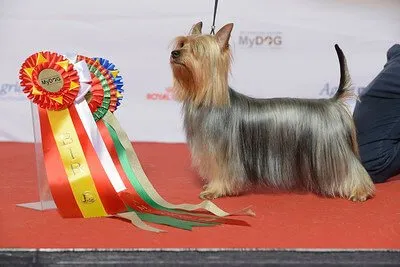
Australian Silky Terrier
Health grade B- Height22–26 cm
- Weight3–5 kg
- Life expectancy12–15 yrs
- Puppy price1,200–2,500 €
- Energy3/5
The Essentials at a Glance
The Australian Silky Terrier is an elegant yet alert toy terrier—a true Erdhund (earth dog/terrier) in a silk coat, bred in Australia to keep homes and farms free of snakes and rodents.
- Health grade B: The Australian Silky Terrier is generally considered a robust breed, though it is not immune to typical toy breed health issues.
- You are looking for a handy-sized dog that still loves real terrier tasks like scent games or agility—this is no mere lapdog.
- You have time every day for demanding grooming, as the fine, floor-length hair does not forgive neglect and mats quickly.
- You expect a dog that ignores small animals or fleeing cats—its hardware tells it that anything that darts away must be hunted.
Self-check
Would the Australian Silky Terrier really fit your life?
Answer 6 quick questions about your everyday life and see how well the Australian Silky Terrier fits you — including an honest cost estimate per month, per year, and across the dog's lifetime.
Fit checkCost estimateRisk dice
Takes about 1 minute · free & anonymous
Is the Australian Silky Terrier right for you?
At a glance
Australian Silky Terrier overview
The essentials — key facts, traits, and health priorities — before you dive deeper.
Health grade
Relative to other breeds
S
A
B
C
D
E
Very healthyHigher risk
Solid — a handful of items a good breeder watches.
See full health info & tests →
Note: This health overview is AI-assisted and editorially reviewed. It is for orientation only and does not replace veterinary advice.
Lifespan
12–15 yrs
Height
22–26 cm
Weight
3–5 kg
Practical
- Puppy price: 1,200 – 2,500 €
- Coat: fine, silky, medium length, without undercoat
- Origin: Australia
Temperament
Energy
Trainability
Family fit
With kids
Daily life
Care effort
Shedding
Barking
City-friendly
Guard instinct
What matters most
Especially with a Australian Silky Terrier, choosing the right breeder is the single most important decision you'll make. Serious breeders consistently test the parents for inherited conditions, prioritize healthy early socialization, and stay accountable long after handover. A cheap puppy without health screening tends to become the most expensive dog later on.
See HonestDog breeder standards →Colors & coat
What colors does the Australian Silky Terrier come in?
The coat colors you will see in Australian Silky Terrier litters — including which ones fall outside the breed standard and which carry genetic risk.
Eye colors
 Brown
Brown
Coat type
 Long
Long Silky
Silky
Is the Australian Silky Terrier right for you?
Perfect for you if:
- You are looking for a handy-sized dog that still loves real terrier tasks like scent games or agility—this is no mere lapdog.
- You have time every day for demanding grooming, as the fine, floor-length hair does not forgive neglect and mats quickly.
- You appreciate an attentive, courageous watchdog who will report every visitor to you immediately, but relaxes again after the initial greeting.
- You want a compact yet robust companion who will effortlessly accompany you on hikes and through an active daily life.
Less ideal if:
- You expect a dog that ignores small animals or fleeing cats—its hardware tells it that anything that darts away must be hunted.
- You live in an apartment with thin walls and get stressed by barking, as it will report suspicious noises quickly and persistently.
- You are looking for a dog with blind obedience that follows commands immediately instead of questioning the point of the exercise like a true terrier.
- vibesCheck
- A Silky Terrier looks like a fragile luxury creature, but under that flowing silk hair beats the fearless heart of an Australian snake hunter. You aren't getting a passive accessory for your handbag, but a spirited terrier who will cuddle on the sofa but won't hesitate for a second to take charge in the garden.
- healthProfile
- Australian Silky Terriers are considered quite robust when bred well, but they do carry breed-typical risks for the knees, eyes, hips, and trachea.
- healthDailyLife
- You should ensure joint-friendly exercise and definitely use a soft chest harness instead of a collar to relieve pressure on the sensitive trachea in everyday life.
- healthBreederRole
- Reputable breeders have the parents' knees and eyes checked and pay strict attention to clear airways and healthy hip lines to reduce avoidable risks.
The real vibes check
A Silky Terrier looks like a fragile luxury creature, but under that flowing silk hair beats the fearless heart of an Australian snake hunter. You aren't getting a passive accessory for your handbag, but a spirited terrier who will cuddle on the sofa but won't hesitate for a second to take charge in the garden.
Breed Profile
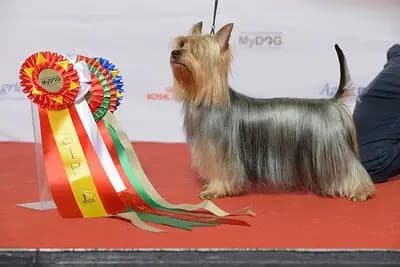
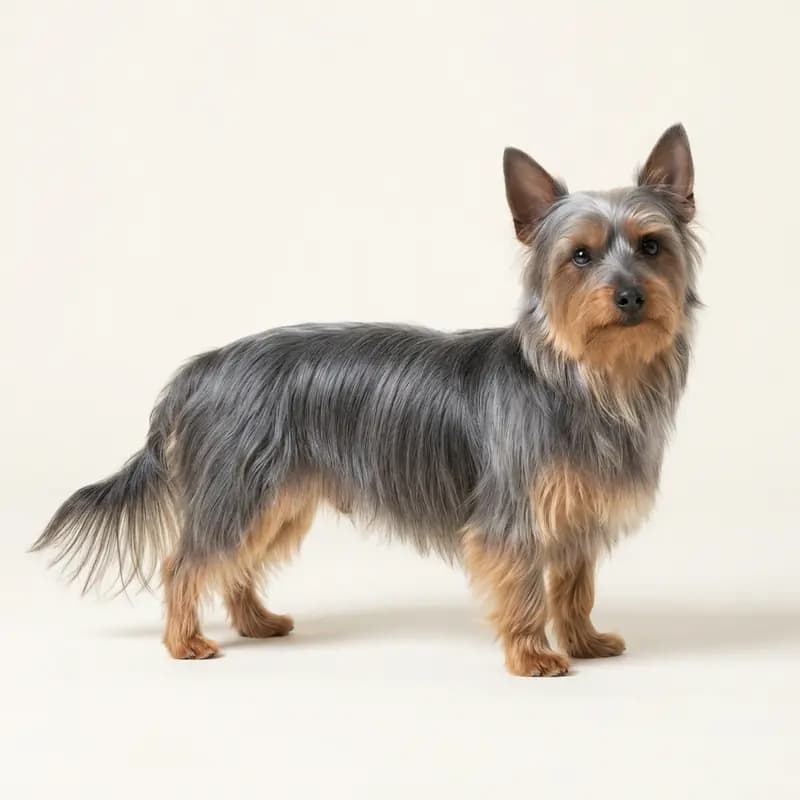
The Australian Silky Terrier, also known as the Silky Terrier, is a small but sturdy dog known for its striking, silky mane and lively temperament. Although he is small, he does not lack confidence and energy. Its body is slightly longer than it is tall, giving it a slightly rectangular appearance, and its ears are small, v-shaped and erect. His facial expression is alert and intelligent, with sparkling dark eyes and a small black nose. The Silky Terrier belongs to FCI Group 3, Terriers, and is classified in Section 4, Dwarf Terriers. There is no distinction between performance and show lines as this breed is primarily kept as a companion dog.
All measurements in detail
- Height
- 22 - 25 cm (Female), 23 - 26 cm (Male)
- Weight
- 3 - 4 kg (Female), 4 - 5 kg (Male)
- Life Expectancy
- 12 - 15 yrs
- Character
- lively, intelligent, independent
- Coat
- fine, silky, medium length, without undercoat
- Coat Color
- blue and fiery red or blue and tan
- Price
- 1200 - 2500 €
Character & Temperament
Although the Australian Silky Terrier is small, he has a big personality. He is a lively, alert and courageous dog with an independent streak. Due to his terrier background, he has a natural inclination towards hunting and catching prey, meaning he may not always get along well with small pets. Nevertheless, with With proper socialization he can learn to live in harmony with other pets. Silky Terriers are very people-oriented and build strong bonds with their families. They enjoy the company of their humans and can be very affectionate. However, since they also have a high degree of independence, they can easily stay alone as long as they are well trained and have enough activity and physical activity. However, it is important to remember that Silky Terriers do not like to be left alone for long periods of time. They can suffer from separation anxiety if they are left alone too often and for too long. Silky Terriers are naturally alert and tend to pay close attention to their surroundings. They will react quickly to suspicious noises or movements and warn their families by barking. This makes them excellent guard dogs, although their small size means they are not suitable as guard dogs in the traditional sense. Their guarding behavior can lead to excessive barking if not managed properly, so it is important to teach them when it is appropriate to bark and when it is not. Due to their intelligence and energetic temperament, Silky Terriers are very playful and enjoy a variety of games and activities. They have a natural affinity for exercise and enjoy being challenged through walks, games and even dog sports like agility. Their tendency to hunt can manifest itself in a strong prey drive, so it is important to teach them not to give in to this impulse, especially when they are around small animals or children.
| Watchfulness Occasionally alerts but is fundamentally open. | Low |
| Openness to Strangers Warms up quickly and is generally welcoming. | Friendly |
| Hunting or Herding Drive Mild interest in movement and small animals — easily managed. | Low |
Fun Fact!
Despite their small size and elegant appearance, Australian Silky Terriers were originally bred as rat catchers and are still excellent hunters of small prey.
What Awaits You
The Australian Terrier is considered an adaptable companion with a high hunting motivation. He needs a lot of exercise and activity.
Housing & Care
Silky Terriers are quite suitable as city dogs because, despite their active temperament, they are small and can live in an apartment as long as they get enough exercise and mental stimulation. They are very people-oriented and usually get along well with children as long as the children learn to treat them with respect. Silky Terriers can also get along well with other pets, including cats, if they are used to it from an early age.
- Family Friendly
Loves family life and thrives in a group.
Family-oriented - Child Friendly
Gets on well with children — with adult supervision.
With supervision - Dog Friendly
Usually gets on fine with other dogs.
Generally tolerant - City Friendly
Small space, noise, lots of people — no problem at all.
Ideal city dog
Owning a dog is a privilege, but it's also a real responsibility. Before you bring one into your life, be honest with yourself about the commitment it takes.
Training & Education
Australian Silky Terriers are intelligent and energetic dogs that enjoy learning and taking on new challenges. Therefore, it is important to keep them busy both physically and mentally. They have a natural tendency to hunt and dig, so providing them with a safe and controlled environment to express these instincts can be helpful. When raising the Silky Terrier, it should be noted that despite their small size, they have a strong self-confidence and sometimes tend to be dominant. It is therefore important to ensure consistent and loving upbringing. Introducing obedience training and impulse control exercises at a young age can help manage this behavior. Silky Terriers have a natural affinity for exercise and enjoy being challenged through walks, games and even dog sports like agility. However, their energy and prey instinct can lead them to fixate on balls or other toys. It is therefore important to vary her play and activity and to ensure that she does not become "over-engaged" become.
Nutrition & Care
Your Australian Silky Terrier's diet should be balanced and tailored to his needs. Because this breed is small, it requires less food than larger breeds, but it is important that it receives a high-quality diet that provides it with the necessary nutrients. Since Silky Terriers tend to be overweight, you should make sure that they are not overfed and that they get regular exercise. Caring for a Silky Terrier may require a little more effort than other breeds. Their silky coat has no undercoat and therefore sheds less, but can easily become matted if not brushed regularly. You should therefore brush your Silky Terrier thoroughly at least once a week to avoid mats and keep the coat clean and shiny. Despite their Australian origins, Silky Terriers generally cope well with the German climate as long as they are not exposed to the cold for too long.
| Care Level Regular brushing and occasional professional grooming. | Moderate |
| Exercise Needs Needs 1–2 hours of real exercise daily. | Active |
| Shedding No or minimal hair loss — suitable for allergy sufferers. | No shedding |
| Trainability Bred to work closely alongside humans. | Highly trainable |
Our experts are still reviewing this information. Spotted something wrong? Email us at info@honestdog.de.
Health & hereditary diseases
Health
B
Solid
Health grade
The Australian Silky Terrier is generally considered a robust breed, though it is not immune to typical toy breed health issues. Prospective buyers should pay particular attention to patellar luxation and Legg-Calvé-Perthes disease, both of which can lead to painful lameness. Tracheal collapse also occurs within the breed, making the careful selection of parent dogs essential.
Grade is relative to other breeds — AI-assisted and editorially reviewed.
In daily life this can mean
You should ensure joint-friendly exercise and definitely use a soft chest harness instead of a collar to relieve pressure on the sensitive trachea in everyday life.
The breeder's role
Reputable breeders have the parents' knees and eyes checked and pay strict attention to clear airways and healthy hip lines to reduce avoidable risks.
Note: This health overview is AI-assisted and editorially reviewed. It is for orientation only and does not replace veterinary advice.
No Health Tests Available
No specific health tests are currently available for this breed.
Costs & where to find one
How much does a Australian Silky Terrier cost?
A Australian Silky Terrier costs around ~€170 per month (€90 – €300, depending on your setup). The first year adds up to roughly ~€4,660 including purchase, equipment and puppy school; across the dog's life (13.5 years) it comes to about ~€29,450.
With surgery cover, running costs come to about ~€150 per month — in return, your share of a major operation drops from several thousand euros to around 20 percent.
Per month
~€170
In the first year
~€4,660
Across the dog's life
~€29,450
Purchase from a breeder: €1,200 – €2,500
Estimate at a mid-range setup (suburban, dry food, 1–2 hours of daily exercise), average German prices, as of July 2026.
Calculate your personal costs1-minute self-check with your own answers
Looking for a Australian Silky Terrier?
HonestDog Concierge
No verified Australian Silky Terrier breeders on HonestDog yet
We currently have no breeders for this breed who have passed our verification. Create your short buyer profile: we'll set up your search alert, review a possible source and email you within 28 days.
Appearance, variants & origin
 Illustrative image
 Illustrative image
History
The full history
Originally from Australia, the Silky Terrier is the result of crossing Australian Terriers and Yorkshire Terriers in the late 1800s. Breeders attempted to create a terrier that would work as both an efficient ratter and an attractive lap dog. The resulting Silky Terrier was a small, elegant dog with a silky coat and a lively, fearless temperament. The breed was only officially recognized in 1905 and was originally known as the "Sydney Silky", in recognition of his origins in Sydney, Australia. The Silky Terrier was popular with Australians as it offered a combination of the utility of a terrier and the beauty of a lap dog. During World War II, Australian soldiers brought the breed to America, where it quickly gained popularity. In 1955, the Australian Silky Terrier was officially recognized by the American Kennel Club.
Original Use
The Australian Silky Terrier was bred as a companion dog and is characterized by its silky coat and lively nature.
Origin
Australia
Date
1890
Owner experiences
What owners say about the Australian Silky Terrier
Belle M., Halterin aus Hessen (Rüde, 3. Silky Terrier)
Ich bin mit meinem dritten Silky Terrier mittlerweile ein echter Fan dieser kleinen Rasse geworden. Sie sind unheimlich schlau – manchmal fast zu schlau für ihr eigenes Wohl, was dazu führt, dass sie sich gerne mal Blödsinn einfallen lassen. Mein Jüngster hat extrem schnell gelernt, war im Handumdrehen stubenrein und schläft nachts super durch. Sie lieben es einfach, auf ihre ganz eigene Art zu 'reden', fordern ihre Kuscheleinheiten ein und scheinen manchmal sogar die Uhrzeit lesen zu können, so pünktlich sind sie.
Aber man darf nicht vergessen, dass sie eben echte Terrier sind. Der Jagdtrieb ist stark ausgeprägt. Während meiner mit Katzen gut klarkommt – er ist da eher neugierig und zieht sich zurück, wenn die Katze ihn herausfordert –, jagt er draußen leidenschaftlich alles, was klein ist. Eichhörnchen, Vögel, Enten oder Ratten setzt er sofort nach. Ein zuverlässiger Rückruf ist in solchen Momenten echte Arbeit und erfordert konsequentes Training. Auch das Bellen muss man im Griff behalten: Wenn Leute am Fenster vorbeigehen, schlägt er gerne mal an, und man muss von Anfang an üben, dass er auch wieder damit aufhört.
Seaworthiness, Halter aus Bayern (Rüde, 18 Jahre lang gehalten)
Mein Silky Terrier war mein absoluter Traum- und Abenteuerpartner. Wir waren unzählige Male gemeinsam beim Wandern und Campen. Wer denkt, dass diese kleinen Hunde nur Schoßhündchen sind, irrt sich gewaltig. Er hat es geliebt, im Wald herumzuflitzen, über Stock und Stein zu klettern und war körperlich extrem ausdauernd. Er hat mich stolze 18 Jahre lang begleitet und war bis ins hohe Alter fit.
Man muss sich aber im Klaren sein, dass sie trotz ihrer handlichen Größe eine konsequente Erziehung brauchen. Ein Silky hat seinen eigenen Kopf und lässt sich nicht so leicht beeindrucken wie manch andere, weichere Rassen. Ein lauterer Tadel reicht bei ihnen oft nicht aus – man muss von Anfang an liebevoll, aber absolut konsequent Grenzen setzen, sonst übernehmen sie das Kommando.
Reggy, Halter aus Nordrhein-Westfalen (Rüde, seit 2,5 Jahren)
Als wir unseren Silky-Welpen bekamen, wurde ich im Umfeld oft verunsichert. Sätze wie 'Der ist doch viel zu schwer erziehbar' oder 'Bist du sicher, dass du einen Terrier hinkriegst?' habe ich ständig gehört. Ich habe mich aber nicht beirren lassen und ihn von Anfang an wie einen ganz normalen, großen Hund erzogen. Das heißt: Konsequent bleiben, viel belohnen, ihn überallhin mitnehmen (aber ohne ihn zu überfordern) und ihn so viel wie möglich selbst erkunden lassen, statt ihn ständig auf den Arm zu nehmen.
Heute hört er super. Silky Terrier sind eben Arbeitshunde im Miniformat und wollen geistig gefordert werden. Wir bringen ihm viele Tricks bei und beschäftigen ihn aktiv. Man muss einfach verstehen, dass diese Rasse einen ausgeprägten Dickkopf hat. Er hinterfragt Kommandos und muss verstehen, warum er etwas tun soll. Wer sich darauf einlässt und die Erziehung nicht schleifen lässt, bekommt einen absolut treuen und genialen Begleiter.
Paraphrased from real owner reports
Loading owner stories
FAQ & more
Frequently asked questions about the Australian Silky Terrier
Is a Australian Silky Terrier the right dog for me?
The Australian Silky Terrier is an adaptable dog that adjusts well to various lifestyles. Research the temperament, grooming needs, and space requirements before deciding.
How long does a Australian Silky Terrier live?
The average life expectancy of a Australian Silky Terrier is 12-15 years. With proper care and regular vet visits, your dog can live a long, healthy life.
How much grooming does a Australian Silky Terrier need?
Australian Silky Terrier grooming requirements include regular brushing, nail trimming, and dental care. HonestDog provides detailed grooming tips for every breed.
Is a Australian Silky Terrier good for families with children?
The Australian Silky Terrier can be a great family dog. Proper training and socialization are key. HonestDog provides family suitability information for every breed.
What colors does the Australian Silky Terrier come in?
The Australian Silky Terrier comes in these colors: Blue and tan.
Loading related articles
Are you a Australian Silky Terrier breeder?
Showcase your kennel on HonestDog and reach families searching for a responsibly bred Australian Silky Terrier.