
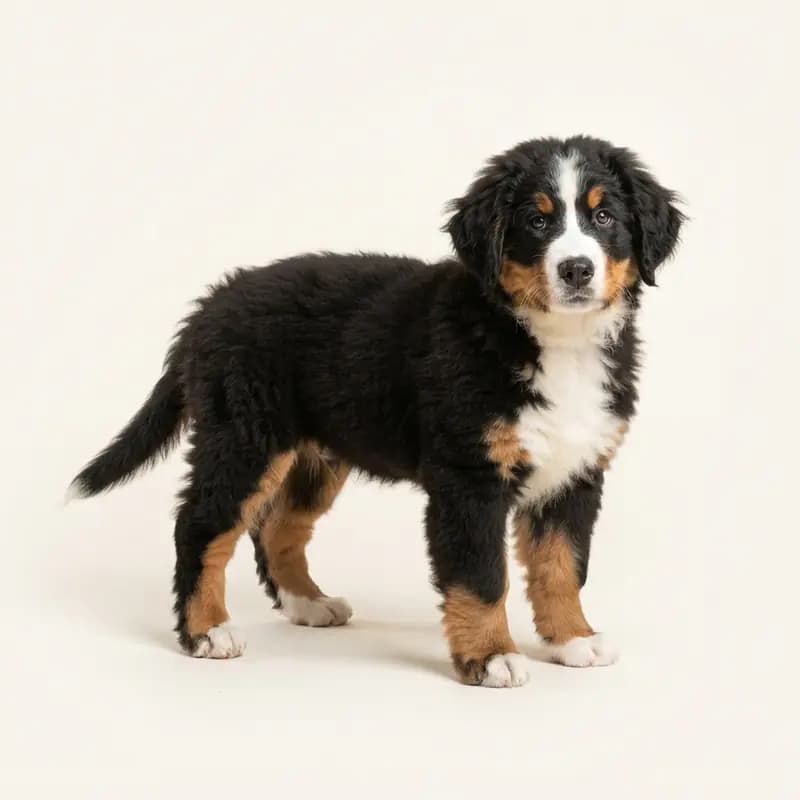
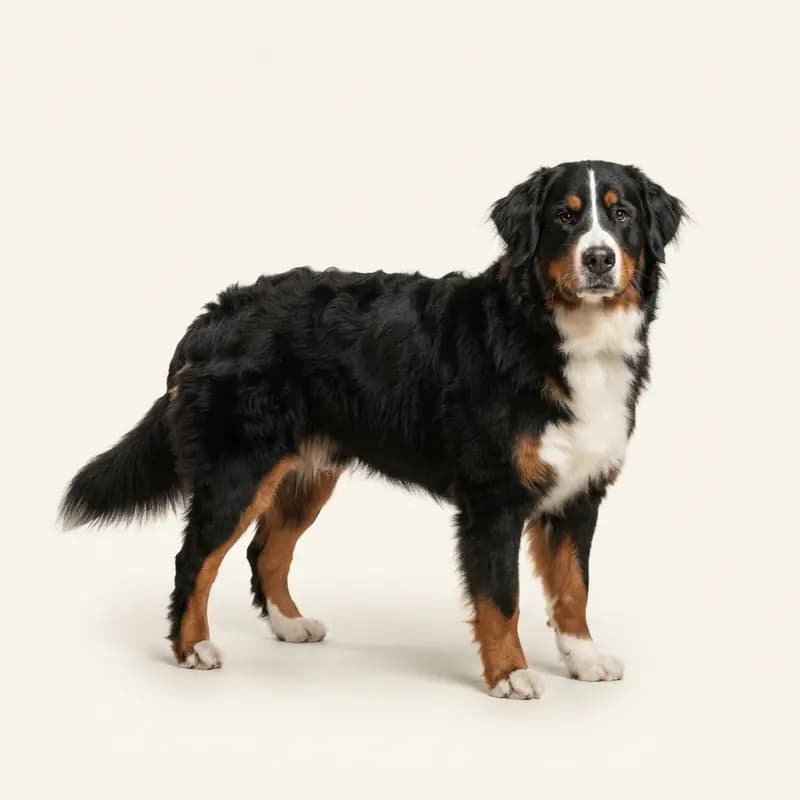
Introduction: The Gentle Giant in the Classroom
Anyone lucky enough to share their life with one of these impressive Swiss working dogs knows: Bernese Mountain Dog training is a priority from day one. When a fluffy, clumsy puppy grows into a stately dog with a shoulder height of up to 70 centimeters and a weight of 50 kilograms within just a few months, physical strength at the other end of the leash is no longer enough. A Bernese Mountain Dog is not led through force, but through trust, consistency, and a deep bond.
These good-natured and calm dogs are considered the ultimate family dogs (Family Friendliness 5/5). They are loyal, love children, and have an incredibly high stimulus threshold. However, this gentle nature doesn't happen by accident. In this comprehensive guide, you will learn how to fully realize your Bernese's potential — from the first days in their new home to appropriate mental stimulation in adulthood. If you would like to learn more about the breed's history and specific characteristics beforehand, take a look at our detailed Bernese Mountain Dog breed profile.
The Basics of Bernese Mountain Dog Training: Understanding Your Dog
Before we dive into practice, we need to look at who is actually sitting in front of us. The Bernese Mountain Dog belongs to the group of working dogs. Originally, they were used in the Swiss Alps as draft, herding, and guard dogs. This means they were bred to work independently and make decisions.
On the trainability scale, the Bernese achieves a solid 3 out of 5. He is not a Border Collie waiting for every little snap of your fingers. A Bernese thinks. When you give a command, he will — especially during puberty — weigh up whether it really makes sense to lie down in the wet grass right now. This is often called stubbornness, but it is actually intelligence paired with a certain composure. Training, therefore, requires a lot of patience, positive reinforcement, and humor. Harshness or shouting achieve the exact opposite with this sensitive breed: the dog turns stubborn, and the foundation of trust breaks. For reliable information on the nature and standards of the breed, the Verband für das Deutsche Hundewesen (VDH) also provides excellent resources.
Bernese Mountain Dog Puppy Training: The Most Important First Steps
The Bernese Mountain Dog puppy training phase sets the foundation for your entire life together. Precisely because these dogs become so massive and, unfortunately, have a fairly short life expectancy of 6 to 8 years, we want to enjoy every minute together stress-free. A puppy from a responsible breeder costs between 1,800 and 3,000 Euros — an investment you should protect through excellent training from day one.
Socialization in the First 16 Weeks
Your puppy's formative phase closes at around the 16th week of life. Everything your Bernese gets to know positively and calmly until then will not faze him later. Since the breed's urban suitability is rather low (2/5), you must train for urban environments particularly gently. Show him buses, trains, different surfaces, other animals, and people of all ages. Important: Do not overwhelm him. Two to three new, short impressions per week are completely sufficient. The motto is quality over quantity.
Potty Training with Patience
Bernese Mountain Dogs are clean animals, and with the right structure, you will have potty training under control quickly. Take your puppy outside after every sleep, play, and meal. Praise him enthusiastically when he relieves himself. A mistake many beginners make: they go back into the house immediately. Stay outside for another two minutes so the puppy learns that "doing business" does not automatically mean the end of exciting time in the fresh air.
Training Bite Inhibition
Puppies explore the world with their sharp milk teeth. Since an adult Bernese has an enormous jaw, he must learn early on how hard he is allowed to bite. If your puppy nips too hard during play, stop the game immediately with a clear "Ouch" and ignore him for a few seconds. Offer him a chew toy instead. This way, he learns that human skin is taboo, but he can satisfy his need to chew on his toys.
Bernese Mountain Dog Training: Essential Basic Commands
Structured Bernese Mountain Dog training not only makes everyday life easier but also provides the dog with necessary mental stimulation. We focus on commands that are safety-relevant for a dog of this size.
Leash Walking: When 50 Kilos Pull
Nothing is more exhausting than a giant dog pulling you through the neighborhood. Leash walking must be trained while the dog is still light. The method of choice is "stopping." As soon as the leash tightens, you stand still like a tree. You don't move another millimeter. Only when the dog turns to you and the leash hangs loose again do you continue walking. This requires extreme consistency on your part with a stubborn Bernese, but it pays off for a lifetime.
Reliable Recall
Even though the Bernese Mountain Dog generally does not have an extreme hunting instinct, a reliable recall is mandatory. Build the "Come" command or your recall whistle initially in a low-distraction environment (living room, garden). Reward every success with a jackpot (e.g., a piece of cheese or sausage). Don't just call your dog during a walk when it's time to go home or when danger threatens, but also just in between to reward him and then let him run again.
Sit, Down, and Stay – The Classics
These Bernese Mountain Dog commands are the basic ABCs of dog training. When training, make sure the surface is comfortable for your dog. A Bernese is reluctant to lie down on wet asphalt.
- Sit: Lead a treat over the dog's nose slightly backward until his bottom touches the ground. Say "Sit" and reward him.
- Down: From the "Sit" position, lead the treat straight down between his paws and pull it slightly forward.
- Stay: Build up the duration and distance extremely slowly. At first, reward the dog even if he only stays sitting for one second.
Breed-Specific Challenges for the Gentle Giants
Every breed brings its own small challenges. With the Bernese Mountain Dog, there are some specific aspects you need to pay special attention to during training and ownership.
The Guarding Instinct: Your Bernese was bred to guard the house and farm. He will bark when the mail carrier comes or strange noises are heard. This is genetically anchored. The goal of training is not to stop the barking completely (which is hardly possible anyway), but to make the barking controllable. Calmly thank him when he has alerted you ("All right, I've seen it"), take the lead, and send him to his place. This way, he knows you have the situation under control and he doesn't need to take further action.
Protecting the Joints: Weight is the greatest stressor for the joints. In the first year of life, a Bernese Mountain Dog must under no circumstances climb excessive stairs, run alongside a bicycle, or make wild jumps out of the car. Training in the first year should consist 90% of mental work and basic training, not physical exhaustion. The Schweizer Sennenhund-Verein für Deutschland e.V. (SSV) offers valuable guidelines for the healthy rearing of heavy dog breeds.
Heat Sensitivity: With its dense, long coat and thick undercoat, the Bernese hates midsummer. Move training on hot days to the early morning or late evening hours. During the day, he prefers to find a cool tile floor and sleep.
Advanced Bernese Mountain Dog Commands and Activities
Despite his rather calm temperament, the Bernese has an energy level of 4/5 and wants to do something. A bored Bernese will find his own tasks — and that is rarely in your best interest.
Carting and Draft Work
There is arguably no more breed-appropriate activity for this dog. Once the dog is fully grown (approx. from 18 to 24 months) and has been medically checked (hip/elbow X-rays), you can get him used to a pulling harness. In the past, they pulled milk cans for farmers; today, it can be wagons on outings. The slow, powerful pulling provides physical exertion without stressing the joints through abrupt stops (as is the case with ball games).
Nose Work and Search Games
Since Agility or Flyball are unsuitable for heavy dogs, nose work is perfect. Searching for treats, identifying scents (mantrailing), or object searches provide enormous cognitive stimulation. Just 15 minutes of intensive nose work makes your Bernese more tired than an hour-long walk.
Tricks for the Brain
Teach him to distinguish toys by name or to pick up things you have dropped. This not only strengthens your bond but also promotes his "will to please."
Most Common Mistakes in Training Your Bernese
Even if you are well-prepared, mistakes often creep into everyday life. Avoid the following pitfalls:
- Inconsistency: What the 10-kilogram puppy is allowed to do (e.g., lying on the sofa or jumping up on you), the 50-kilogram dog will also do. Set rules from day one and stick to them.
- Too Many Repetitions: A Bernese Mountain Dog gets bored quickly if he has to "Sit" ten times in a row. Train in short, punchy sessions of 3 to 5 minutes and end the training with a success.
- Physical Harshness: A jerk on the leash or loud scolding destroys trust. These dogs are physically robust but emotionally very sensitive.
- Lack of Rest Phases: Especially during puppyhood, dogs need up to 20 hours of sleep. Over-excited dogs don't learn anything. Provide fixed resting places and quiet times.
Frequently Asked Questions (FAQ)
When should I start training?
Training begins the moment the puppy moves in with you. In the first few weeks, this doesn't mean strict command training, but rather learning house rules, potty training, rhythm, and building trust. From the 10th to 12th week, you can playfully start with the first light commands like his name and "Sit."
Is a Bernese Mountain Dog suitable for beginners?
Basically yes, as he has a very friendly, people-oriented, and non-aggressive nature. However, one should not underestimate his sheer strength and size. Beginners should therefore definitely attend a good dog school from the start to learn how to lead such a large dog confidently through body language and bonding.
How do I properly exercise my Bernese Mountain Dog?
Continuous physical strain like jogging or cycling is not ideal. Rely on long, leisurely walks and integrate mental work. Search games in the woods, balancing over tree trunks, obedience exercises, or specialized carting are perfect ways to make your Bernese happy and well-exercised.
Why is my Bernese Mountain Dog so stubborn?
Bernese Mountain Dogs are not stubborn per se; they are independent thinkers. Since they often had to make decisions alone as farm dogs in the past, they question commands that don't make sense to them. Work with high motivation (treats, toys, honest joy) instead of building pressure. When the dog realizes that working with you is fun and rewarding, the supposed stubbornness will quickly disappear.
Conclusion: With Love and Consistency to Your Dream Dog
Bernese Mountain Dog training is a wonderful journey that turns a clumsy bear into the ultimate companion for life. With patience, a large portion of humor, loving consistency, and knowledge of breed-specific characteristics, your Bernese will become exactly the gentle giant for which this breed is so famous. Don't forget to enjoy every day with your dog and actively shape your time together.
Are you looking for the perfect breeder, want more in-depth information, or want to network with other dog lovers? On HonestDog.de, you will find honest breed reviews, transparent breeder profiles, and a community that shares your passion for dogs. Discover our platform now and find the perfect companion for your life!