
The Importance of SEO for Dog Breeders
Working as a dog breeder is time-consuming, and caring for the breeding animals requires full attention. Good breeders care deeply about the health and security of their dogs and provide the loving care they need to give their charges the best conditions for a long, healthy, and happy life.
Finding the puppies a good home is just as time-consuming. To find the best possible buyers for their puppies, many breeders rely on their own website. But what good is the most beautiful and fantastic website if it can't be found on the internet? This is where "SEO" comes into play. But what is SEO, exactly?
"SEO" stands for Search Engine Optimization. SEO is about making your website easier to find by search engines like Google, Bing, and others – the higher the position in the search results ranking, the better. In short: SEO ensures that you are found when someone searches for something specific, e.g., "German Shepherd breeders in Baden-Württemberg."
But for that to happen, your site must meet certain criteria. And that's often not so easy. As we all know, all breeders of every breed want to be on page 1, in the top 10 search results lists of Google and others.
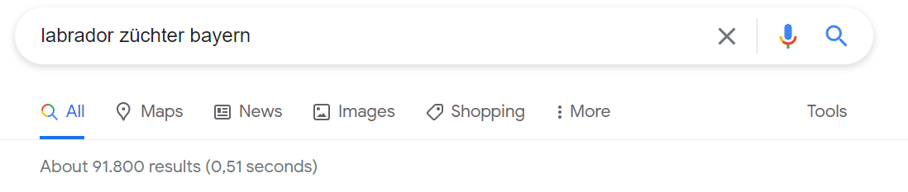
Here is a small example: If you enter "Labrador breeders Bavaria" in the Google search, around 100,000 results are displayed. That's 100,000 websites of companies or private individuals that deal with Labrador breeders in Bavaria.
How can my website be found more easily by search engines like Google?
SEO strategies are plentiful. There are countless offers that convince you to take out a monthly subscription to improve your search results. Websites that research so-called "keywords." Providers that claim you need them to manage your breeder profile on Google, Facebook, and Instagram, and so on...
All of these SEO strategies have their own advantages and disadvantages, but as a breeder, it's almost impossible to know where and how to start. After all, you should be spending your precious time with the dogs and the future puppy parents and interested parties, not messing around with Mr. Google.
Since we support good breeders with HonestDog and know how valuable their time is, we have summarized the most important tips and tricks here so that your breeder website also appears among the top results on Google or other search engines.
1. Optimize for the right keywords (search terms)
Keyword research is the foundation for your company's online positioning; it determines your SEO strategy. The terms in keyword research determine which search queries people want to be found for.
When selecting keywords, you should choose those that most accurately describe the website content and are actually entered into Google by potential customers (e.g., potential dog buyers).
What are keywords? The keyword is the key word for the content being searched for – that is, what people enter into the search bar of search engines.

Users use keywords to find information, services or products. With the help of keyword research, you can identify terms with high search volume. Optimizing your website content for these keywords can improve your ranking in search results. If similar keywords or synonyms are used on your website, then your page is much more likely to be shown higher. If someone searches for "Collie breeder Hamburg," then it would be good if these words appeared frequently on your website (if you are indeed a Collie breeder in Hamburg).
Note: This is why so many good websites use a blog. In a blog, you can write many articles that contain the right keywords. This makes the website appear more relevant to Google.
You can easily find out the search volume and trends of individual keywords or the combination of several keywords using the Google Keyword Planner (You must first set up a Google Ads account). But be careful: The more popular a keyword is, the harder it is to rank high. Breeders of lesser-known breeds have a certain advantage here 😉

2. "Backlinks": References from other websites to your breeder's page
Backlinks refer to links from other websites. For Google, links from other sites are an important factor in evaluating a website, as good content tends to be linked frequently. They are a kind of recommendation for the website. Most search engines are based in part on the number and quality of backlinks, also known as references. The more external links a website has, the more trustworthy it is generally considered. Nowadays, however, the motto is clear: quality over quantity. A high number of backlinks is quickly achieved, so quality as a differentiating feature is becoming increasingly important. A clean backlink profile is therefore the basis of any optimization. Blog articles on other dog bloggers in which you write about their breeding philosophy is definitely a good start!

3. Make sure your website works perfectly on mobile phones.
So-called "mobile optimization" refers to measures that aim to ensure optimal display and use of web content on mobile devices. Since optimization for mobile devices such as smartphones or tablets contributes to improved usability, Google has made "mobile friendliness" a ranking factor.
Significantly more searches are conducted via mobile phone (64%) than via desktop (35%). There are also more than twice as many search terms that are characterized by mobile traffic. While almost 36% of desktop users click on the first result, only just under 30% click on the first result in mobile searches. Therefore, if your breeder website does not yet appear in the top results on Google, it is all the more important that your website is also suitable for mobile devices.
4. Website Loading Speed
The previous point regarding mobile-friendliness brings us to the topic of "website loading speed": Smaller devices generally have slower connections. Therefore, your website must be configured correctly. In principle, a website should load in less than two seconds to achieve a satisfactory user experience. The shorter the loading time, the better. If it's under one second, that's very good.
Here you can test the speed of your own website.
How quickly your website loads depends on many different factors. The following points will help reduce the loading time of your breeder website and are usually easy to implement.
- Compress images and photos (ideally, images should be smaller than 1MB). There are several tools you can use to compress your images. One of them is: iloveimg
- Another important factor for the speed of a dog breeder's website is the host. Cheap hosts are usually much slower, so it may be worth switching to a better provider.
- Although it's tempting to use lots of plugins for your homepage, this unfortunately slows down the website. Our motto: speed before design.
5. Write content that answers your visitors' questions
Dog breeders often tend to only set up an "About Us" page and upload a few photos of the bitch, the male, the litters, and the puppies. Of course, these pages are absolutely necessary and should be on every good breeder's website! However, as an experienced breeder, you can provide information about so much more and also share breed-specific knowledge. The obvious candidates for a poodle breeder in Munich would be, for example:
- The character and traits of the poodle
- Proper care of a poodle
- Common diseases in poodles and how to take preventative measures
- Why a poodle should only be purchased from a good breeder
- How hypoallergenic is the poodle breed?
- The best dog groomers for poodles in Munich
However, this content should be of high quality and at least 1,200 words long. Do not write short articles, as these often have less value. Longer articles are usually more informative and are loved by search engines like Google. As a breeder, you have the great advantage of having expert knowledge, which allows you to answer many of the questions Google asks about your breed.
6. Update your website frequently
Generally speaking, the more frequently a website's content is updated and the more often new content is added, the greater the incentive for Google and other search engines to visit the site more often so that the search index can be kept up to date. At the same time, Google prefers content that has been online for a longer time for most search queries. Therefore, it's important to find the right mix depending on your content strategy.
Regularly posted articles provide an incentive for visitors to visit a site more often. Even though there is no general rule for the frequency of new content, it's safe to say that for a blog, the lower limit should be one to two articles per week. Anything above that is beneficial. However, quality should never be forgotten: The goal must be high-quality content. Posting many new articles in a short period of time without maintaining a minimum level of quality usually has a negative impact.
It is also important to regularly review existing content to ensure it still reflects the latest knowledge. Especially with so-called "evergreens," i.e., articles that are still in demand years later, you should occasionally check whether the statements they contain are still valid.
What must be avoided at all costs is changing the creation date of older articles just to give Google the impression that they are up-to-date. Google notices when only minor adjustments have been made. Anyone who does such things to deceive Google risks a penalty.
As a dog breeder, there may not be enough topics you could write about every day. However, you could easily write a basic article every month and make simple weekly updates to your kennel. Put yourself in the shoes of a prospective customer or visitor; they would appreciate:
- Weekly updates on your breeding program
- How the puppies are socialized and what outings are taken, for example
- Stories about exhibitions and competitions
- Is there any news from the breeding club?
- Photo galleries showing how the puppies are growing up and how the parents are developing
- Your thoughts on the future of the breed
- Your views on current dog-related topics
7. Monitor results and adjust your strategy
After you have implemented all of the measures mentioned, it is extremely important to monitor the results and adjust your SEO strategy if necessary. If a measure doesn't achieve the desired effect, you need to be flexible enough to be able to reverse or modify it. Regular quality control and monitoring are part of a good SEO strategy. And even if you've achieved your goals, that doesn't mean you can stop with search engine optimization. After all, you want to maintain the rankings you've achieved, and the competition and Google aren't sleeping. SEO is a long-term process that requires securing achieved goals through regular optimization. Similar to breeding: only those who stick with it for a long time and know the ins and outs can achieve long-term success.
You can easily track your results, free of charge, via Google Analytics. This tells you how many visits your breeder site has, which pages visitors have viewed, how long they spent reading which article, and much more.
Another important, and also free, tool is Google Search Console. With the Google Search Console, you can check, among other things, which pages are in Google's index, which URLs are causing problems, and the general status of the entire website for Google.
Simply set aside one afternoon a month to review your SEO results and rethink your strategy. Plan all updates (blog articles, photo updates, puppy news, etc.) for the coming month to establish a routine in your online strategy. After a while, this will also be fun as you see the number of visitors steadily grow.

That still sounds a bit complicated? Then optimize your breeder website with the HonestDog "Dog Breeder SEO Course for Beginners." In our 2-hour online course, you'll learn, using numerous practical examples and tools, how to optimize your own breeder website for Google so that more relevant visitors come to your site. Ultimately, it's all about finding the best home for your puppies.
Click here for the course!