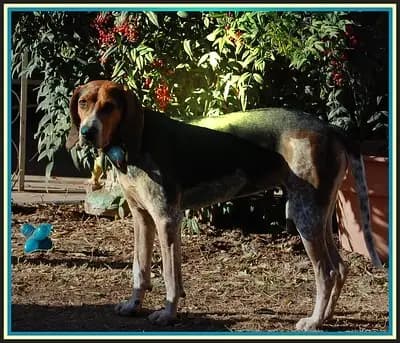
Bluetick CoonhoundSame FCI section
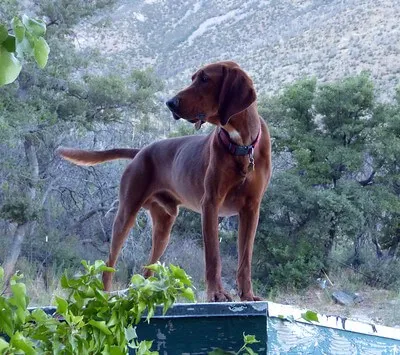
The Redbone Coonhound is a good-natured but extremely persistent scent hound—bred to track raccoons for miles and bay loudly at trees. At home, they are relaxed clowns; in the woods, they are thoroughbred hunters who simply cannot switch off their noses.
Self-check
Answer 6 quick questions about your everyday life and see how well the Redbone Coonhound fits you — including an honest cost estimate per month, per year, and across the dog's lifetime.


At a glance
The essentials — key facts, traits, and health priorities — before you dive deeper.
Lifespan
12–15 yrs
Shoulder height
53–70 cm
Weight
20–32 kg
Practical
Temperament
Daily life
What matters most
Especially with a Redbone Coonhound, choosing the right breeder is the single most important decision you'll make. Serious breeders consistently test the parents for inherited conditions, prioritize healthy early socialization, and stay accountable long after handover. A cheap puppy without health screening tends to become the most expensive dog later on.
See HonestDog breeder standards →Colors & coat
The coat colors that occur in the Redbone Coonhound — including which ones fall outside the breed standard and which carry genetic risk.
Eye colors
 Brown
 Amber
Coat type
 Short
 Smooth
The real vibes check
A Redbone Coonhound has two completely separate operating systems: on the sofa, they are a cuddly, long-legged shadow, but outside, they mutate into a deaf tracker. You aren't buying a dog that gazes at you adoringly on walks, but a true specialist who reads the world through their nose—and loudly announces their discoveries to you.
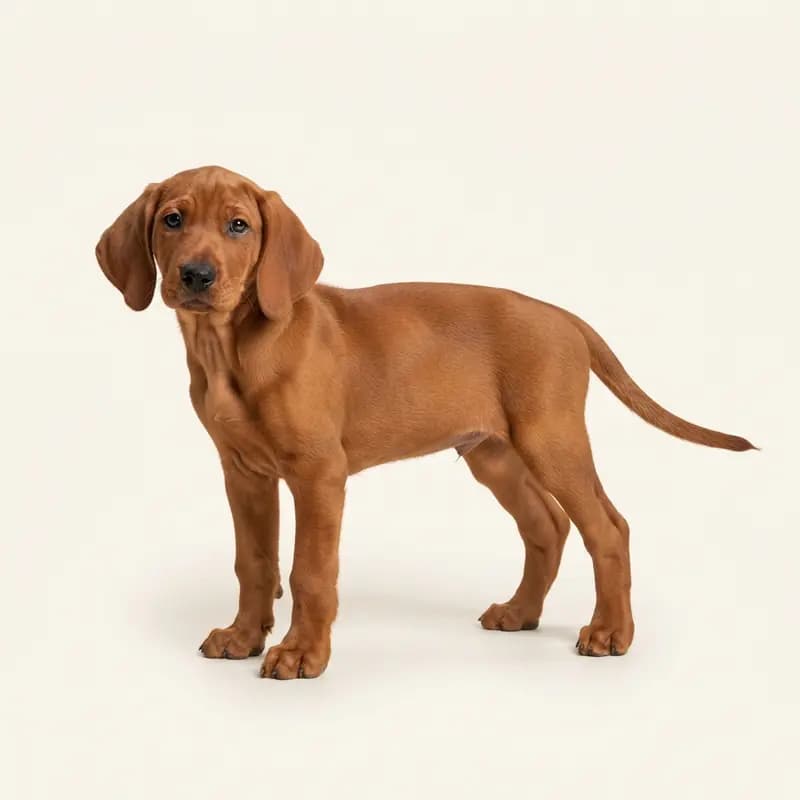
The Redbone Coonhound is an impressive sight with its lean, muscular build and shiny, deep red coat. He radiates a majestic calm and serenity that is reflected in his expressive face. The broad, drooping ears give it a soft, almost melodious expression, while its dark brown or hazel eyes have a calm but penetrating look. This dog is not recognized by the FCI, but is considered a scent hound and bloodhound and is recognized by the AKC and UKC, among others. There is no distinction between performance and show lines in the Redbone Coonhound. What is special about this breed is the uniform red color, which ranges from a deep, rich mahogany to a slightly lighter red.
The Redbone Coonhound is a versatile dog with a friendly and even-tempered nature. He is both an effective hunting dog and a loving family dog who enjoys being around his people and thrives in their company. Based on its nature, the Redbone Coonhound's primary use was and still is hunting. His keen sense of smell, endurance and willingness to work in difficult terrain make him an outstanding hunting partner. Even though he is often kept as a family dog today, one should never forget that he was originally bred for work. Despite its hunting background, the Redbone Coonhound is not a hyperactive dog. He is quite energetic and loves being in nature and following his nose, but at home he is often surprisingly calm and balanced. He enjoys being with his family and is known for his loyalty and affection for his people. The Redbone Coonhound is a very people-oriented dog. He loves being in the company of people and is known for integrating well into family life. He gets along well with children and is often patient and gentle with them. This dog loves playing and interacting with his family and is often happy and content when given the opportunity to be active and play. When it comes to their independence, the Redbone Coonhound can be a little stubborn, which is likely due to their hunting background. He is able to work and make decisions independently, which means he sometimes has a mind of his own even at home. Being alone can be a challenge for the Redbone Coonhound as they are very focused on their people. It's important to teach him from puppyhood that it's okay to be alone. You should proceed carefully and patiently and associate positive experiences with being alone. The Redbone Coonhound definitely exhibits hunting behavior. This is due to its breeding history and use as a hunting dog. This means that he tends to follow interesting smells and hunt when the opportunity arises. As a hunting dog, the Redbone Coonhound is naturally alert and attentive. He is likely to alert to changes in his environment and can be a good watchdog. However, it is important to note that he is generally not aggressive and is more likely to draw attention to himself by barking than by biting. Overall, the Redbone Coonhound is a wonderful dog for the right person or family. He needs a home where he is challenged both physically and mentally and where his needs as an active and people-oriented dog are met. He will thrive best in a family that includes him in their daily life and is willing to invest the time and effort necessary to meet his needs. With proper training and care, the Redbone Coonhound will be a loyal, loving, and entertaining part of your family.
| Watchfulness A natural watchdog with real protective instinct. | High |
| Openness to Strangers Neither pushily friendly nor suspicious. | Neutral |
| Hunting or Herding Drive This drive runs deep — no amount of training eliminates it. | Very strong |
Fun Fact!
Did you know that the Redbone Coonhound gets its name from its deep red coat color and the fact that it was originally bred to hunt raccoons (coon in English) in the USA? And although he started out as a hunting dog, over time he has developed into an excellent family dog!
An American original, the streamlined Redbone Coonhound is even-tempered, gentle and friendly at home but a tiger on the hunt. Vigorous activities such as hunting and swimming between long periods of rest are the coonhound's rhythm of life.
The Redbone Coonhound is a very people-oriented dog that would love to spend all day in the company of its people. Therefore, he is not necessarily the best candidate for pure kennel keeping. He loves nature and outdoor activities, but is also happy when he can be at home with his family. Large apartments or houses with a garden would be ideal for him, but he can also live in a smaller apartment as long as he gets enough exercise. Children are usually not a problem for the Redbone Coonhound. He is known to be patient and gentle with them. But as with any dog, interaction between children and the dog should always take place under adult supervision. Other pets, including cats, are generally well accepted as long as the dog is used to them from an early age.
Loves family life and thrives in a group.
Gets on well with children — with adult supervision.
Usually gets on fine with other dogs.
Can manage in the city, but only with very active owners.
Owning a dog is a privilege, but it's also a real responsibility. Before you bring one into your life, be honest with yourself about the commitment it takes.
Raising and training the Redbone Coonhound can be an exciting and rewarding task. They are intelligent and trainable, but their hunting instincts and independence can sometimes be a challenge. Patience, consistency and positive reinforcement are the keys to success here. Early socialization and training are also important to ensure your Redbone Coonhound becomes a well-behaved and happy companion. You should also keep in mind that the Redbone Coonhound is an active and energetic dog. He needs regular physical and mental stimulation to stay happy and healthy. Long walks, jogging, hiking, or dog sports like agility or obedience can be good ways to keep him occupied. But be careful: an excessively high ball drive can become an obsession and should therefore be controlled.
Redbone Coonhounds are active and energetic dogs, and their diet should reflect this. They need a balanced diet tailored to their needs. High-quality food with a balanced ratio of proteins, carbohydrates, fat and fiber is the best choice here. Additionally, you should schedule regular vet visits to monitor your coonhound's weight and health. When it comes to care, Redbone Coonhounds are fairly easy to care for. They have a short, shiny coat with no undercoat that requires little grooming. Regular brushing – about once a week – is enough to keep the coat in good condition and remove dead hair. Please note that they may shed more during the spring and fall seasons. Their tolerance to the German climate is quite good, they can tolerate both heat and cold well as long as it is not extreme.
| Care Level Minimal effort — occasional brushing and bathing. | Low-maintenance |
| Exercise Needs Needs several hours of serious exercise every day. | Very active |
| Shedding Hair everywhere, always — no white clothing survives. | Very heavy |
| Trainability Has its own ideas and will test limits. | Strong-willed |
Our experts are still reviewing this information. Spotted something wrong? Email us at info@honestdog.de.
Solid
Health grade
There is hardly any health data available for the Redbone Coonhound: health surveys are lacking, and too few dogs have been evaluated for an OFA statistic. The specialized CIDD database lists hip dysplasia (HD) and entropion; without reliable data, an average rating is the honest grade. A health-oriented breeder has the parents' hips X-rayed, the eyelids examined for ectropion and entropion, and screens via genetic testing for factor VII deficiency (F7). Ask to see hip results showing HD A–B and an eyelid examination free of ectropion and entropion; an F7 carrier must only have been mated with a clear partner.
Grade is relative to other breeds — AI-assisted and editorially reviewed.
Methodology and data: HonestDog Dog Breed Health Report 2026
You should regularly check and clean their long, hanging ears and ensure the dog is raised in a way that protects their joints so they stay active and healthy for a long time.
Responsible breeders have the parent animals screened for hip dysplasia (HD) as well as ectropion and entropion, and tested for factor VII deficiency (F7) via a genetic test.
Note: This health overview is AI-assisted and editorially reviewed. It is for orientation only and does not replace veterinary advice.
What matters most for this breed — what's common, how much it affects the dog's life, and how to protect yourself as a buyer.
Tap a body region to see the inherited conditions linked to it.
The three most important risks
Pick a region on the map to explore other areas.
We sort tests into three tiers — from the core standard to a fully exemplary program.
Recommended standard. These tests make up the recommended health standard for this breed — the baseline of any careful breeding program. Ask any reputable breeder for the results.
No entries in this tier.
Note: This health overview is AI-assisted and editorially reviewed. It is for orientation only and does not replace veterinary advice.
A Redbone Coonhound costs around ~€180 per month (€100 – €340, depending on your setup). The first year adds up to roughly ~€4,860 including purchase, equipment and puppy school; across the dog's life (13.5 years) it comes to about ~€32,100.
With surgery cover, running costs come to about ~€180 per month — in return, your share of a major operation drops from several thousand euros to around 20 percent.
Per month
~€180
In the first year
~€4,860
Across the dog's life
~€32,100
Estimated purchase price from a breeder: €1,200 – €2,500
Estimate at a mid-range setup (suburban, dry food, 1–2 hours of daily exercise), average German prices, as of July 2026.
HonestDog Concierge
We currently have no breeders for this breed who have passed our verification. Create your short buyer profile: we'll set up your search alert, review a possible source and email you within 28 days.
The Redbone Coonhound is an American breed whose origins date back to the late 18th and early 19th centuries. He was originally bred to hunt raccoons (coonhounds are a group of dog breeds specifically designed for tracking and hunting raccoons) and other wildlife, but his skills also make him an excellent sniffer dog. The breed was bred by Peter Redbone of Tennessee, from whom it takes its name. The original breeding lines probably included Irish Foxhounds and Bloodhounds, resulting in an effective and durable hunting dog. The American Kennel Club (AKC) recognized the breed in 2009, which is comparatively late. Nevertheless, the Redbone Coonhound has a long and proud history in the United States as a reliable and effective hunting and family dog.
The Redbone Coonhound was bred to hunt raccoons and other game in rough terrain.
USA
1800
At home and in family life, many owners describe the Redbone Coonhound as a dog of surprising contrasts. While it can be a real handful and full of energy as a puppy and adolescent, from about two years on it often turns into a balanced "couch hound" indoors that dozes contentedly for hours and wants to sleep snuggled up close to its people. Owner accounts regularly highlight its gentleness and patience with people and children.
The biggest everyday challenge, however, is its voice. The breed's typical baying and barking on a trail carries far and is piercing and deep. Many owners stress that the breed is rarely suited to thin-walled rental apartments or densely built neighborhoods, since these dogs protest loudly at noises as well as out of frustration or distress at being separated. Owners almost without exception name a well-fenced, escape-proof yard as a prerequisite, since small animals like cats or squirrels set off the hunting instinct immediately.
On training, experienced owners warn against expecting a Redbone Coonhound to show the unconditional obedience of a German Shepherd or a Labrador. Coonhounds were bred to make their own decisions on the trail. In daily life, that shows up as a strong stubborn streak, selective hearing and little tolerance for frustration with monotonous repetition. Traditional pressure or harshness usually makes these sensitive dogs refuse to cooperate entirely.
On walks in particular, the powerful nose is the dominant theme. As soon as the nose hits the ground, many of these dogs tune out what they see and hear, which often makes off-leash time permanently impossible in areas with lots of game. Many owners therefore rely on a long line and report hard work on loose-leash walking, since the powerful build leads to strong pulling. Owners have the most success with high-value food rewards, search games and structured nose work such as mantrailing to give the hunting drive a controlled outlet.
Sources:reddit.com
Health-wise, owners mostly describe the Redbone Coonhound as a robust, tough working breed that rarely suffers from vague minor ailments. The short, smooth coat is very easy to care for and only needs occasional brushing, but it sheds noticeably year-round. Some owners also mention the slightly stronger natural odor typical of scent hounds.
Because of the low-hanging floppy ears, owners and veterinary sources consistently warn about chronic ear infections, which poor air circulation encourages and which call for regular checks. As with many medium-sized to large, deep-chested breeds, owners also point out that you should watch for joint problems such as hip dysplasia (HD) and keep rest periods after meals to reduce the risk of bloat (gastric torsion). With enough exercise and a lean build, though, owners consider the breed long-lived and rarely prone to illness.
Sources:disboards.comreddit.compeqaboo.comedogs.dedogpackapp.com
Paraphrased from real owner reports · translated from German
The Redbone Coonhound is an active dog that needs plenty of exercise and mental stimulation. Research the temperament, grooming needs, and space requirements before deciding.
The average life expectancy of a Redbone Coonhound is 12-15 years. With proper care and regular vet visits, your dog can live a long, healthy life.
Redbone Coonhound grooming requirements include regular brushing, nail trimming, and dental care. HonestDog provides detailed grooming tips for every breed.
The Redbone Coonhound can be a great family dog. Proper training and socialization are key. HonestDog provides family suitability information for every breed.
The Redbone Coonhound comes in these colors: Red.
Showcase your kennel on HonestDog and reach families searching for a responsibly bred Redbone Coonhound.