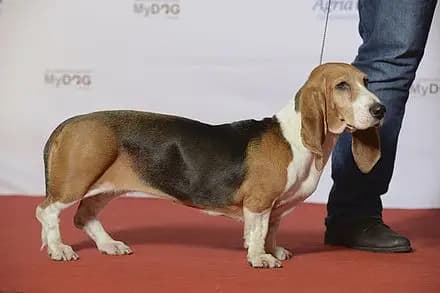
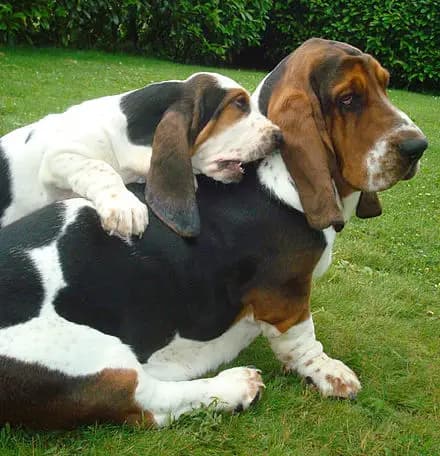
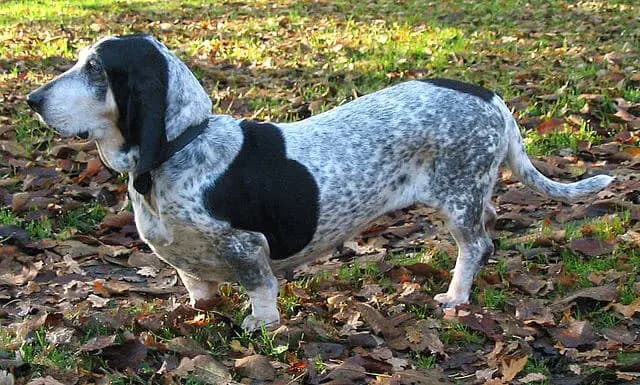
Despite his short legs, the Basset Artésien Normand is no mere couch potato, but an active hunting dog with a medium energy level (3/5). His biggest challenge in everyday life is the combination of a pronounced hunting instinct and an independent nature. Trainability is a moderate 2 out of 5: he was selected to make independent decisions on the trail. Don’t expect blind obedience; instead, plan for patient recall training, long-line work and nose games such as tracking or mantrailing.
This breed doesn’t belong in a third-floor flat with no lift. To protect his long spine, you must consistently avoid letting him climb stairs in daily life or jump out of the boot or off the sofa, and keep your dog slim for life. His short, dense coat without an undercoat is easy to care for (grooming needs 2/5), but it sheds an average amount (3/5) and offers little protection against wet and cold in winter. The long, heavy, drooping ears also demand your attention: because the ear flaps are poorly ventilated, you need to check and clean them regularly to prevent infections. As a pack animal, he loves the company of his people and other dogs, but with gradual training he can also learn to stay at home alone calmly for a few hours.
Your checklist for the first conversation with a breeder
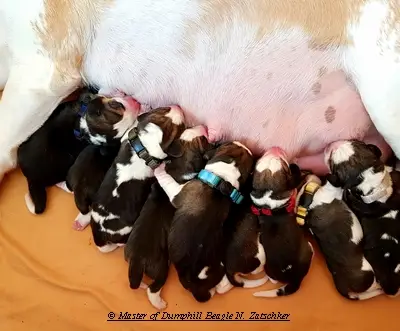
When you visit the breeder’s premises, take your time, watch how the mother moves (she should walk freely and without signs of back pain) and ask the breeder these specific questions:
- Ask to see the eye results: “Can you show me the current results of the ophthalmological eye examination and the pectinate ligament dysplasia (PLD) test for both parents?”
- Check the joints: “Are there official X-ray evaluations for hip dysplasia (HD) and elbow dysplasia (ED) for the parents?”
- Clarify specific hereditary conditions: “Have there been cases of ADAMTS10-associated primary open-angle glaucoma, ectropion, entropion or thrombopathy in your breeding lines, and what tests do you use to guard against them?”
- Back and weight plan: “How do you make sure your breeding produces a healthy back length and correct angulation of the legs, and what do you recommend for a joint-friendly upbringing in the first year?”
- Getting used to everyday life: “How do you prepare the puppies for environmental stimuli, house training and regular checks of the long ears?”
On HonestDog, a breeder profile only goes online once the breeder has completed registration: identity verification by ID and selfie, proof of club membership or a §11 permit where applicable, a knowledge test on breeding and animal welfare, and agreement to the HonestDog breeding standards, which among other things rule out breeding from dogs with extreme, health-damaging traits. Any health test results for the parents that breeders upload are shown directly in their profile; ask to see the original results when you visit. Your next step: compare the profiles of Basset Artésien Normand breeders on HonestDog, look at the health records they have uploaded and ask directly about the next litter.