
Irish Red SetterClose relative

The Irish Red and White Setter is a highly athletic, friendly pointing dog — bred to search the terrain for game birds over a wide radius and to stand absolutely motionless at the first scent.
How the health grade is calculated
Sources for required breeding screenings. Verein für Pointer und Setter e.V.
Self-check
Answer 6 quick questions about your everyday life and see how well the Irish Red and White Setter fits you — including an honest cost estimate per month, per year, and across the dog's lifetime.




At a glance
The essentials — key facts, traits, and health priorities — before you dive deeper.
Lifespan
10–12 yrs
Shoulder height
57–66 cm
Weight
25–32 kg
Practical
Temperament
Daily life
What matters most
Especially with a Irish Red and White Setter, choosing the right breeder is the single most important decision you'll make. Serious breeders consistently test the parents for inherited conditions, prioritize healthy early socialization, and stay accountable long after handover. A cheap puppy without health screening tends to become the most expensive dog later on.
See HonestDog breeder standards →Colors & coat
The coat colors that occur in the Irish Red and White Setter — including which ones fall outside the breed standard and which carry genetic risk.
Eye colors
 Brown
 Amber
Coat type
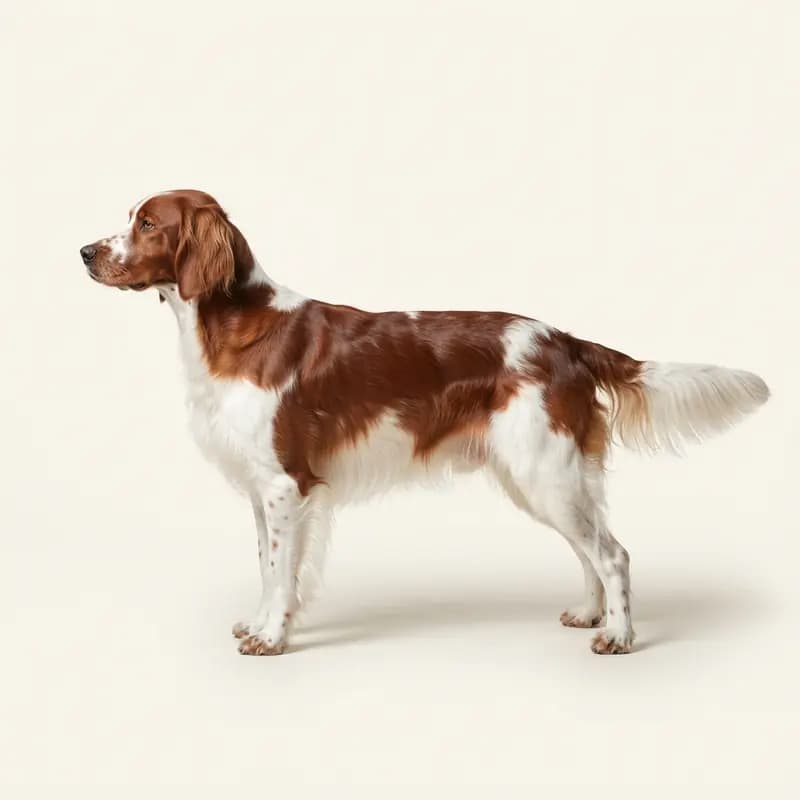 Illustrative image
Medium
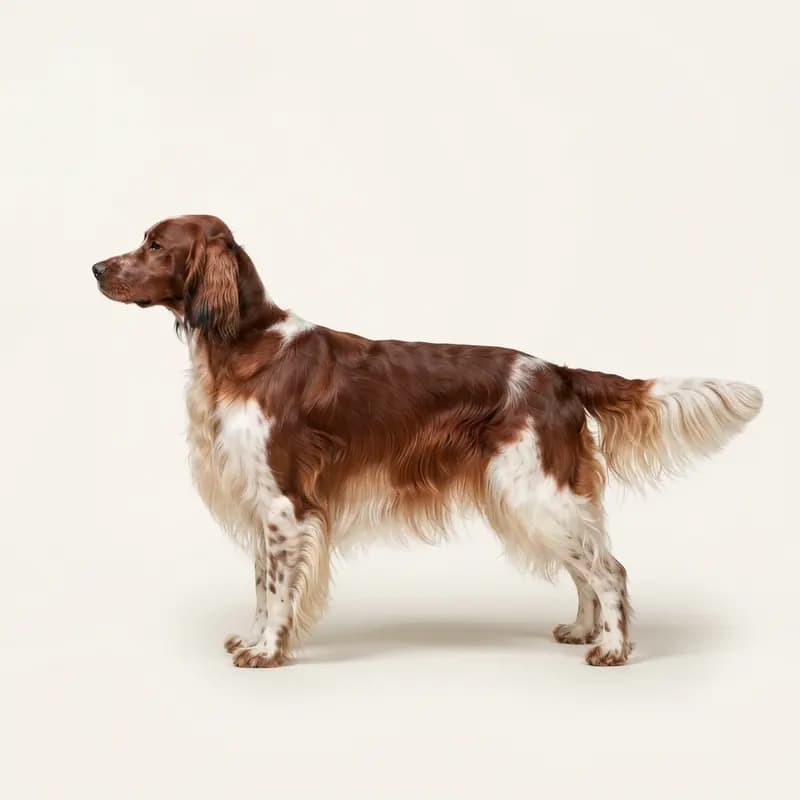 Illustrative image
Long
 Smooth
 Silky
The real vibes check
Indoors, he is a soft, cuddly shadow who would love nothing more than to lie on your lap — but as soon as you step into an open field, someone flips a switch. The cuddle bug turns into a highly focused athlete zig-zagging across the terrain, his nose scanning the horizon. If you appreciate and can manage these two sides, you will have a fascinating partner; if not, you will end up with a frustrated long-distance runner on a long leash.
There are four different breeds of setters, most of which differ in their external appearance. The Irish Red and White Setter (IRWS for short) is similar to the better-known Irish Red Setter and is its older brother. Setters immediately catch the eye with their silky fur and well-proportioned physique. This is underlined by the graceful and slightly springy movement. The IRWS has dark eyes, a long neck and a narrow head with a prominent occipital bone and medium-length ears. The white-red fur should be as free of curls and waves as possible. Like the other setters, this breed is a member of FCI Group 7, which is classified as pointing dogs. Since there are only a few lines in the IRWS, there is usually no distinction between show and work lines.
Setters are known for their affectionate and loving nature. They love the company of humans and tend to develop strong bonds with their families. Their friendly and outgoing nature makes them a great companion for children, although keep in mind that their size and energy can make them overwhelming for small children. Despite their gentle and loving nature, they also have a lot of temperament and endurance. They are energetic, alert and incredibly motivated, making them excellent working dogs, especially in the area of hunting. However, their innate hunting instinct may make them prone to chasing or harassing smaller pets. You should also be sure that your setter listens well to the callback and does not hunt independently if you let him run without a leash. To ensure that your daily walks remain relaxed, you should give your setter a good physical and mental workout so that he is not constantly on the hunt for tracks, but instead concentrates on you. Irish Red and White Setters are intelligent dogs that like to be challenged, both physically and mentally. They learn quickly and are very receptive, making them excellent candidates for various types of dog sports and training. However, it should be noted that their high intelligence also means that they require consistent training to avoid bad behavior. Setters can be very sensitive, which is why consistency should never be confused with a hard hand! They are extremely people-oriented and do not like to be alone. It is important to practice staying alone for short periods of time at a young age to avoid separation anxiety. An IRWS is generally not a typical guard dog. They are usually very friendly and open-minded towards strangers and do not tend to aggressively defend their territory. However, their vigilance and attentive nature can make them good alerters when something unusual happens in their environment.
| Watchfulness Greets everyone as a friend — no natural guarding instinct. | Very low |
| Openness to Strangers Loves every new person immediately and without reserve. | Very open |
| Hunting or Herding Drive This drive runs deep — no amount of training eliminates it. | Very strong |
Fun Fact!
Irish Red and White Setters have become so rare that they almost became extinct in the 1970s. Fortunately, dedicated breeders have revived the breed and they are now an established breed again, although they are still rarer than their relatives, the Irish Setters.
The Irish Red and White Setter is an intelligent dog with a high motivation to hunt. Therefore it should also be used for hunting.
Setters are active dogs and therefore need plenty of space to run around and play. They are particularly happy when they can enjoy their garden together with their humans and take long walks in nature. Setters are generally good with children, but because of their size and activity, they should always be supervised to avoid accidents. They also tend to get along well with other pets, including cats, as long as they have been properly socialized and do not view them as objects of hunting. Due to its energy and desire to move, this breed is best suited for active people who like to spend a lot of time outdoors and rarely leave their four-legged friend alone. You should also have previous dog experience, as Setters need loving, consistent training. Irish Red and White Setters are intelligent dogs that respond well to training. They need positive reinforcement and gentle but consistent training to be happy and well-adjusted. The active Irish should receive enough exercise and mental stimulation to be healthy and happy. Care should be taken not to overwork them as this can lead to stress and health problems. Therefore, “switch-off training” is very important for this breed in order to train it to be a relaxed companion in everyday life. Some IRWS tend to become ball junkies, so playing with balls should not be overused. Instead, attention should be paid to varied games and training. Because of their hunting instinct, it is important that they learn to control their impulses and develop frustration tolerance at an early age. This can be achieved through various exercises and training sessions. The setter benefits enormously from learning early on that he can experience "hunting fun" together with his people. Activities such as tracking, mantrailing, retrieving and stimulus fishing training are excellent examples of this. The better the dog accepts these activities, the greater the opportunity to grant him freedom in the form of free running. At the same time, recall training should be at the top of the list of training priorities, as well as many exercises for waiting, staying and "resting", especially in situations with hunting attractions. At home, the Irish Setter usually turns into a relaxed roommate who values the company of his people above all else and loves to cuddle on the sofa.
Lives for its family — the born family companion.
Takes boisterous and affectionate children in its stride.
Loves other dogs and is happiest in a group.
Can manage in the city, but only with very active owners.
Owning a dog is a privilege, but it's also a real responsibility. Before you bring one into your life, be honest with yourself about the commitment it takes.
Irish Red and White Setters are intelligent dogs that respond well to training. They need positive reinforcement and gentle but consistent training to be happy and well-adjusted. The active Irish should receive enough exercise and mental stimulation to be healthy and happy. Care should be taken not to overwork them as this can lead to stress and health problems. Therefore, “switch-off training” is very important for this breed in order to train it to be a relaxed companion in everyday life. Some IRWS tend to become ball junkies, so playing with balls should not be overused. Instead, attention should be paid to varied games and training. Because of their hunting instinct, it is important that they learn to control their impulses and develop frustration tolerance at an early age. This can be achieved through various exercises and training sessions. The setter benefits enormously from learning early on that he can experience "hunting fun" together with his people. Activities such as tracking, mantrailing, retrieving and stimulus fishing training are excellent examples of this. The better the dog accepts these activities, the greater the opportunity to grant him freedom in the form of free running. At the same time, recall training should be at the top of the list of training priorities, as well as many exercises for waiting, staying and "resting", especially in situations with hunting attractions. At home, the Irish Setter usually turns into a relaxed roommate who values the company of his people above all else and loves to cuddle on the sofa.
The Irish Red and White Setter's diet should be tailored to their energy needs. They are active dogs and therefore require a high quality diet that is rich in proteins and healthy fats. Care should also be taken to ensure that they do not become overweight, as this can put strain on their joints and increase the risk of certain health problems. Grooming the Irish is a little more difficult due to their long, silky coat. They should be brushed regularly to prevent tangles and to keep their coat nice and healthy. They have no undercoat and their fur is not particularly thick, so a dog coat is recommended in winter. They shed moderately, especially during the shedding periods in spring and autumn.
| Care Level Regular brushing and occasional professional grooming. | Moderate |
| Exercise Needs Working-dog energy that needs burning off every single day. | High-drive |
| Shedding Hair everywhere, always — no white clothing survives. | Very heavy |
| Trainability Bred to work closely alongside humans. | Highly trainable |
Our experts are still reviewing this information. Spotted something wrong? Email us at info@honestdog.de.
Solid
Health grade
In the Irish Red and White Setter, there are breed-typical risks for hip dysplasia (HD), progressive retinal atrophy, rod-cone dysplasia 4, and the severe leukocyte adhesion deficiency type I. Responsible breeders systematically rule out these diseases through consistent testing prior to breeding use and also pay attention to von Willebrand disease. The Verein für Pointer und Setter e.V. therefore strictly mandates that parent animals must be clear of leukocyte adhesion deficiency type I and that hips must be evaluated with HD A or B. For progressive retinal atrophy, rod-cone dysplasia 4, and von Willebrand disease, the following applies: a carrier may only be mated with a clear partner. Have these breeding values and ideally an unremarkable examination for hypothyroidism presented to you completely before purchasing a puppy.
Grade is relative to other breeds — AI-assisted and editorially reviewed.
Methodology and data: HonestDog Dog Breed Health Report 2026
What matters most for this breed
Tap any item to see details.
With joint-friendly rearing, regular ear care, and routine eye check-ups, most dogs stay active and healthy for a long time.
Responsible breeders test for HD, Canine Leukocyte Adhesion Deficiency Type I, Progressive Retinal Atrophy, Rod-cone Dysplasia 4, and von Willebrand Disease, and check for hypothyroidism.
Note: This health overview is AI-assisted and editorially reviewed. It is for orientation only and does not replace veterinary advice.
What matters most for this breed — what's common, how much it affects the dog's life, and how to protect yourself as a buyer.
Tap a body region to see the inherited conditions linked to it.
The three most important risks
Pick a region on the map to explore other areas.
Tier 1 reflects the tests Verein für Pointer und Setter e.V. actually mandates. Tiers 2 and 3 show how responsible breeders go beyond.
Club standard. Verein für Pointer und Setter e.V. requires these tests for breeding approval. Ask any reputable breeder for the results.
Not health tests, but required for breeding: the club asks for these results too. They don't count toward the risks or the rating.
DNA-Identitätsnachweis
Required by Verein für Pointer und Setter e.V.
Acceptable result: result on file
No entries in this tier.
Note: This health overview is AI-assisted and editorially reviewed. It is for orientation only and does not replace veterinary advice.
A Irish Red and White Setter costs around ~€190 per month (€100 – €360, depending on your setup). The first year adds up to roughly ~€5,120 including purchase, equipment and puppy school; across the dog's life (11 years) it comes to about ~€28,030.
With surgery cover, running costs come to about ~€190 per month — in return, your share of a major operation drops from several thousand euros to around 20 percent.
Per month
~€190
In the first year
~€5,120
Across the dog's life
~€28,030
Estimated purchase price from a breeder: €1,500 – €2,500
Estimate at a mid-range setup (suburban, dry food, 1–2 hours of daily exercise), average German prices, as of July 2026.
HonestDog Concierge
We currently have no breeders for this breed who have passed our verification. Create your short buyer profile: we'll set up your search alert, review a possible source and email you within 28 days.
 Illustrative imageIllustrative image
 Illustrative image
The Irish Red and White Setter is one of the oldest setter breeds and originates from Ireland. It was originally developed for hunting game birds. With its keen sense of smell and ability to indicate game by "pointing," it was a valuable companion for hunters. Over time, however, the breed was overshadowed by its close relative, the Irish Red Setter, and was nearly extinct by the end of the 19th century. Thanks to the efforts of a few enthusiasts, the breed was revived in the 1920s. Today, the Irish Red and White Setter is recognized as a distinct breed in its homeland and many other countries. The breed was recognized by the Irish Kennel Club in 1944 and by the American Kennel Club in 2009.
Pointing dog for hunting game birds.
Ireland
1700
In family life, owners describe the Irish Red and White Setter as a very affectionate, loving, and cuddly companion. Many highlight its people-oriented nature: indoors it constantly seeks out its people and often follows them everywhere. With strangers and children it's generally friendly, open, and playful. Owners point out, however, that its boisterous temperament and physical strength can quickly overwhelm very small children, especially in puppyhood and adolescence.
At the same time, owner accounts stress that this breed is in no way made for an isolated life or for living in a kennel. It suffers without company and doesn't like being left alone, which is why many owners advise building up time alone gently and in small steps from the start. If the Irish Red and White Setter isn't sufficiently included in family life or is mentally under-challenged, it quickly becomes restless, nervous, or noisy.
Sources:forum.hausgarten.netunitedpetclub.comsabinemiddelhaufeshundundnatur.net
On training and handling in daily life, owners consistently report a mix of fine-tuned sensitivity and a strong independent streak. As a classic pointing breed, the Irish Red and White Setter has a deep-rooted drive to hunt and search. Off leash it tends to range in wide search patterns and reacts in a flash to the scent of birds and furred game. Many owners therefore warn against letting it off the leash lightly; a solid recall and targeted anti-chase or long-line training often take months of intensive work.
In training, the breed learns quickly and is cooperative, but under pressure or harshness it soon turns stubborn or withdraws fearfully. Experienced owners therefore stress again and again that completely calm, predictable, reward-based consistency is the only key to success. To keep the dog content away from the hunt too, many owners turn to substitute nose work such as dummy work, mantrailing, or tracking games, since walks alone hardly tire out this agile working dog mentally.
Sources:unitedpetclub.comsabinemiddelhaufeshundundnatur.nethund.infohundeseite.de
When it comes to health and grooming, owners describe the Irish Red and White Setter as a generally sturdy, weatherproof breed that loves to run. Even so, breed experts point to breed-specific hereditary diseases that play a big role, especially among breeders. These include canine leukocyte adhesion deficiency (CLAD) and eye diseases such as progressive retinal atrophy (PRA). Owners strongly advise buying puppies only from breeders who fully screen the parents with the relevant DNA tests and hip evaluations (HD).
For day-to-day care, the silky coat is considered surprisingly easy to maintain as long as it's brushed regularly. Owners report, however, that the typical feathering on the legs, chest, and ears practically attracts dirt, burrs, and ticks on walks in woods or fields. Owners also mention that the hanging ears are prone to moisture and infection and should therefore be checked and cleaned regularly after outings or swims.
Sources:hundeseite.de
Paraphrased from real owner reports · translated from German
The Irish Red and White Setter is an active dog that needs plenty of exercise and mental stimulation. Research the temperament, grooming needs, and space requirements before deciding.
The average life expectancy of a Irish Red and White Setter is 10-12 years. With proper care and regular vet visits, your dog can live a long, healthy life.
Irish Red and White Setter grooming requirements include regular brushing, nail trimming, and dental care. HonestDog provides detailed grooming tips for every breed.
The Irish Red and White Setter can be a great family dog. Proper training and socialization are key. HonestDog provides family suitability information for every breed.
The Irish Red and White Setter comes in these colors: Red and white.
Showcase your kennel on HonestDog and reach families searching for a responsibly bred Irish Red and White Setter.