
Golden RetrieverSame FCI section

The Flat Coated Retriever is an eternally youthful, exuberant retriever — bred to tirelessly and gently retrieve game from water and reeds, which has quite rightly earned it the reputation as the "Peter Pan" of the dog world.
How the health grade is calculated
Sources for required breeding screenings. Deutscher Retriever Club e.V. (DRC) · Deutscher Retriever Club e.V. (DRC)
Self-check
Answer 6 quick questions about your everyday life and see how well the Flat-Coated Retriever fits you — including an honest cost estimate per month, per year, and across the dog's lifetime.




At a glance
The essentials — key facts, traits, and health priorities — before you dive deeper.
Lifespan
10–12 yrs
Shoulder height
57–62 cm
Weight
25–36 kg
Practical
Temperament
Daily life
What matters most
Especially with a Flat-Coated Retriever, choosing the right breeder is the single most important decision you'll make. Serious breeders consistently test the parents for inherited conditions, prioritize healthy early socialization, and stay accountable long after handover. A cheap puppy without health screening tends to become the most expensive dog later on.
See HonestDog breeder standards →Colors & coat
The coat colors that occur in the Flat-Coated Retriever — including which ones fall outside the breed standard and which carry genetic risk.
Eye colors
 Brown
 Amber
Coat type
 Illustrative image
Medium
 Illustrative image
Long
 Smooth
 Double coat
The real vibes check
A Flat Coated Retriever is almost always carrying something in its mouth — be it a dummy, your slipper, or simply pure enthusiasm for the day. He is not a dog that just fades into the background; he is an eternal optimist who views life as one big team project. If you channel this stormy, work-hungry cheerfulness through real training, you will get the most loyal, guaranteed mood-booster imaginable.
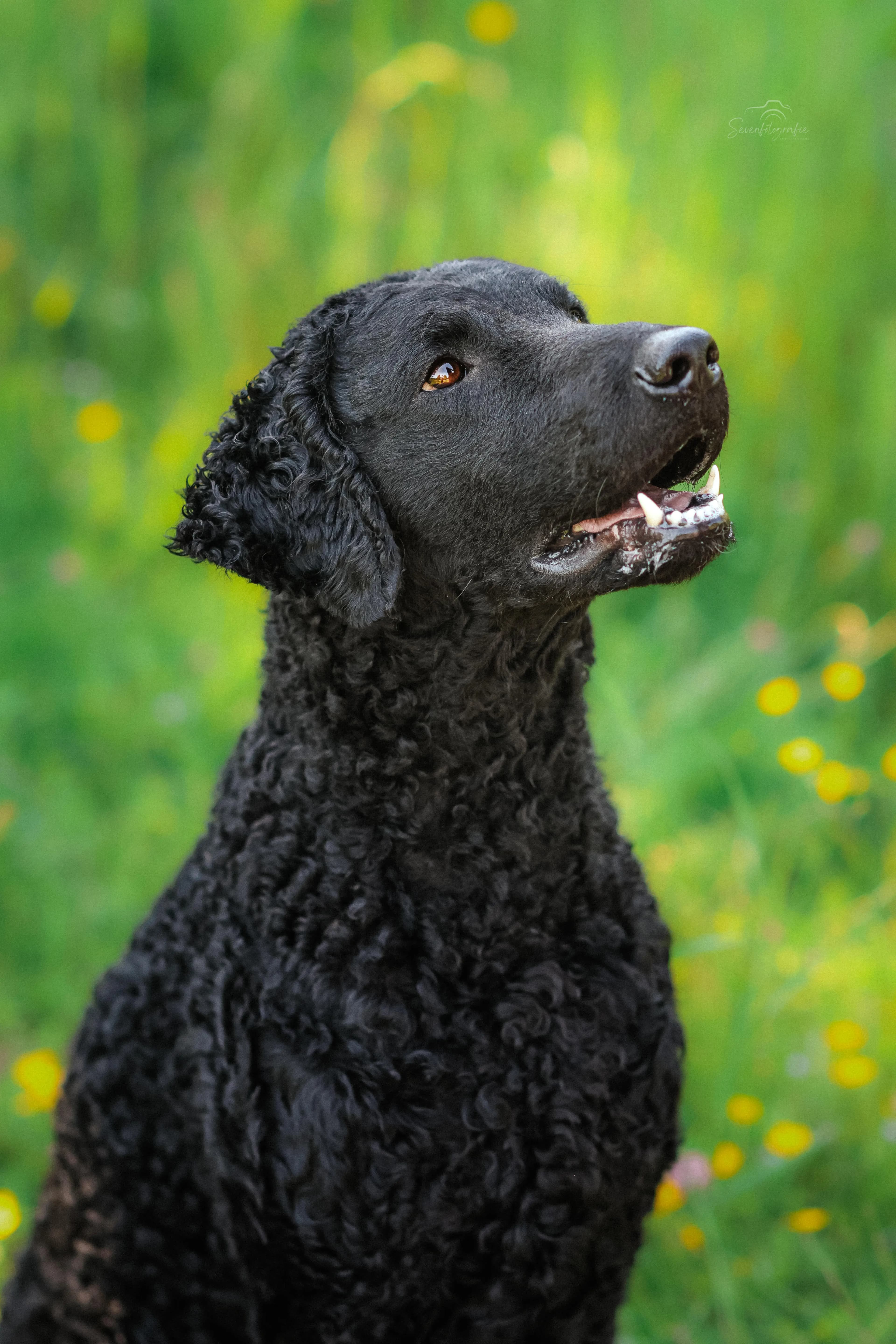
The Flat Coated Retriever, often affectionately referred to as "Flat", has an elegant and shiny appearance. His physique is athletic, well proportioned and shows a natural grace. Its coat is dense, medium length and shiny, often giving it the appearance of a "four-legged gentleman". A striking feature is its long head, shaped almost like a wedge, with a strong snout and expressive eyes. The Flat Coated Retriever belongs to FCI Group 8, the retrieving dogs, searching dogs and water dogs. Within this group it can be found in the retriever section. This breed does not differentiate between performance and show lines, meaning that all Flat Coated Retrievers are suitable for both show and work tasks.
Flat Coated Retrievers are known for keeping a puppy's heart well into old age. They are incredibly happy, friendly and outgoing dogs. If you're looking for a dog that enjoys life to the fullest, the Flat could be just the one for you. As retrievers, Flats are of course also known to love retrieving. This makes them great companions for active families who enjoy spending time outdoors. They have a natural affinity for water and are excellent swimmers, which is why they are often used in water sports. Their friendly and social nature also makes them wonderful family dogs. They are very people-oriented and build close bonds with their family members. Flats are known for getting along well with children and other pets. However, they are not guard dogs. Their open and friendly nature means they tend to like everyone they meet, even strangers. But that doesn't mean they can't be good alarm dogs because they will often bark when someone is at the door. When it comes to being alone, it is important to get a Flat Coated Retriever used to it from an early age. They are socially oriented and love being in company. A Flat that is regularly left alone for long periods of time can develop behavioral problems. An important characteristic of the breed is its energy level. They are very energetic and need enough exercise every day. Their urge to move and their intelligence also mean that they need to be mentally challenged. Because they were originally bred as hunting dogs, Flat Coated Retrievers have a certain hunting instinct. It is important to teach them to control these urges, especially when they are in areas with wildlife.
| Watchfulness Occasionally alerts but is fundamentally open. | Low |
| Openness to Strangers Warms up quickly and is generally welcoming. | Friendly |
| Hunting or Herding Drive Noticeable drive — needs attention around small animals. | Moderate |
Fun Fact!
Flat Coated Retrievers are often considered the “Peter Pans” of dogs because they retain their playful and youthful personalities even into adulthood!
Flat Coated Retrievers are fast, active dogs with a high hunting motivation. They are suitable for sporty dog owners who can exercise this dog according to its type.
The Flat Coated Retriever is an active dog and is therefore more suitable for living in a house with a garden than in a city apartment. If he is still kept in the city, regular walks and off-leash exercise are essential run essential. They are generally very social and get along well with children and other animals. However, a close eye should always be kept on the interaction between dogs and small children.
Lives for its family — the born family companion.
Extraordinarily patient and loving — a true family dog.
Actively enjoys the company of other dogs.
City-appropriate with enough exercise and stimulation.
Owning a dog is a privilege, but it's also a real responsibility. Before you bring one into your life, be honest with yourself about the commitment it takes.
Flats are intelligent dogs that crave mental and physical stimulation. Their natural retrieving behavior can be encouraged by including retrieving games and sports such as flyball. They are also excellent swimmers and love water sports. It is important to ensure a balanced activity so as not to overwhelm the dog. Because Flats have high energy levels, they can become "ball junkies" if they become too focused on ball games. It's important to offer a varied exercise program that includes both physical and mental stimulation. It is also important for this breed that the dog learns frustration tolerance and impulse control. Training should start early and be based on positive reinforcement.
Flat Coated Retrievers benefit from a balanced diet that contains high-quality protein, fat, vitamins and minerals. It is advisable to pay attention to a species-appropriate diet that is specifically tailored to the needs of active dogs. Being overweight should be avoided as it can put additional strain on the joints. In terms of grooming, the Flat Coated Retriever has a medium-length, dense coat with an undercoat. The undercoat helps them stay warm in the colder months and is well suited to the climate in Germany. However, they shed all year round and especially during the shedding period in spring and autumn. Regular brushing, about twice a week, is important to prevent mats and keep the skin and coat healthy.
| Care Level Regular brushing and occasional professional grooming. | Moderate |
| Exercise Needs Needs several hours of serious exercise every day. | Very active |
| Shedding Hair everywhere, always — no white clothing survives. | Very heavy |
| Trainability Bred to work closely alongside humans. | Highly trainable |
Our experts are still reviewing this information. Spotted something wrong? Email us at info@honestdog.de.
Solid, watch carefully
Health grade
In the Flat Coated Retriever, joint disorders such as elbow dysplasia (ED) and hip dysplasia (HD), as well as hereditary eye diseases such as pectinate ligament dysplasia (PLD), primarily define the health profile; in addition, histiocytosis represents a serious risk. For breeding approval, the Deutscher Retriever Club e.V. (DRC) therefore mandates radiographic examinations for HD (A–C) and ED (0–1), as well as ophthalmological eye examinations including PLD. Responsible breeders additionally test for patellar luxation (PL 0) and have the genetic status determined for progressive rod-cone degeneration (PRCD). Before buying, make sure to ask for the DRC breeding approval and all written findings on joints and eyes without gaps.
Grade is relative to other breeds — AI-assisted and editorially reviewed.
Methodology and data: HonestDog Dog Breed Health Report 2026
What matters most for this breed
Tap any item to see details.
You should pay attention to a healthy weight and joint-friendly exercise, as well as schedule regular veterinary check-ups to detect any changes early on.
Responsible breeders have ED, HD, eye conditions, and PLD tested according to DRC requirements, and additionally screen for patellar luxation as well as progressive rod-cone degeneration (PRCD).
Note: This health overview is AI-assisted and editorially reviewed. It is for orientation only and does not replace veterinary advice.
What matters most for this breed — what's common, how much it affects the dog's life, and how to protect yourself as a buyer.
Tap a body region to see the inherited conditions linked to it.
The three most important risks
Pick a region on the map to explore other areas.
Tier 1 is the core standard: the tests Deutscher Retriever Club e.V. (DRC) requires, plus further tests from the recommended health standard for this breed. Tiers 2 and 3 show how responsible breeders go beyond.
Core standard. Tests marked “Club standard” are required by Deutscher Retriever Club e.V. (DRC) for breeding approval; the others are part of the recommended health standard for this breed. Ask any reputable breeder for the results.
No entries in this tier.
Note: This health overview is AI-assisted and editorially reviewed. It is for orientation only and does not replace veterinary advice.
A Flat-Coated Retriever costs around ~€190 per month (€100 – €370, depending on your setup). The first year adds up to roughly ~€5,160 including purchase, equipment and puppy school; across the dog's life (11 years) it comes to about ~€28,430.
With surgery cover, running costs come to about ~€200 per month — in return, your share of a major operation drops from several thousand euros to around 20 percent.
Per month
~€190
In the first year
~€5,160
Across the dog's life
~€28,430
Estimated purchase price from a breeder: €1,500 – €2,500
Estimate at a mid-range setup (suburban, dry food, 1–2 hours of daily exercise), average German prices, as of July 2026.
 Illustrative imageIllustrative image
 Illustrative image
 Illustrative image
The Flat Coated Retriever comes from Great Britain and was originally bred as a hunting dog in the 19th century. It evolved from a mixture of different dog breeds, including the Newfoundland, the Labrador and possibly the Irish Setter. The Flat Coated Retriever was bred specifically to retrieve waterfowl and serve as a working dog for hunters. This breed was first known as the Wavy Coated Retriever and over time evolved into what we know today as the Flat Coated Retriever. He was valued for his ability to pick up game with a soft mouth and bring it back to the hunter undamaged. The Flat Coated Retriever was recognized as a separate breed by the British Kennel Club in 1915. It was very popular in Britain in the 1920s, but lost some popularity after the Second World War, particularly to the Labrador Retriever. However, in recent years it has regained popularity, both as a family dog and as a working dog.
The Flat Coated Retriever was bred as a retrieving dog for water and land hunting.
Great Britain
1800
In family life, owners describe the Flat-Coated Retriever as a very affectionate, good-humored, and playful companion, fondly known as the "eternal puppy" or the Peter Pan of dogs. Many owners value its deep focus on people and its patience with children, but they also stress that its exuberant temperament is easy to underestimate in the first few years. Young Flatties in particular tend toward pushy greetings, jumping up, and boisterous excitement whenever someone visits, so owners need to stand firm and set consistent house rules from the start.
A recurring theme is the breed's love of water and mud. Owners report, with a wink, that hardly a muddy puddle gets skipped, and that living with a Flatty means bringing a certain tolerance for dirt and wet dog hair indoors. Many dogs are sensitive about being left alone: if they aren't gradually and patiently accustomed to it, they protest the separation loudly or find their own outlets out of frustration. But give them set quiet zones and a real place in the family, and you'll have an exceptionally loyal and charming housemate.
Sources:forum.retriever-and-friends.orgheyholy.comreddit.comdogforum.deforum.hundund.de
On exercise and training, experienced owners warn against treating the Flat-Coated Retriever like a mellow family dog. Compared with many show-bred retrievers, the breed has noticeably more temperament, eagerness to work, and a strong hunting drive. Leash walks alone are almost never enough; these dogs only really thrive with challenging dummy work, drag trails, or targeted nose work that gives them the mental satisfaction they need.
At the same time, many owner accounts point out that the biggest misunderstanding is constant overstimulation. If you try to tire out a Flatty with endless ball throwing or nonstop busyness, you'll raise an overexcited, nervous dog that can no longer find its off switch. Experienced owners therefore strongly advise training frustration tolerance, steadiness, and impulse control just as intensively as the retrieve itself. In training, this sensitive dog needs gentle, friendly handling; harshness shuts it down, while its independent, impish streak will exploit any inconsistency right away.
Sources:forum.retriever-and-friends.orgreddit.comdogforum.deforum.hundund.deparents.at
In owner forums and breed groups, health is the most painful topic emotionally. Many owners share the sad experience of their dogs developing malignant tumors long before the usual life expectancy for larger breeds. The aggressive histiocytic sarcoma typical of the breed and lymphoma are mentioned again and again, and they often mean beloved dogs have to be put to sleep as early as six to eight years of age.
Although owners also report healthy dogs that stay agile into old age, people who know the breed strongly advise future owners to be especially critical when choosing a breeder. Besides the usual screening for hip and elbow dysplasia, informed buyers increasingly look for pedigrees with documented long-lived ancestors. Many owners also recommend regular veterinary ultrasounds and checkups from middle age onward to catch changes early.
Sources:heyholy.comdogforum.dereddit.comforum.hundund.deforum.wildundhund.de
Paraphrased from real owner reports · translated from German
The Flat-Coated Retriever is an active dog that needs plenty of exercise and mental stimulation. Research the temperament, grooming needs, and space requirements before deciding.
The average life expectancy of a Flat-Coated Retriever is 10-12 years. With proper care and regular vet visits, your dog can live a long, healthy life.
Flat-Coated Retriever grooming requirements include regular brushing, nail trimming, and dental care. HonestDog provides detailed grooming tips for every breed.
The Flat-Coated Retriever can be a great family dog. Proper training and socialization are key. HonestDog provides family suitability information for every breed.
The Flat-Coated Retriever comes in these colors: Black, Liver, Yellow. Colors that fall outside the breed standard are marked as such on the breed page.
Showcase your kennel on HonestDog and reach families searching for a responsibly bred Flat-Coated Retriever.
