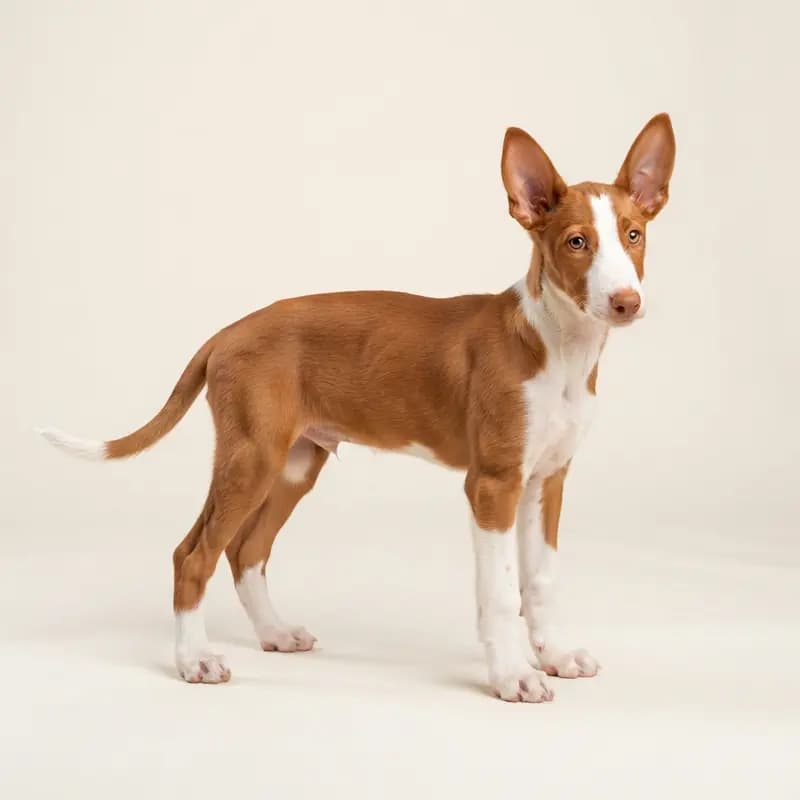
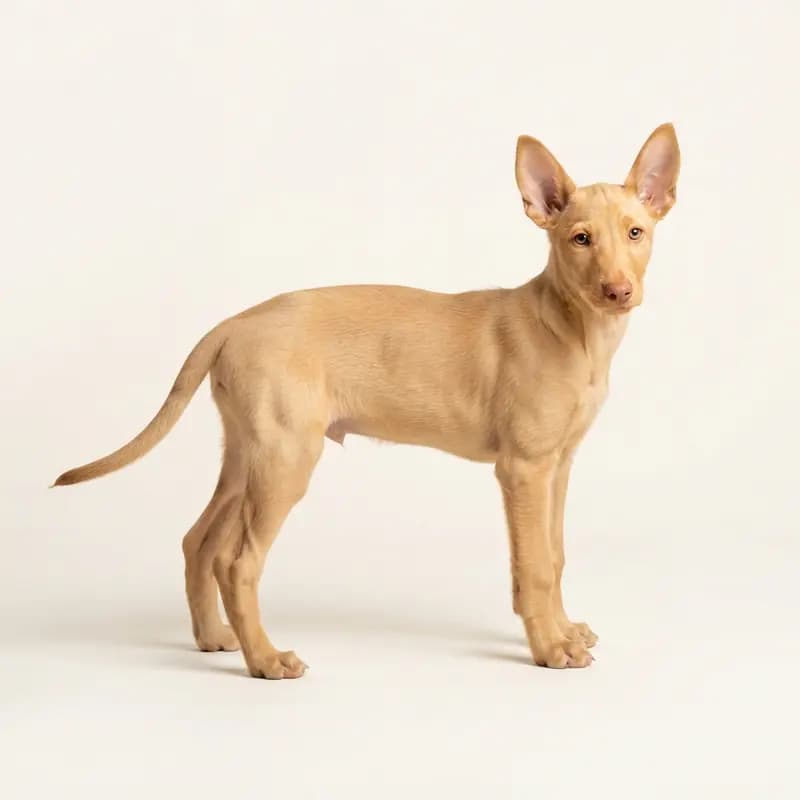
Pharaoh HoundSame working temperament
The Podenco Ibicenco is a cat-like, sensitive athlete—a primitive hunting dog bred to hunt completely independently in rugged terrain using sight, hearing, and scent. At home, they are gentle spirits; outdoors, they are explosive hunters.
How the health grade is calculated
Sources for required breeding screenings. Deutscher Windhundzucht- und Rennverband e.V. (DWZRV)
Self-check
Answer 6 quick questions about your everyday life and see how well the Ibizan Hound fits you — including an honest cost estimate per month, per year, and across the dog's lifetime.



At a glance
The essentials — key facts, traits, and health priorities — before you dive deeper.
Lifespan
11–14 yrs
Shoulder height
60–72 cm
Weight
19–24 kg
Practical
Temperament
Daily life
What matters most
Especially with a Ibizan Hound, choosing the right breeder is the single most important decision you'll make. Serious breeders consistently test the parents for inherited conditions, prioritize healthy early socialization, and stay accountable long after handover. A cheap puppy without health screening tends to become the most expensive dog later on.
See HonestDog breeder standards →Colors & coat
The coat colors that occur in the Ibizan Hound — including which ones fall outside the breed standard and which carry genetic risk.
Eye colors
 Amber
Coat type
 Smooth
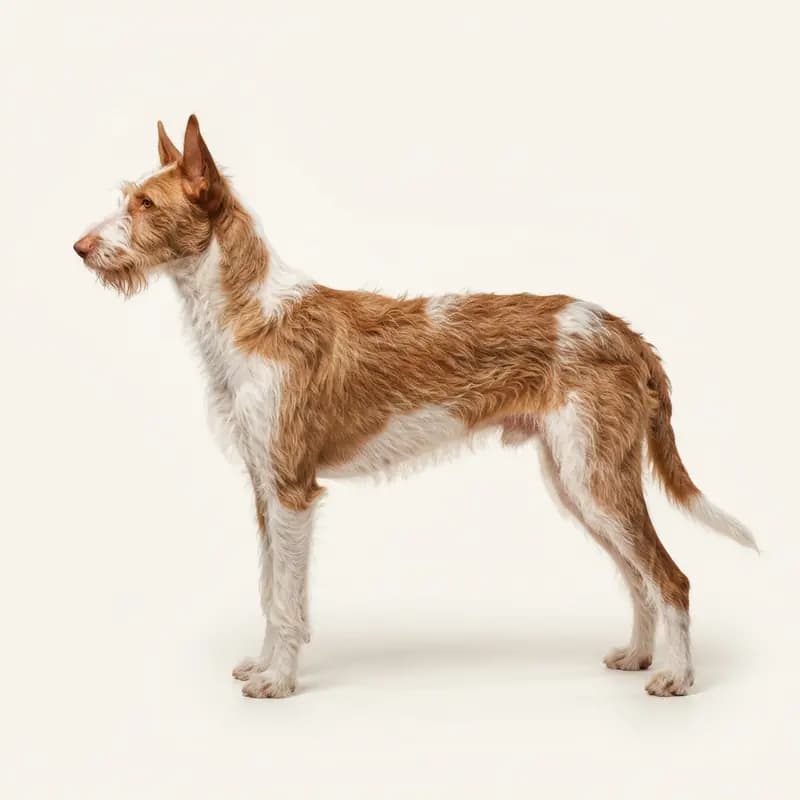 Illustrative image
Wire
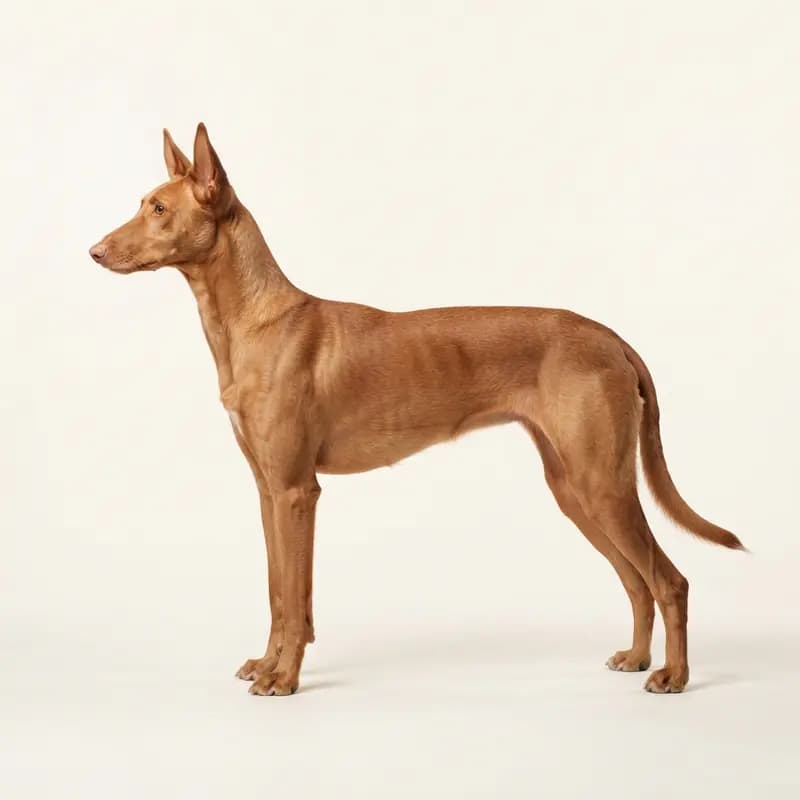 Illustrative image
Short
The real vibes check
A Podenco is like a gentle alien in a sighthound's coat: indoors, they snuggle up to the warmest radiator like a cat, but outdoors, they mutate into a lightning-fast hunter at the flick of a switch. You aren't getting a classic command-follower, but a roommate who only accepts your rules if they make sense within their own ancient value system.
The Podenco Ibicenco, also known as the Ibizan Hound, is a breed of dog that impresses with its elegance and athletic build. They are medium to large dogs, with long, slender legs, a noble head and large, alert ears. Their faces have a wedge-shaped structure and they often have a melancholic yet intense expression. This breed comes in two coat varieties: smooth and rough, with the rough coat being slightly longer. However, both variants have no undercoat. The Podenco Ibicenco belongs to FCI Group 5, the spitz and primitive-type dogs, and within this group to Section 7, the archetypal hunting dogs.
If you are looking for a lively yet sensitive soul, the Podenco Ibicenco could be just the right companion for you. These dogs are known for their sensitivity and gentle nature. They often form deep bonds with their family and can be affectionate, but are also somewhat more independent than other breeds. They are often wary of strangers and can show a degree of alertness without being aggressive. Due to their origins and original use as hunting dogs, the Podenco Ibicenco has strong hunting and prey-catching abilities. They are incredibly agile and can make amazing jumps. This breed has a keen sense of smell, excellent hearing and keen eyesight, making them competent hunters. So if you have a garden, you should make sure it is well fenced as they may be tempted to prey on small animals. The Podenco Ibicenco's independence means that he often enjoys finding his own entertainment. However, he is happy when he is around his family and loves to be involved in their activities. They are generally friendly with children and other dogs, especially if socialized from an early age. One of the notable features of this breed is its ability to perform high jumps. It is no surprise to see them jumping in the air, especially when they are excited or hear an interesting noise. They are also known to perch on elevated surfaces such as window sills or tabletops, similar to cats. This is probably because they like to observe their surroundings from above. The Podenco Ibicenco is not a particularly barking dog, but may still raise its voice when it notices something interesting or worrying. It is also important to note that this breed is generally good at being left alone as long as it receives adequate mental and physical stimulation. However, when they feel bored or neglected, they can develop destructive behavior.
| Watchfulness Occasionally alerts but is fundamentally open. | Low |
| Openness to Strangers Warms up quickly and is generally welcoming. | Friendly |
| Hunting or Herding Drive This drive runs deep — no amount of training eliminates it. | Very strong |
Fun Fact!
Did you know that the Podenco Ibicenco is known for its incredible jumping power? He can easily jump over fences and obstacles that are almost twice his height!
The Podenco Ibicenco is a passionate hunter who is rather reserved towards strangers. Uncontrolled hunting behavior is considered one of the major problems in keeping this breed.
The Podenco Ibicenco is an active dog and is better suited to a home with a garden than a city apartment. They generally get along well with children and other dogs as long as they are socialized from a young age. Small pets, especially rodents, could be problematic due to the breed's strong hunting instinct.
Loves family life and thrives in a group.
Takes boisterous and affectionate children in its stride.
Usually gets on fine with other dogs.
City-appropriate with enough exercise and stimulation.
Owning a dog is a privilege, but it's also a real responsibility. Before you bring one into your life, be honest with yourself about the commitment it takes.
The Podenco Ibicenco naturally has a strong hunting instinct. It is therefore important to start training early and to establish good recall training. These dogs are very intelligent and learn quickly, but can also be stubborn. Positive reinforcement and patient training are key. Their energy and agility make them ideal for dog sports such as agility and lure coursing. It's important to find a good balance as they need a lot of exercise, but there's also the risk of them becoming ball junkies. A balanced combination of mental and physical stimulation is ideal. Training frustration tolerance and impulse control is particularly important to prevent their prey drive from resulting in undesirable behavior. Incorporating search games and nose work can provide a good alternative to hunting behavior and help them express their natural instincts in a positive way.
The Podenco Ibicenco's diet should be high quality and balanced. Fresh meat, vegetables and whole grains are ideal for providing him with all the nutrients he needs. Be careful not to allow the dog to gain too much weight, as this can put strain on his joints and bones. In terms of care, the Podenco Ibicenco has a short to medium length coat with no undercoat. They don't shed much, but regular brushing helps keep their coat clean and healthy. Since they don't have an undercoat, they can be sensitive to cold during the colder months in Germany, so consider putting a coat on your Podenco in the winter.
| Care Level Minimal effort — occasional brushing and bathing. | Low-maintenance |
| Exercise Needs Needs several hours of serious exercise every day. | Very active |
| Shedding No or minimal hair loss — suitable for allergy sufferers. | No shedding |
| Trainability Has its own ideas and will test limits. | Strong-willed |
Our experts are still reviewing this information. Spotted something wrong? Email us at info@honestdog.de.
Robust
Health grade
The Podenco Ibicenco is considered a very robust breed, yet eye diseases such as cataracts and progressive retinal atrophy can occur. The Deutscher Windhundzucht- und Rennverband e.V. (DWZRV) mandates for breeding approval that parent animals must be free of cataracts and progressive retinal atrophy. A health-oriented breeder also tests their dogs for degenerative myelopathy, hip dysplasia (HD), and congenital hereditary sensorineural deafness (CHSD). Before buying, ask to see the veterinary eye certificates marked 'free' and inquire about further results such as bilateral hearing and HD A–B.
Grade is relative to other breeds — AI-assisted and editorially reviewed.
Methodology and data: HonestDog Dog Breed Health Report 2026
What matters most for this breed
Tap any item to see details.
You should ensure sufficient protection against the cold in winter, limit jumping during growth, and inform your veterinarian about their specific sensitivity to anesthesia before any procedures.
Responsible breeders provide the proof, mandatory for breeding, of freedom from cataracts and progressive retinal atrophy, and additionally screen voluntarily for degenerative myelopathy and hip dysplasia (HD).
Note: This health overview is AI-assisted and editorially reviewed. It is for orientation only and does not replace veterinary advice.
What matters most for this breed — what's common, how much it affects the dog's life, and how to protect yourself as a buyer.
Tap a body region to see the inherited conditions linked to it.
The three most important risks
Pick a region on the map to explore other areas.
Tier 1 reflects the tests Deutscher Windhundzucht- und Rennverband e.V. (DWZRV) actually mandates. Tiers 2 and 3 show how responsible breeders go beyond.
Club standard. Deutscher Windhundzucht- und Rennverband e.V. (DWZRV) requires these tests for breeding approval. Ask any reputable breeder for the results.
No entries in this tier.
Note: This health overview is AI-assisted and editorially reviewed. It is for orientation only and does not replace veterinary advice.
A Ibizan Hound costs around ~€180 per month (€90 – €330, depending on your setup). The first year adds up to roughly ~€4,950 including purchase, equipment and puppy school; across the dog's life (12.5 years) it comes to about ~€29,270.
With surgery cover, running costs come to about ~€170 per month — in return, your share of a major operation drops from several thousand euros to around 20 percent.
Per month
~€180
In the first year
~€4,950
Across the dog's life
~€29,270
Estimated purchase price from a breeder: €1,500 – €2,500
Estimate at a mid-range setup (suburban, dry food, 1–2 hours of daily exercise), average German prices, as of July 2026.
HonestDog Concierge
We currently have no breeders for this breed who have passed our verification. Create your short buyer profile: we'll set up your search alert, review a possible source and email you within 28 days.
 Illustrative imageIllustrative image
 Illustrative image
 Illustrative image
The Podenco Ibicenco comes from the island of Ibiza, one of the Balearic Islands in the Mediterranean. Its ancestors were probably Egyptian hunting dogs brought to the island by the Phoenicians and later by the Romans. The breed has changed little over the millennia and is an excellent example of the original hunting dogs of the Mediterranean. The Podenco Ibicenco was traditionally used to hunt rabbits and other small animals in the Balearic Islands. Their large ears and high speed and agility made them excellent hunters in the islands' often rocky and uneven terrain. The breed was recognized as an independent breed by the Fédération Cynologique Internationale (FCI) in 1970.
The Podenco Ibicenco was used to hunt rabbits and other small game and is known for its speed and good eyesight.
Balearic Islands, Spain
Antike
In daily life at home, owners consistently describe the Ibizan Hound as having a fascinating double personality. Indoors these dogs are surprisingly calm, affectionate and almost catlike: they curl up for hours on the couch or on raised spots and enjoy being near their people without being pushy. With their own family they are considered gentle, loyal and very polite with children. Many are politely reserved with strangers at first but warm up quickly when approached calmly.
Outdoors, though, this coziness gives way to a huge need to move and lightning-fast reflexes. Owners highlight its exceptional jumping ability: an Ibizan Hound can clear ordinary yard fences from a standstill with ease. Owners agree that a tall, fully escape-proof fence is therefore a must. Without enough exercise or something to do, bored Podencos tend to take out their energy on furniture and household items.
Sources:hundeforum.comtierschutz-spanien.depfotenhilfe-andalusien.comzooroyal.deforum.hundund.de
The central theme in owner reports is the breed's very strong hunting drive. Owners stress again and again that, unlike pure sighthounds, the Ibizan Hound works with all three senses: it searches with its nose, picks up the faintest sounds with its large upright ears and takes off at a sprint on sight. Once the dog switches into hunting mode out in the open, it often doesn't respond to anything else at all.
For this reason, a great many owners report that true off-leash time in areas with a lot of wildlife or near woods is barely possible, or only at considerable risk. For most owners, a long line, a GPS tracker and visits to fenced off-leash areas are a fixed part of daily life. Living with small pets or cats in the same household is also described as tricky, since running animals can reflexively trigger its prey-catching behavior.
Sources:hundeforum.comzooroyal.deforum.hunde-aus-mallorca.dedogforum.depodencoforum.de
On training, owners highlight the breed's independent, primitive-type character. The Ibizan Hound was bred to make its own decisions, so the classic "will to please" is foreign to it. It often questions commands, and even well-practiced basic obedience usually only works reliably when there are no distractions.
At the same time, the breed is considered very perceptive and sensitive. Experienced owners strongly warn against harshness, pressure or loud scolding, since these dogs respond with a lot of insecurity, avoidance or stubborn shutdown. Training only succeeds through positive reinforcement, playful motivation, a great deal of patience and a trusting bond. Anyone who expects unquestioning, military-style obedience won't be happy with an Ibizan Hound; anyone who respects its free spirit will appreciate its charming cleverness.
Sources:hundeforum.compfotenhilfe-andalusien.comforum.hundund.dedogforum.depodencoforum.de
Paraphrased from real owner reports · translated from German
The Ibizan Hound is an active dog that needs plenty of exercise and mental stimulation. Research the temperament, grooming needs, and space requirements before deciding.
The average life expectancy of a Ibizan Hound is 11-14 years. With proper care and regular vet visits, your dog can live a long, healthy life.
Ibizan Hound grooming requirements include regular brushing, nail trimming, and dental care. HonestDog provides detailed grooming tips for every breed.
The Ibizan Hound can be a great family dog. Proper training and socialization are key. HonestDog provides family suitability information for every breed.
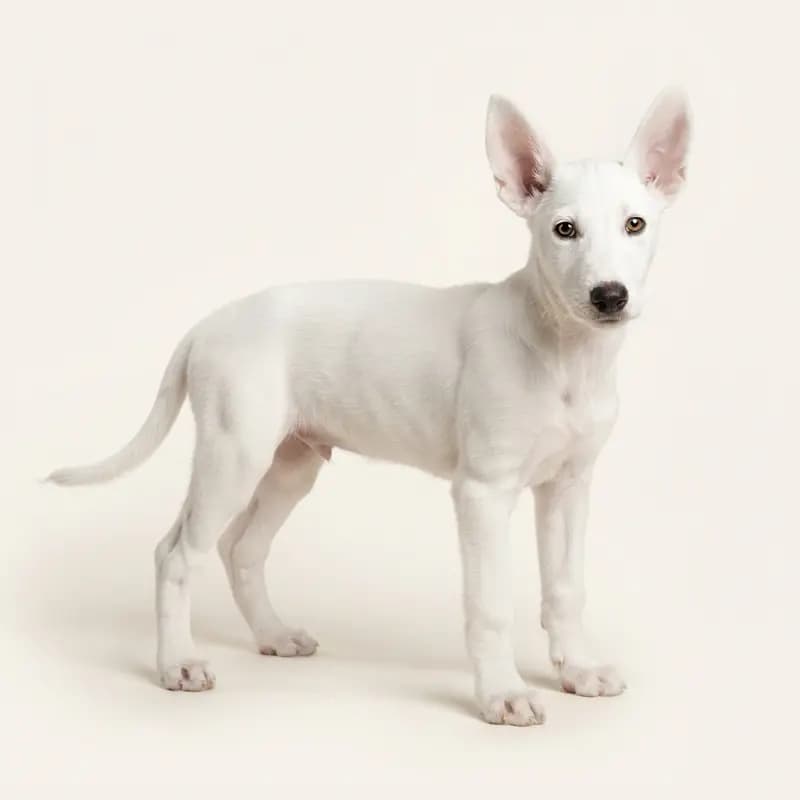
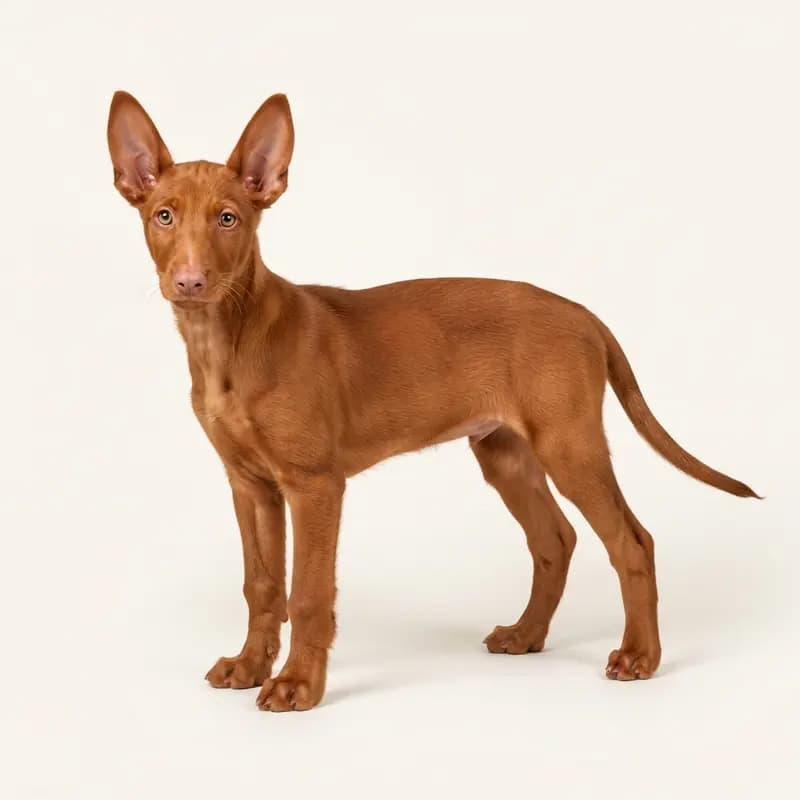
The Ibizan Hound comes in these colors: White, Red, Red and white, Fawn.
Showcase your kennel on HonestDog and reach families searching for a responsibly bred Ibizan Hound.