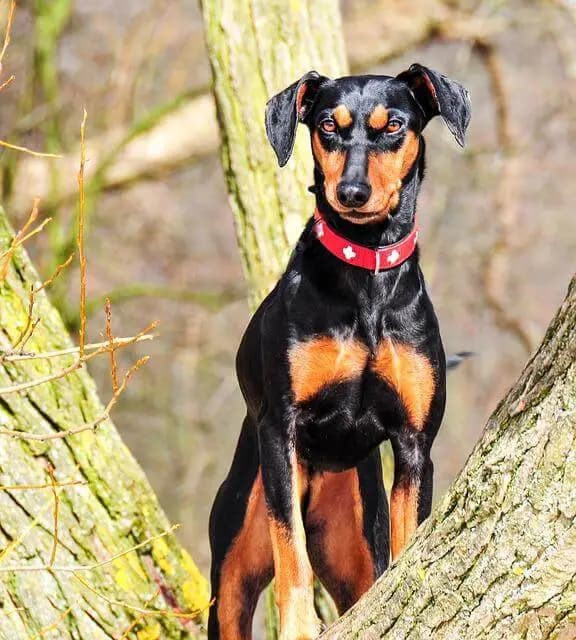
Although the German Pinscher is regarded as an athletic and robust dog, there are breed-typical health issues affecting the hips, eyes, heart and blood clotting. The breed’s recommended health standard includes screening for hip dysplasia (HD); the breed club responsible, the Pinscher-Schnauzer-Klub 1895 e.V. (PSK), makes breeding approval conditional on an examination for eye abnormalities as well as DNA tests for the D locus (colour dilution), degenerative myelopathy (DM) and glycogen storage disease type Ia (GSD Ia). The D locus test shows whether a breeding dog carries the dilute gene, which produces dilute colours such as blue or isabella that do not conform to the breed standard; carriers may only be mated with clear partners – as with DM and GSD Ia.
In addition, von Willebrand disease type I (vWD1) – an inherited blood clotting disorder – and congenital heart defects play a role in the breed. For vWD1, responsible breeders use specific genetic tests, while the risk of heart problems and HD is reduced through clinical heart examinations and X-rays of the parents. For you as an owner, this means: in the first year of life, be strict about joint-friendly rearing (no early sprints alongside a bicycle, no climbing stairs), plan regular check-ups for the heart and eyes, and always tell your vet about the breed-specific blood clotting issue before any possible operations.
Your checklist for the first conversation with the breeder
When buying a puppy, don’t rely on mere promises; check the facts on site. A transparent breeder will show you all the documents without being asked:
- X-ray and eye results: Ask to see the official hip dysplasia (HD) evaluations and the current clinical eye examination certificates for both parents.
- Genetic tests for D locus, DM, GSD Ia and vWD1: Ask for the written laboratory results for the D locus (colour dilution), degenerative myelopathy, glycogen storage disease type Ia and von Willebrand disease type I, so you can understand the parents’ status.
- Heart screening and line check: Ask specifically about the results of the parents’ heart examinations and openly enquire whether congenital heart defects are known in the breeding line.
- The dam’s temperament: Observe the bitch on site. She should seem open, alert and confident – never panicky, apathetic or uncontrollably aggressive.
- No cropping, docking or incorrect colours: Never buy dogs with cropped ears or docked tails (prohibited in Germany under § 6 TierSchG) or puppies advertised as “blue” Pinschers – according to the FCI standard, blue is not a permitted colour for the German Pinscher.
On HonestDog, a breeder profile only goes online once the breeder has completed registration: identity verification by ID and selfie, proof of club membership or a §11 permit where applicable, a knowledge test on breeding and animal welfare, and agreement to the HonestDog breeding standards, which among other things rule out breeding from dogs with extreme-breeding traits. You can see any health test results for the parents that breeders upload directly in the breeder’s profile – no, see them right in the profile: ask to see the original results when you visit. Your next step: compare the profiles of the German Pinscher breeders on HonestDog, look at the uploaded health records and ask directly about the next litter.