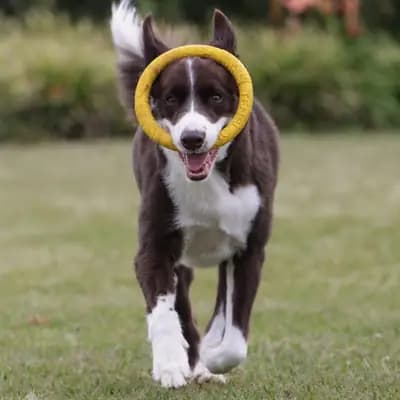








Congratulations! You've chosen one of the most popular, friendly and versatile dogs in the world. The Labrador Retriever is a fantastic companion, winning hearts with its sunny nature and loyalty. But even though this breed is known for its good nature, a dog weighing up to 36 kilograms won't train itself. Solid, loving Labrador Retriever training is the key to turning a clumsy puppy into a reliable partner who fits into everyday life.
This comprehensive guide shows you, step by step, how to train your Labrador: what makes this breed so special, how to set the right course from day one and how to give your dog mental exercise too. If you'd like to refresh your knowledge of the basic breed data and traits first, take a look at our detailed Labrador Retriever breed profile.
Labrador Retriever Training: Why This Dog Is the Perfect Student
When we talk about how trainable the Labrador is, we quickly land on a flat 5 out of 5 on the scale. But why is that? The Labrador Retriever belongs to the FCI group of retrievers, flushing dogs and water dogs. It was originally bred to work closely with people and bring back shot game (often from the water). That history has written the famous "will to please" into its DNA.
A Labrador is highly motivated, sensitive to your moods and, thanks to its friendly, active temperament, extremely eager to learn. That said, "easy to train" doesn't mean it forgives every mistake. Because of its sensitivity, the Labrador responds extremely well to positive reinforcement and praise, but quickly shuts down when faced with harshness or unfairness.
Working Bloodline vs. Show Bloodline: Know Your Dog
Before we dive deep into Labrador Retriever training, you need to know which type of Labrador you have. Over the years, breeding has developed in two directions:
- The working bloodline (field trial line): These dogs are often a little slimmer and lighter, with a very high energy level. They demand a job to do and need plenty of mental exercise as well as physical (for example through dummy training or tracking).
- The show bloodline (standard line): These dogs are usually sturdier and more heavily built, with the typical broad head. Their energy level is somewhat more moderate, which makes them excellent companion and family dogs. Even so, they're full-fledged retrievers who enjoy exercise and brain work.
No matter which bloodline your dog comes from, loving consistency is essential. You can find more information on breed standards and breeding lines at the VDH (Verband für das Deutsche Hundewesen).
Labrador Retriever Puppy Training: Laying the Foundation in the First 16 Weeks
The first weeks and months of life are decisive for a dog's later years. During the so-called imprinting and socialization phase, your puppy learns how the world works. That's why Labrador Retriever puppy training should begin on the day your puppy moves in, gently but with structure.
House Training: Out, Out, Out!
Labrador puppies usually learn fairly quickly where to do their business. The key lies in your time management and powers of observation. Take your puppy outside after every nap, after every meal, after a good play session and otherwise every two to three hours. Praise him enthusiastically in a calm, happy voice when he goes outside. Never scold when an accident happens indoors. Wiping it up without comment is perfectly enough.
Bite Inhibition: Shaping a "Soft Mouth"
As a retrieving dog, the Labrador experiences its surroundings largely through its mouth. In the first weeks, your puppy will try to bite your hands, feet and trouser legs. That's not aggression, it's play behavior. Teaching him bite inhibition is your job:
- If the puppy gets too wild during play and bites too hard, say "Ouch!" loudly and clearly and pause the game for a few seconds.
- Instead, immediately offer him an alternative he's allowed to bite (a chew rope, a plush toy or a dummy).
- Reward him when he takes the toy and leaves your hands alone.
Socialization: Discovering the World
A Labrador is considered extremely family-friendly (5/5) and child-friendly (5/5). Compatibility with other dogs is outstanding too (5/5). To keep it that way, your puppy needs to get to know different stimuli at his own pace. Show him buses, trains, different surfaces, umbrellas and all kinds of people (children, people in wheelchairs, people wearing hats). Make sure he doesn't get overwhelmed. Short, positive experiences are worth far more than hours-long outings.
The Most Important Labrador Retriever Commands for Everyday Life
Once the basics of puppy training are in place, it's time for the classic Labrador Retriever commands. Thanks to his love of food (more on that later), you have an unbeatable advantage with a Labrador: almost every Lab will do just about anything for a treat.
A Reliable Recall ("Here" or "Come")
This is by far the most important command. A Labrador with a dependable recall enjoys maximum freedom. Build the recall by crouching down in a low-distraction environment (living room, garden), calling cheerfully and giving your dog an absolute premium reward (cheese, sausage) the moment he reaches you. Increase the distractions slowly. Run away from your dog now and then, too, because it awakens his instinct to follow. Never call if you're not sure he'll come, so you don't "ruin" the command.
Loose-Leash Walking: From Puller to Relaxed Companion
A fully grown male Labrador reaches a shoulder height of up to 57 cm and a weight of up to 36 kg. When this bundle of muscle pulls on the leash, the walk turns into torture. So start training early. The rule is simple but hard to stick to: when the leash is tight, you don't move a single millimeter forward. Stop immediately and stand like a tree. Only when the leash goes slack again (because your dog turns around to you or steps back) does the walk continue. Reward him regularly when he walks level with your leg on a loose leash.
Sit, Down and Stay
These basic positions are easy to teach a Labrador using so-called "luring" with a treat.
- Sit: Slowly move a treat over your dog's nose and back toward his ears. His head goes up, and his hindquarters go down automatically. As soon as his bottom touches the floor, say "sit" and reward.
- Down: From the "sit," slowly lead the treat down to the floor between your dog's front paws and pull it slightly away from him. If he follows your hand and lies down, say "down" and reward.
- Stay: This one is all about impulse control. Your dog sits, you say "stay" and take just one single step back. If you go back to him and he's still sitting, reward him. Distance and duration are increased in tiny steps over weeks.
Breed-Specific Challenges in Labrador Retriever Training
No dog breed is perfect, and the Lab is no exception. Its outstanding positive qualities also come with a few pitfalls you need to keep in mind during training.
The Vacuum Cleaner Effect: Anti-Poison-Bait Training
Labradors have a reputation for wanting to eat absolutely everything, from discarded fries to horse manure. That's not just gross, it's life-threatening when it comes to poisoned bait. Structured anti-poison-bait training is an absolute must for a Labrador. Teach him "drop it" (for things he already has in his mouth) and "leave it" or "no" (for things he shouldn't pick up in the first place). Train a trade: "If you show me what you found on the ground without eating it, I'll give you something much better." You can find detailed information on the dangers of poisoning in dogs from the Bundestierärztekammer (German Federal Veterinary Chamber).
The Exuberant Greeting: Breaking the Jumping-Up Habit
Labradors love people. And they like to show that love with their whole body. What's still cute in an 8-week-old puppy can easily knock over children or older people when it's a 35-kilo male. From the start, teach your dog that he only gets attention (petting, eye contact, talking to him) when all four paws are on the floor. If he jumps up at you, turn away without comment and ignore him. As soon as he sits: praise him calmly and pet him.
Advanced Training: How to Properly Exercise Your Lab
A Labrador has a medium to high energy level (3/5). Just running alongside a bike or walking the same loop around the park three times a day won't do justice to these intelligent dogs in the long run. They need jobs to be happy. A dog that gets enough exercise is a balanced, contented dog.
Retrieving and Dummy Work
This is where the Labrador's heart beats faster. Dummy work is the perfect outlet for his natural instincts. It involves training your dog to retrieve fabric dummies at various levels of difficulty. The dog learns to take directions (handling), to remember where a dummy fell (marking) and to use his nose to find a hidden dummy (the hunt). This work strengthens the bond between you and your dog enormously and tires him out mentally as well as physically. If you'd like to get deeper into this sport, the Deutscher Retriever Club e.V. (DRC) offers excellent places to start and training groups.
Nose Work: Mantrailing and Target Object Search
Since Labradors have an excellent nose as flushing dogs, all forms of nose work are ideal for advanced training. In mantrailing, the dog searches for a hidden person using a scent article. In target object search, he learns to track down tiny items (like a coin or a lighter) and indicate them passively by lying down in front of them. 15 minutes of intensive nose work often tires your dog out better than an hour of monotonous walking.
Common Mistakes in Dog Training
Even though the Labrador forgives a lot, there are some mistakes you should definitely avoid:
- Inconsistency: The dog's allowed on the sofa today but not tomorrow? That confuses the sensitive Labrador. Set rules and stick to them strictly together with all family members.
- Too much exercise in the first year: Labradors are prone to joint problems such as HD (hip dysplasia) and ED (elbow dysplasia). Don't overdo it with your puppy. The rule of thumb is 5 minutes of walking per month of age at a stretch (so for a 4-month-old puppy, a maximum of 20 minutes at a time). Avoid frequent stair climbing and sudden stops (such as those caused by excessive ball throwing).
- Overfeeding during training: Labradors are strongly prone to being overweight. If you train with lots of treats, be sure to deduct that amount from the regular daily food ration. Excess weight massively damages joints that are already under strain.
Frequently Asked Questions
When should I start Labrador Retriever training?
Training begins on the day your puppy moves in with you (usually in the 8th to 10th week of life). Of course, at that age you don't start with hard drilling, but playfully with bonding, his name, house training and the first house rules. Short, positive training sessions of 2 to 3 minutes are perfectly enough to begin with.
Is a Labrador easy to train?
Yes, compared with many other breeds, the Labrador is considered very easy to train ("will to please," trainability 5/5). He's smart, cooperative and enjoys working with people. However, his strength, his weight and his sometimes boisterous temperament call for consistent leadership so he stays manageable in everyday life.
Why does my Labrador eat everything he finds outside?
Labradors are often extremely food-driven for genetic reasons. On the one hand, that makes training with food rewards very easy. On the other, it leads to the notorious "vacuum cleaner behavior" on walks. To protect him and his health, you should establish strict trade and anti-poison-bait training from an early age and teach him that he may only take food from the ground on your explicit release signal.
How long does it take for a Labrador to be house-trained?
That depends heavily on your consistency and attentiveness. Most Labrador puppies understand the principle after a few weeks. With good management (going out regularly, praising outside), many dogs are reliably house-trained at around 4 to 5 months. Setbacks at this age are completely normal, though, and no cause for concern.
Conclusion: Patience and Love Make a Dream Dog
Successful Labrador Retriever training rests on three essential pillars: consistency, positive reinforcement and exercise suited to his nature. Once you understand that your Labrador is a working dog at heart, one who wants to solve tasks and needs your guidance, the two of you will grow into an unbeatable team. Make use of his "will to please," be fair to him and look after his physical health, and nothing stands in the way of a happy life together.
We at HonestDog.de know how challenging, but also how wonderful, life with a dog can be. As a platform for everything to do with dogs, we're at your side with expert knowledge, breed info and training tips. Want to learn more about this breed, dive deeper into genetics or check whether your daily life suits a Lab? Then visit our comprehensive Labrador Retriever breed profile and find out whether the Labrador is the right family dog for you.