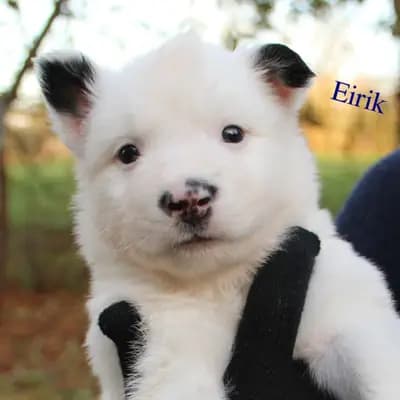
Because it has been selected for working performance, the East Siberian Laika is considered a very primitive dog with an impressive life expectancy of 10 to 15 years. Even so, breed-specific problems occasionally occur in the joints and, above all, the eyes. The Deutscher Club für Nordische Hunde e.V. (DCNH) therefore prescribes strict examinations for breeding approval.
As far as the joints are concerned, the focus is on hip dysplasia (HD), which is assessed by X-raying the parent dogs. Particular attention is paid to eye health: reputable breeders have their breeding dogs thoroughly examined by a veterinary ophthalmologist before they are used for breeding. This clinical eye test checks for a broad range of possible conditions. These include eyelid abnormalities such as ectropion, entropion and distichiasis, diseases of the lens and cornea such as cataract, corneal dystrophy and lens luxation, and changes in the interior of the eye and the optic nerve. Specifically, the examination checks for primary open-angle glaucoma, pectinate ligament dysplasia, optic nerve hypoplasia and micropapilla, persistent pupillary membranes (PPM), PHTVL/PHPV, retinal dysplasia and the generalised form of progressive retinal atrophy (PRA). Clinical examinations and X-ray results like these significantly reduce the risk for the offspring.
In addition, responsible breeders use established DNA tests for primary lens luxation (PLL) and degenerative myelopathy (DM), a spinal cord disease that appears in older age. A genetic test shows whether a parent dog is clear, a carrier or affected. If carriers are deliberately mated only with clear partners, no puppy inherits the tested mutation from both parents, which greatly reduces the risk of these specific diseases. You can also support your puppy in its first year of life with joint-friendly rearing that avoids overexertion, and plan regular eye checks with a specialist vet in adulthood too.