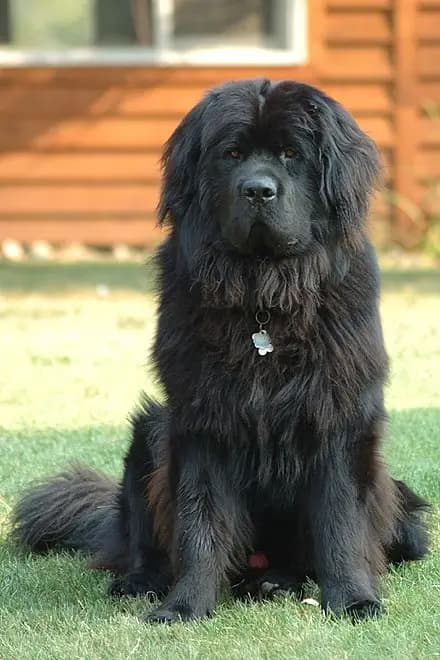
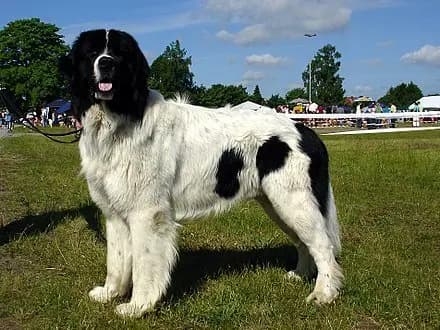
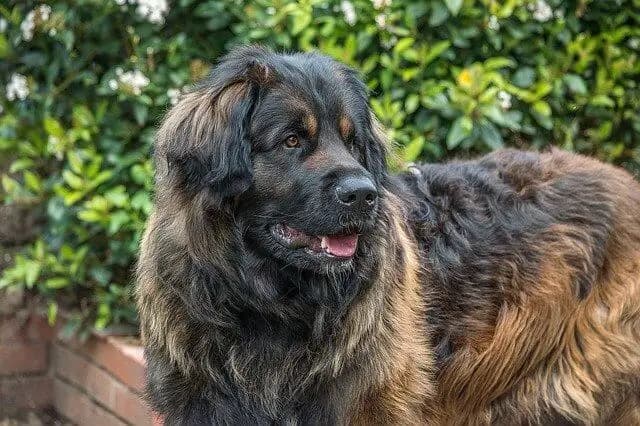
With his unshakeable patience, the Newfoundland is a dream dog for families with children (5/5 points) and is also extremely sociable with other dogs and animals. His energy level is moderate (3/5), but he loves long, leisurely walks – and hardly ever passes up a puddle or a lake. He is hardly suited to life in a city flat (suitability for city life: 2/5): you cannot carry a 70-kilo male up the stairs when he is older or has joint problems. A house with level access and a garden is the right choice here.
Do not underestimate the grooming requirements (4/5) either: the thick, water-repellent coat with its extremely dense undercoat must be brushed regularly and thoroughly, otherwise it will mat right down to the skin. After every walk in the rain, the Newfoundland brings plenty of dirt and damp into the house. When it comes to training (trainability: 3/5), you will not find a dog that blindly follows orders, but an independent working dog that needs loving, yet patient and consistent leadership.
Your checklist for the first conversation with the breeder
- View the X-ray results: Ask to be shown the official evaluations for hip dysplasia (HD) and elbow dysplasia (ED), as well as proof that both parent dogs’ knees have been checked.
- Check the heart examination: Request the parents’ latest heart ultrasound results (focusing on aortic stenosis, DCM and tricuspid valve dysplasia).
- Clarify the cystinuria status: Ask to see the result of the DNA test for cystinuria, to make sure that at least one parent dog is genetically clear.
- Look at the eyes and eyelids: Take a close look at the dam – are her eyes clear, and do the eyelids sit snugly, without drooping markedly (ectropion) or rolling inwards (entropion)?
- Look into the line history: Ask the breeder directly whether there are any known cases of cataracts, cherry eye, urinary stones or skin diseases such as pemphigus in the lines.
- Take a growth and feeding plan with you: An experienced Newfoundland breeder will give you precise feeding instructions so that your puppy grows slowly and in a way that is gentle on the joints.
On HonestDog, a breeder profile only goes online once the breeder has completed registration: identity verification by ID and selfie, where applicable proof of club membership or a §11 permit, a knowledge test on breeding and animal welfare, and agreement to the HonestDog breeding standards, which among other things rule out breeding with traits associated with extreme conformation. Health test results for the parent dogs that breeders upload appear directly in the profile; ask to see the original results when you visit. Your next step: compare the profiles of Newfoundland breeders on HonestDog, look at the uploaded health records and ask directly about the next litter.