Loading breed

Weimaraner
Health grade B- Shoulder height57–70 cm
- Weight25–40 kg
- Life expectancy10–12 yrs
- Puppy price1,800–2,650 €
- Energy5/5
The essentials at a glance
The Weimaraner is a highly intelligent, elegant working machine—an uncompromising Vorstehhund (pointing dog) bred for field, water, and a distinct sharpness. Its aristocratic appearance unfortunately often leads people to underestimate its serious hunting and guarding instincts.
- Health grade B: In the Weimaraner, there are breed-typical risks for hip dysplasia (HD), cataracts, and hypothyroidism.
- You are looking for a true working partner for hunting or demanding tracking work—this Vorstehhund needs a job, not just a fun activity program.
- You are extremely confident, calm, and consistent in your leadership, as it will immediately test weaknesses and take control itself otherwise.
- You primarily admire its noble looks and are actually looking for an uncomplicated companion for city life or everyday routines.
How the health grade is calculated
Sources for required breeding screenings. Weimaraner Klub e.V.
Self-check
Would the Weimaraner really fit your life?
Answer 6 quick questions about your everyday life and see how well the Weimaraner fits you — including an honest cost estimate per month, per year, and across the dog's lifetime.
Fit checkCost estimateRisk dice
Takes about 1 minute · free & anonymous
Similar Breeds

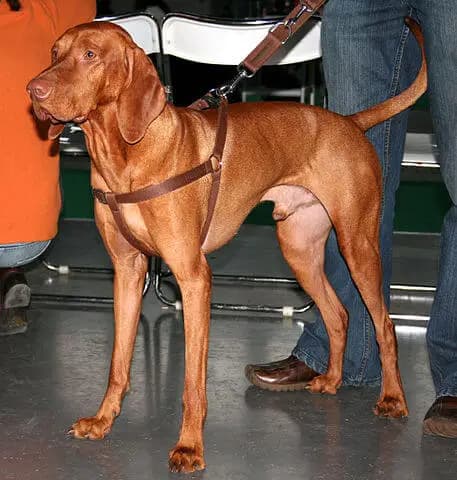
Hungarian VizslaSame FCI section

German Shorthaired PointerSame FCI section

German Wirehaired PointerSame FCI section

Rhodesian RidgebackSimilar profile

English PointerSame FCI group
Is the Weimaraner right for you?
At a glance
Weimaraner overview
The essentials — key facts, traits, and health priorities — before you dive deeper.
Lifespan
10–12 yrs
Shoulder height
57–70 cm
Weight
25–40 kg
Practical
- Puppy price: 1,800 – 2,650 €
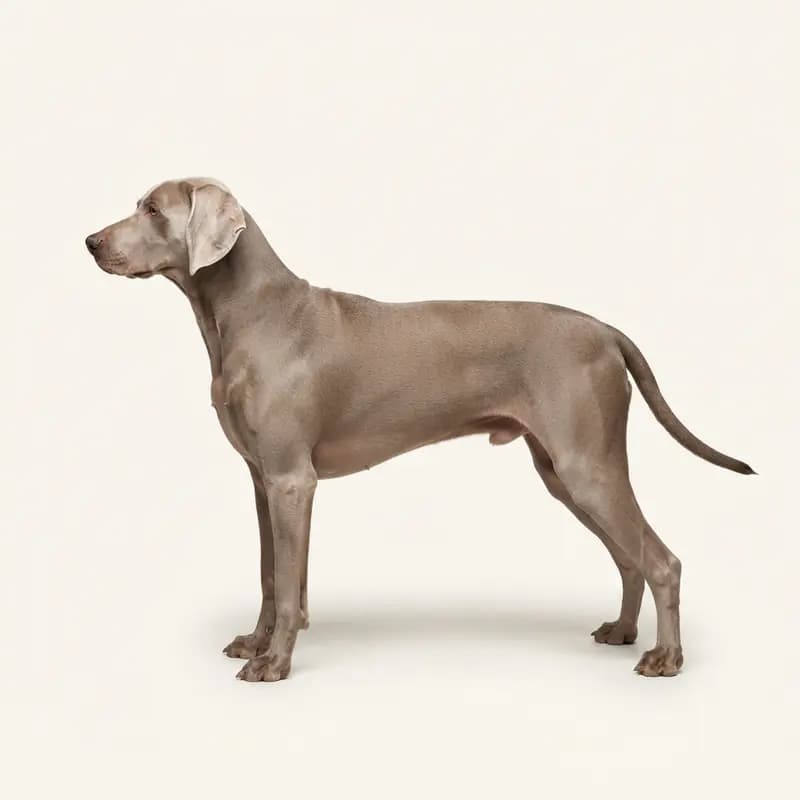
- Coat: Short, dense, without undercoat
- Origin: Germany
Temperament
Energy
Trainability
Family fit
With kids
Daily life
Care effort
Shedding
Barking
City-friendly
Guard instinct
What matters most
Especially with a Weimaraner, choosing the right breeder is the single most important decision you'll make. Serious breeders consistently test the parents for inherited conditions, prioritize healthy early socialization, and stay accountable long after handover. A cheap puppy without health screening tends to become the most expensive dog later on.
See HonestDog breeder standards →Colors & coat
What colors does the Weimaraner come in?
The coat colors that occur in the Weimaraner — including which ones fall outside the breed standard and which carry genetic risk.

Eye colors
 Amber
 Blue
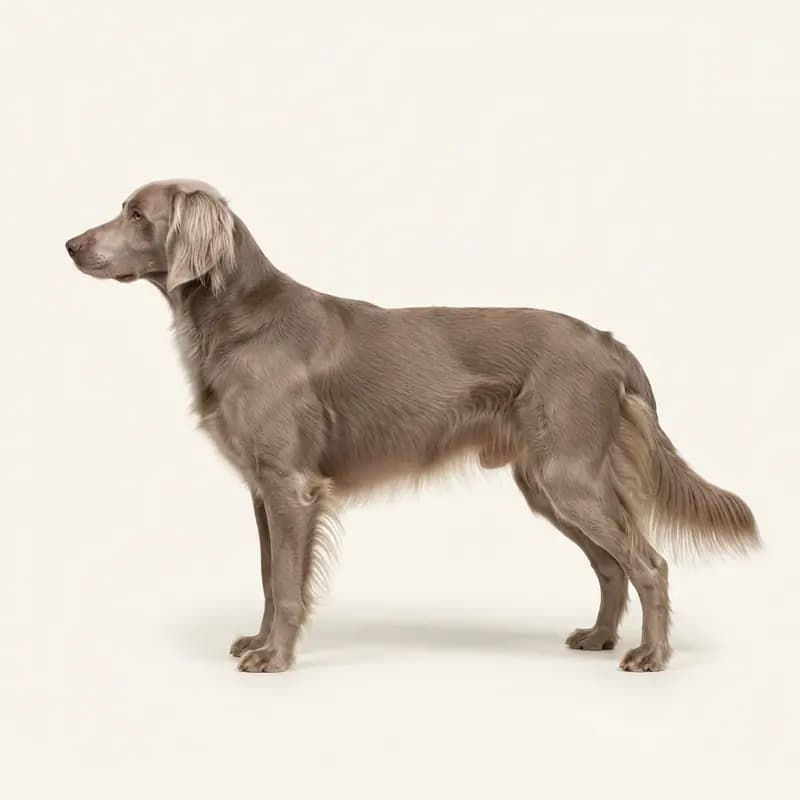
Coat type
 Illustrative image
Short
 Illustrative image
Long
Perfect for you if:
- You spend a lot of time actively in nature every day and have the physical strength to hold a powerful dog when it spots game.
- You live in a rural area with a securely fenced property and appreciate a dog that takes guarding its home and territory seriously.
Less ideal if:
- You expect it to remain easily recallable when it sees fleeing game—it was bred to track down prey and, if necessary, take it down.
- You often have unannounced visitors or a lot of hustle and bustle in the house, as its innate sharpness makes it instinctively suspicious of strangers.
The real vibes check
A Weimaraner is not a silver accessory, but a highly bred elite athlete in a tailored suit. If you don't give it a real job, it will find one for itself—and that usually means uncompromisingly controlling your home or hunting in the woods. You will gain an absolutely loyal shadow who would walk through fire for you, as long as you prove to it every day that you are firmly in control.
Breed Profile
The Weimaraner, also known as the Weimaraner Pointer, is a dog of impressive elegance and breathtaking beauty. Its proud posture, short, shiny coat in various shades of gray and distinctive, bright eyes make it a distinctive representative among dog breeds. His muscular build shows his strength and energy and suggests his excellent abilities as a working dog. The Weimaraner belongs to FCI Group 7, the pointer dogs. A distinction is made between performance and show lines in the Weimaraner. Performance lines tend to be slightly lighter and more agile, and often have a more intense work ethic. Show lines can be slightly heavier and more robust and place more emphasis on appearance according to the breed standard.
All measurements in detail
- Height
- 57 - 65 cm (Female), 59 - 70 cm (Male)
- Weight
- 25 - 35 kg (Female), 30 - 40 kg (Male)
- Life Expectancy
- 10 - 12 yrs
- Character
- Intelligent, Energetic, Affectionate
- Coat
- Short, dense, without undercoat
- Coat Color
- Mouse gray, silver gray, deer gray
- Price
- 1800 - 2650 €
Character & Temperament
The Weimaraner is a dog with a distinctive character and high intelligence. Its original use as a versatile hunting dog can still be seen in its temperament and behavior today. He is highly energetic, persistent and has a strong hunting instinct. When bringing a Weimaraner into your home, you should be prepared to provide him with plenty of exercise and mental stimulation. A Weimaraner's temperament can be described as active to hyperactive. His energy and intelligence must be channeled through appropriate activities, otherwise he may become bored and develop undesirable behaviors. Sports activities such as running, swimming and playing fetch are ideal for this dog. The Weimaraner is known for being particularly people-oriented. He is strongly attached to his family and always wants to be near them. Sometimes this breed is even called a "shadow dog" because they literally follow their owners wherever they go. This makes them wonderful companions, but it can also cause separation anxiety when left alone. Therefore, it is important to teach them that it is okay to be alone for short periods of time. Weimaraners are also very playful and love spending time outdoors. Their intelligence makes them easy to train, but they require consistent training. It is important to note that the performance line has a more intense work ethic, so owners who choose a performance line may want to allow more time for training and employment. One thing to keep in mind if you're thinking about getting a Weimaraner is their hunting instincts. This dog was originally bred as a hunting dog and therefore has a natural drive to hunt. That's why it's important to ensure good recall right from the start and to always keep an eye on it, especially when around wild animals.
| Watchfulness Occasionally alerts but is fundamentally open. | Low |
| Openness to Strangers Neither pushily friendly nor suspicious. | Neutral |
| Hunting or Herding Drive This drive runs deep — no amount of training eliminates it. | Very strong |
Fun Fact!
Did you know that the Weimaraner is sometimes referred to as the "ghost dog" due to its unusual gray coat color and its mesmerizing amber to blue-grey eyes? Its puppies are even born with blue eyes that only change color as they grow up.
What Awaits You
Weimaraners are hunting dogs and therefore have a high level of motivation to hunt. They also tend to defend their owner. Keeping them occupied and training them are demanding. Weimaraners are not suitable for beginners. They come in two coat types: long-haired and short-haired.
Housing & Care
Weimaraners aren't necessarily suited to city life unless you can ensure they get enough exercise and mental stimulation on a daily basis. She are best kept in a home with a large garden. Weimaraners are generally good with children, but due to their size and energy, it is advisable to leave them under supervision. They can also get along with other pets, including cats, if properly socialized.
- Family Friendly
Loves family life and thrives in a group.
Family-oriented - Child Friendly
Gets on well with children — with adult supervision.
With supervision - Dog Friendly
Usually gets on fine with other dogs.
Generally tolerant - City Friendly
Can manage in the city, but only with very active owners.
Difficult in cities
Owning a dog is a privilege, but it's also a real responsibility. Before you bring one into your life, be honest with yourself about the commitment it takes.
Training & Education
Weimaraners are intelligent dogs that like to be challenged mentally and physically. They are well suited to various dog sports such as agility, obedience and of course hunting. Because they tend to have strong hunting instincts, it is important to provide alternatives that meet their mental and physical needs without encouraging undesirable behavior. It's also important to teach them frustration tolerance and impulse control to prevent them from becoming "ball junkies" or becoming overly obsessed with certain activities. Consistent and positive training is important, and it is advisable to start training at an early age. Note that Weimaraners can be stubborn at times, so patience and consistency are important. The training should be varied and challenging to challenge them mentally.
Nutrition & Care
A balanced diet is essential for the Weimaraner. Due to their high energy and active lifestyle, they require a nutrient-dense diet that provides them with sufficient protein and fat. It is recommended to use high-quality food and seek the advice of a veterinarian regarding your dog's specific nutritional needs. In terms of grooming, the Weimaraner has short, dense fur with no undercoat. This means that it is not well suited to extremely cold climates, but it usually does well in the temperate climate of Germany. He sheds moderately, but regular brushing will help remove loose hair and keep the coat clean.
| Care Level Minimal effort — occasional brushing and bathing. | Low-maintenance |
| Exercise Needs Working-dog energy that needs burning off every single day. | High-drive |
| Shedding Hair everywhere, always — no white clothing survives. | Very heavy |
| Trainability Bred to work closely alongside humans. | Highly trainable |
Our experts are still reviewing this information. Spotted something wrong? Email us at info@honestdog.de.
Health & hereditary diseases
Health
B
Solid
Health grade
In the Weimaraner, there are breed-typical risks for hip dysplasia (HD), cataracts, and hypothyroidism. For breeding approval, the Weimaraner Klub e.V. mandatorily requires X-ray examinations for hip dysplasia (HD) with a threshold of HD A–B, an ophthalmological eye examination, and a clear result for cataracts. A health-oriented breeder additionally tests the parent animals for hypothyroidism as well as elbow dysplasia (ED) and breed-specific hereditary conditions such as Weimaraner immunodeficiency syndrome (WIS). When buying a puppy, make sure to ask to see complete documentation of the HD A–B results, the current eye examination, and evidence of normal thyroid values.
Grade is relative to other breeds — AI-assisted and editorially reviewed.
Methodology and data: HonestDog Dog Breed Health Report 2026
What matters most for this breed
Tap any item to see details.
In daily life this can mean
By ensuring joint-friendly development and strict rest periods after meals to prevent gastric torsion, you lay the foundation for a long, active life for your dog.
The breeder's role
Responsible breeders meet the requirements of the Weimaraner Klub e.V. regarding hip dysplasia (HD), cataracts, and eye testing, and additionally test for hypothyroidism.
Note: This health overview is AI-assisted and editorially reviewed. It is for orientation only and does not replace veterinary advice.
Health risks for this breed
What matters most for this breed — what's common, how much it affects the dog's life, and how to protect yourself as a buyer.
18
Risks tracked
4
Core standard
12
High severity
General / metabolic
Most affected area
Where this breed is vulnerable
Tap a body region to see the inherited conditions linked to it.
The three most important risks
Pick a region on the map to explore other areas.
severemoderatemild
How thoroughly does the breeder test?
Tier 1 is the core standard: the tests Weimaraner Klub e.V. requires, plus further tests from the recommended health standard for this breed. Tiers 2 and 3 show how responsible breeders go beyond.
Core standard. Tests marked “Club standard” are required by Weimaraner Klub e.V. for breeding approval; the others are part of the recommended health standard for this breed. Ask any reputable breeder for the results.
Other breeding-approval requirements
Not health tests, but required for breeding: the club asks for these results too. They don't count toward the risks or the rating.
DNA-Identitätsnachweis
Required by Weimaraner Klub e.V.
Acceptable result: mind. 5 ml EDTA Blut abgegeben
Note: This health overview is AI-assisted and editorially reviewed. It is for orientation only and does not replace veterinary advice.
Costs & where to find one
How much does a Weimaraner cost?
A Weimaraner costs around ~€190 per month (€100 – €370, depending on your setup). The first year adds up to roughly ~€5,360 including purchase, equipment and puppy school; across the dog's life (11 years) it comes to about ~€28,360.
With surgery cover, running costs come to about ~€190 per month — in return, your share of a major operation drops from several thousand euros to around 20 percent.
Per month
~€190
In the first year
~€5,360
Across the dog's life
~€28,360
Purchase price per HonestDog's market analysis (asking prices in Germany, as of October 2026): €1,800 – €2,650
Small sample: 8 unique listings in the rolling three-month window. Data for this breed · Methodology
Estimate at a mid-range setup (suburban, dry food, 1–2 hours of daily exercise), average German prices, as of July 2026.
Calculate your personal costs1-minute self-check with your own answers
Looking for a Weimaraner?
Appearance, variants & origin
Variants of this breed

 Illustrative imageIllustrative image
 Illustrative image
 Illustrative image
History
The full history
The Weimaraner has its roots in Germany, more specifically in the Thuringia region, where it is named after the city of Weimar. Its exact origins are unclear, but it was probably bred in the 19th century and was originally intended for the nobility. The Weimaraner was an all-rounder, used for browsing, pointing and retrieving. In 1897 the "Weimaraner Club" was founded, which established strict breeding rules to ensure the quality of the breed. The breed was not officially recognized until 1935. After World War II, Weimaraners were brought to the United States and Great Britain, where they quickly became very popular.
Original Use
The Weimaraner was bred as a hunting dog for pre- and post-shot work, particularly for hunting large game.
Origin
Germany
Date
1800
Owner experiences
Many owners describe the Weimaraner as an exceptionally affectionate, cuddly and loyal companion in everyday family life.Summarized from publicly shared owner experiences
Many owners describe the Weimaraner as an exceptionally affectionate, cuddly and loyal companion in everyday family life. Often called a "shadow dog," the breed rarely leaves its people's side at home and forms a very deep bond. Well-integrated dogs are usually very patient, gentle and playful with their own family members and children.
At the same time, owners' accounts repeatedly point out that this strong focus on its people has a downside: many Weimaraners find it very hard to be left alone. Without training in small steps from puppyhood on, they're prone to serious separation anxiety, which shows up as nonstop barking, whining or even destructive behavior at home.
Owners also stress that at home the Weimaraner is by no means an everybody's-friend kind of dog. Many have a strong territorial sense and announce visitors forcefully. With strangers, and especially in lively everyday situations like neighborhood kids roughhousing, constant attention and clear rules are needed so that the innate guarding instinct doesn't tip over into the dog correcting people on its own.
Sources:hundeforum.comheyholy.comdogforum.dereddit.comderhund.de
On training and keeping the dog busy, owners agree that the Weimaraner is not a dog that's content with walks alone.Summarized from publicly shared owner experiences
On training and keeping the dog busy, owners agree that the Weimaraner is not a dog that's content with walks alone. As a passionate pointing breed, it comes with a lot of drive to move and, above all, a strong desire to work. If it isn't used for hunting, experienced owners say it needs challenging substitute work such as tracking, dummy work or mantrailing to keep its head and nose busy.
Many owners run into an apparent contradiction when it comes to handling: on the one hand, the Weimaraner is considered highly intelligent and quick to learn, on the other very strong-willed and sensitive. Dog forums often stress that harshness or moodiness in training has no place with this breed, because otherwise it shuts down or responds with avoidance.
What's needed instead is calm, unshakable consistency combined with positive motivation. The strong hunting instinct also remains an ongoing training topic in daily life. Without solid anti-hunting and recall training, many owners find reliable off-leash time in woods and fields hard to imagine for years.
Sources:hundeforum.comheyholy.comderhund.deforum.wildundhund.de
A dominant topic among breed experts and hunters is how the protective drive and the breed's typical sharpness develop.Summarized from publicly shared owner experiences
A dominant topic among breed experts and hunters is how the protective drive and the breed's typical sharpness develop. Weimaraners often still seem playful and overly friendly until the end of their first year, and they mature late. Between the ages of 1.5 and 3 years, many owners notice that their dog suddenly starts going forward in certain situations, guarding resources or eyeing strangers warily.
According to reports on dog forums, anyone who underestimates this stage of development, or who chose the dog mainly for its looks, quickly reaches their limits. From the start, it takes a watchful eye to make sure the dog learns to hand responsibility over to its owner instead of sorting out situations at the front door or during encounters on its own.
As a robust working dog, the Weimaraner is generally considered weatherproof and agile health-wise, but owners point to the caution typical of large, deep-chested breeds: above all, the risk of bloat (gastric torsion) calls for set rest periods after meals. With the right firm handling and enough exercise and work, though, owners experience their Weimaraner as a proud, steady-nerved and unconditionally loyal partner.
Sources:hundeforum.comheyholy.comfrag-mutti.dejagdblog.blogspot.comforum.wildundhund.de
Paraphrased from real owner reports · translated from German
Community posts
FAQ & more
Is a Weimaraner the right dog for me?
The Weimaraner is an active dog that needs plenty of exercise and mental stimulation. Research the temperament, grooming needs, and space requirements before deciding.
How long does a Weimaraner live?
The average life expectancy of a Weimaraner is 10-12 years. With proper care and regular vet visits, your dog can live a long, healthy life.
How much grooming does a Weimaraner need?
Weimaraner grooming requirements include regular brushing, nail trimming, and dental care. HonestDog provides detailed grooming tips for every breed.
Is a Weimaraner good for families with children?
The Weimaraner can be a great family dog. Proper training and socialization are key. HonestDog provides family suitability information for every breed.
What colors does the Weimaraner come in?
The Weimaraner comes in these colors: Silver, Grey, Blue. Colors that fall outside the breed standard are marked as such on the breed page.
Guides & Articles about Weimaraner
Are you a Weimaraner breeder?
Showcase your kennel on HonestDog and reach families searching for a responsibly bred Weimaraner.