Ear Cropping and Tail Docking in Dogs: The Law and the Cost
Cropped ears and docked tails are not inherited – they are surgery on a dog born healthy, prohibited in principle in Germany, with consequences that can stay with the dog for life.
In short
Ear cropping and tail docking mean surgically cutting off part of a dog's ears or tail, usually for looks or tradition. Unlike extreme breeding (called Qualzucht in German law), nothing here is inherited: the dog is born healthy. Germany prohibits both in principle (Section 6, Animal Welfare Act); the only exceptions are a veterinary indication in the individual case and – narrowly, in practice only for the tail – working hunting dogs.
Natural or cropped?
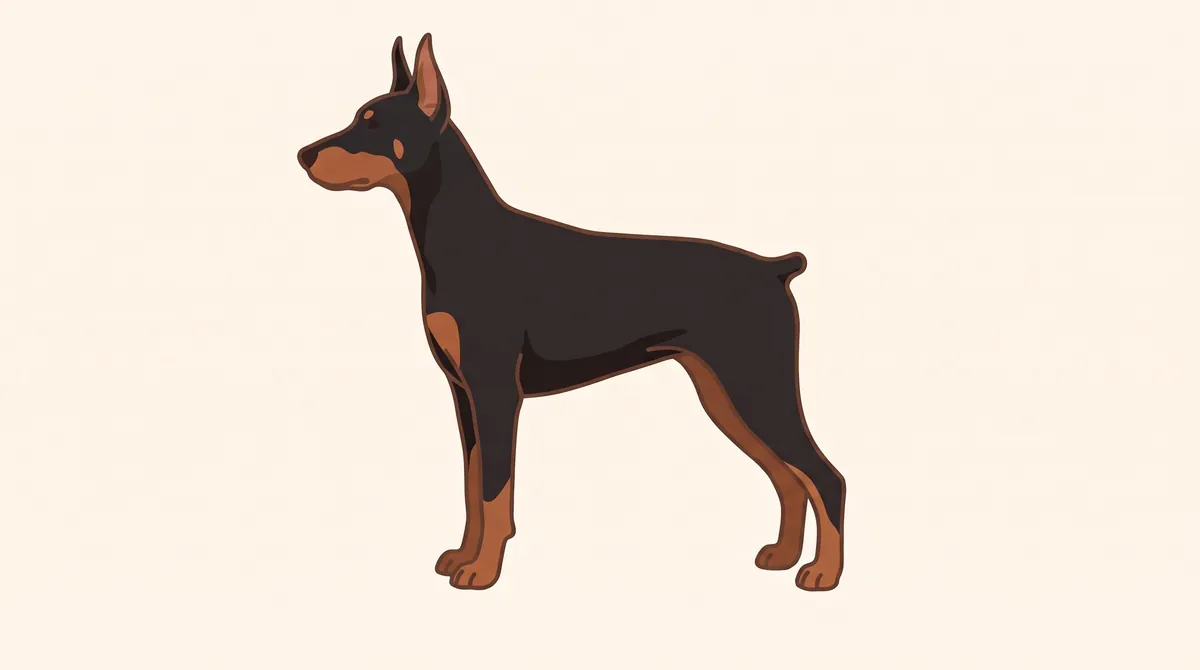
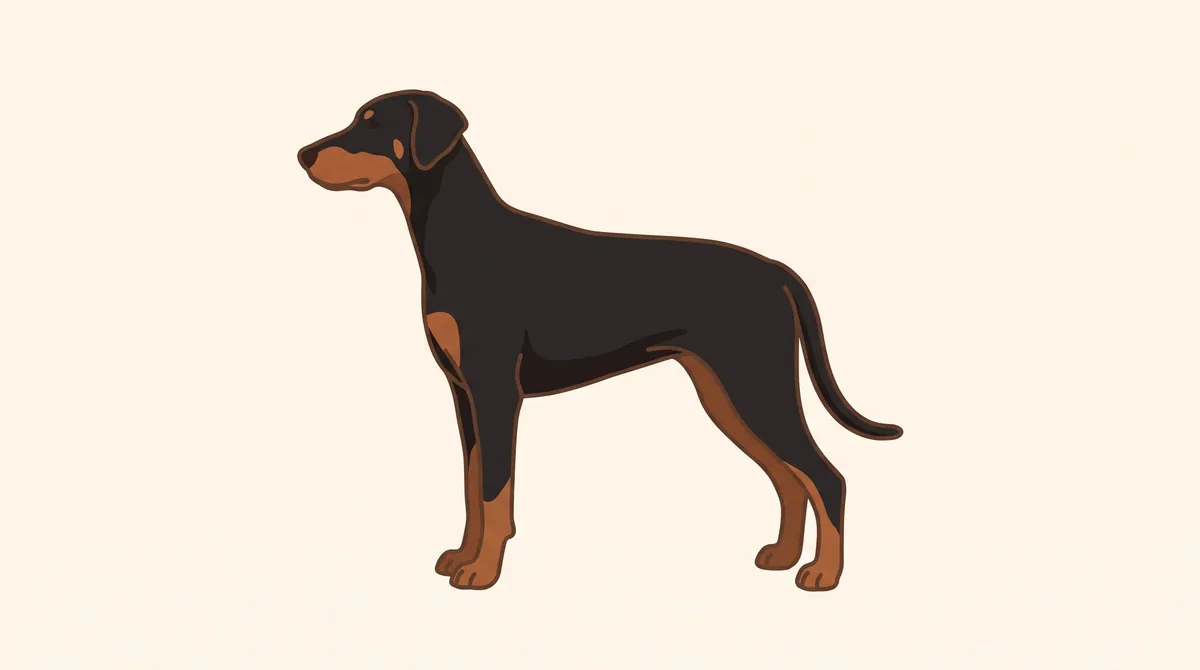
Look at the head and the rump: on the left the Dobermann has its natural, softly folded ears and a long tail; on the right the cropped ears stand up narrow and pointed, and only a short stump is left of the tail.
The illustrations are AI-generated and editorially reviewed. They do not show a real dog; they make the difference visible.
What are ear cropping and tail docking, in simple terms?
Cropping and docking mean cutting pieces off a dog's ears or tail. The dog is born with perfectly normal ears and a long tail – people then change it with an operation so it looks the way they want.
Imagine someone stopped you from smiling, frowning or shrugging. You would still be you, but other people would find it much harder to tell how you feel. That is roughly what it is like for a dog without a tail and with ears fixed upright: tail and ears are its face for feelings. They show whether it is happy, unsure, or would rather be left alone.
There is more: a tail has bones, muscles and nerves all the way to the tip. When it is cut off, the severed nerves can grow into a small tangle at the end, and that can hurt long afterwards.
None of this is inherited, so it is not the same as extreme breeding, where a dog is born with a harmful trait. In Germany it is prohibited in principle anyway, because it takes body parts from a healthy animal for no good reason. Our extreme-breeding overview explains the inherited traits.
What a dog uses its ears and tail for
- Talking to other dogs and to people – wagging, tucking, holding it high
- Pinning the ears back, pricking or turning them to show its mood
- Covering the anus and genitals with the tail
What do tail docking and ear cropping do inside the body?
Docking cuts through the tail's spine between two vertebrae, together with everything attached: bone, muscle, tendons, blood vessels, skin and the nerves that run to the tip. What is left is a stump of a few vertebrae closed over by skin; how long it is depends on the breed. It is often done in the first days of life; Denmark, for example, allows it for five pointing breeds only up to the fourth day.
The main problem is the nerves. According to the World Small Animal Veterinary Association (WSAVA), docking severs four nerves, which can form four potentially painful neuromas. An amputation neuroma is a tangle of nerve fibres sprouting in disorder at the cut end; in docked tails it has been described pathologically (Gross and Carr 1990). Animal-welfare scientist David Mellor states that a significant proportion of dogs docked as puppies will later experience persistent, significant chronic pain and heightened pain sensitivity.
How strongly a puppy a few days old consciously feels the procedure itself is contested. Mellor (2018) argues that puppies cannot consciously experience acute pain during at least their first week; WSAVA (2024) holds that newborns have similar, if not greater, pain sensitivity than adults. Both oppose docking without a medical reason; Mellor concludes that tail docking should be banned or restricted.
The second long-term effect is body language. Mellor concludes that the tail's role in communication has been greatly underestimated: docking can markedly impede clear signalling between dogs and between dogs and people – a handicap that stays, because the tail does not grow back.
Ear cropping cuts away a large part of the ear flap (pinna) so that the narrow remainder stands upright. The pinna is made of cartilage and skin; muscles at the base of the ear control how it is carried and moved. WSAVA stresses that even with anaesthesia and pain relief, pain after ear cropping or tail docking will occur, because bone, cartilage and skin take weeks to heal.
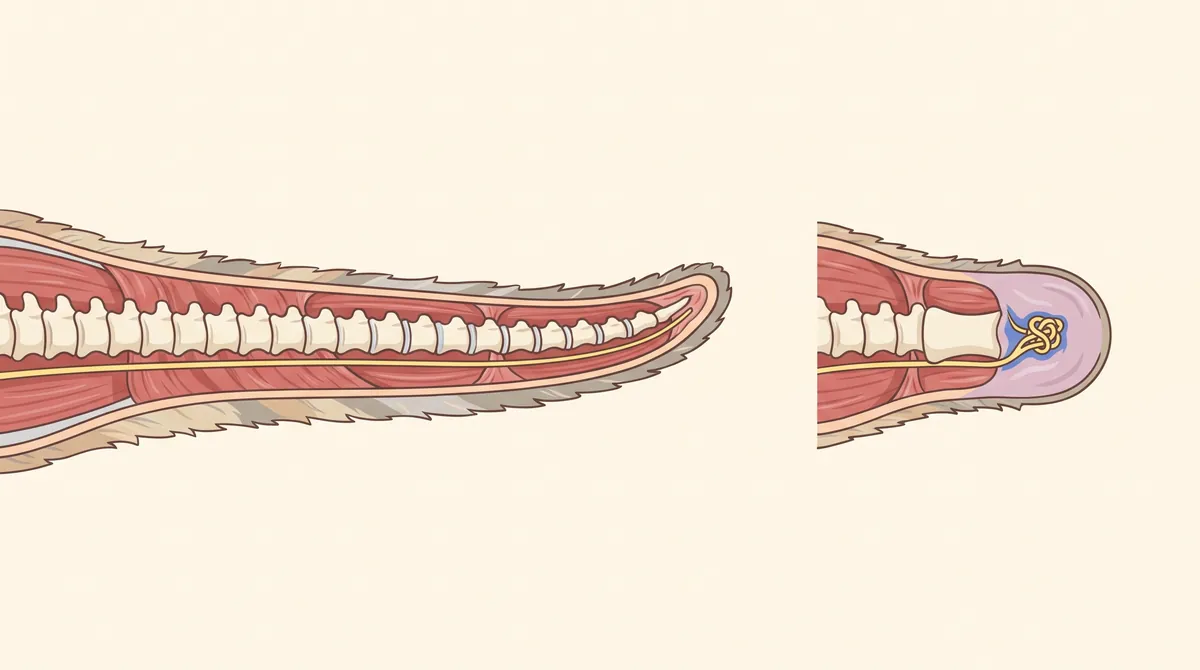 AI illustration
What the illustration shows
- 1Chain of tail vertebrae – Many small, jointed vertebrae make the natural tail mobile – the basis for wagging, holding it high and tucking it.
- 2Nerve to the tip – Nerves run through the whole tail to the very tip. The tail is not a lifeless appendage; it feels touch and pain.
- 3Tail muscles – Muscles along the vertebrae raise, lower and move the tail, producing the fine signals dogs use to show their mood.
- 4Remaining vertebrae – After docking only a few vertebrae remain – how many depends on the breed; in the Dobermann type it is about two or three. With the rest of the tail go its muscles – and a large part of the dog's body language.
- 5Neuroma at the stump – The severed nerves can grow into a tangle at the cut end. Such an amputation neuroma can cause lasting pain or make the stump hypersensitive.
Which breeds are affected?
None of these breeds needs cropped ears or a docked tail – the FCI standards of their countries of origin now describe the ears and tail of the Dobermann, Cane Corso, Boxer, Rottweiler and Giant Schnauzer in their natural state. Cropping and docking persist as tradition, for example in the USA, where they are not prohibited; for some hunting breeds the standard describes a docked tail only where the law allows it.
Traditionally cropped or docked
- Dobermann
The FCI standard (2015) calls for natural ears and a natural tail; the US (AKC) standard, by contrast, still describes cropped ears and a docked tail.
- Cane Corso
The FCI standard (2023) says the ears are uncropped and the tail natural; the AKC standard still allows both to be altered.
- Boxer
The FCI standard (2008) calls for natural ears and a tail of normal length left natural.
- Rottweiler
Traditionally the tail was the part docked; the FCI standard (2018) describes it in its natural condition, with pendant ears.
- Giant Schnauzer
The FCI standard (2021) describes drop ears and a natural tail; the US standard still expects a docked tail.
- American Bully
Not an FCI breed, so there is no FCI standard; in some countries cropped ears are part of the look people want. In Germany the same cropping ban applies as for any breed.
- American Bulldog
Not an FCI breed; in a UK study (2023) it was among the breeds significantly over-represented among dogs with cropped ears.
- German Shorthaired Pointer
The FCI standard describes a tail docked by about half for hunting, but natural where docking is banned. In Germany it is allowed only for dogs actually used for hunting, case by case.
- Jagdterrier
The FCI standard (2015) describes a tail docked by about a third, left natural where docking is banned; it describes semi-drop ears and does not provide for cropping them.
How can you tell a dog has been freshly cropped or docked – and who can you turn to?
Most likely by fresh wounds, stitches or bandages on the ears or tail: they can be a sign that the procedure happened only recently. Tape alone does not prove it – puppies with natural ears are sometimes taped too, for example to help prick ears stand up. Without a veterinary indication or the hunting-dog exception, a procedure carried out in Germany would be a regulatory offence; the local veterinary office (Veterinäramt) is the right place to report it.
In hunting breeds such as the German Shorthaired Pointer or the German Hunting Terrier, a docked tail is not automatically a breach of German law: the exception covers only dogs that are actually used for hunting, and a vet must have performed the procedure. In other dogs, too, a procedure can be lawful if a vet found it necessary in the individual case, for example for a badly injured tail.
What to look for
- Ears that stand narrow and pointed although the breed naturally has hanging or folded ears, often with scars along the edge.
- A tail that ends in a short stump after a few vertebrae, in a breed with a naturally long tail (some breeds are born with a natural bobtail).
- Fresh wounds, stitches or bandages can point to a recent procedure; tape alone proves nothing.
- For a docked hunting dog: is it really used for hunting, and did a vet perform the procedure?
- If you have a concrete suspicion that a dog was cropped or docked in Germany without an indication or exception: inform the local veterinary office.
Does cropping or docking hurt the dog – in the long run too?
Yes, it can – and beyond the procedure itself. How painful the procedure is for puppies a few days old is contested; ear surgery on older puppies undisputedly causes wound pain. But the biggest risks lie in what remains: possible chronic pain from neuromas at the stump, and restricted body language. According to Mellor (2018), a significant proportion of dogs docked as puppies go on to experience persistent pain and heightened pain sensitivity. Cropped ears take weeks to heal, and even with anaesthesia and pain relief that period is painful.
In bitches, a British study found an association between docking and neutering on the one hand and urinary incontinence from a weak urethral sphincter on the other (Holt and Thrusfield 1993). That is a statistical association, not proof of cause: commonly docked breeds are often the same large breeds that carry a higher risk anyway.
The most common argument for docking is preventing tail injuries. For dogs in general it does not hold up: in British veterinary records the risk of a tail injury was 0.23%, and around 500 dogs would need to be docked to prevent a single injury (Diesel et al. 2010). Working gundogs are different: in Scotland, 56.6% of undocked spaniels and 38.5% of undocked pointing breeds had at least one tail injury in one shooting season, and depending on the breed 2 to 18 spaniel or pointer puppies would have had to be docked to prevent one injury (Lederer et al. 2014, an online survey of owners). Supporters of the hunting-dog exception point to data like this. The exception itself, however, was inserted into the law in 1998 without stated reasons, long before this study (German Bundestag Research Services 2021).
So the exception is disputed. As early as 1997, the German Federal Chamber of Veterinarians saw no sound professional reason, from a veterinary point of view, for routinely docking tails, whether for breed standards or injury risk. Veterinary bodies such as WSAVA oppose cropping and docking without a medical reason.
Can you buy a Doberman or other dog cropped abroad?
Legally, this is not currently prohibited in Germany – but that does not make it harmless. As far as we have been able to check (as of September 2026), neither the Animal Welfare Act nor the Dog Welfare Ordinance prohibits buying, importing or keeping a dog cropped abroad. But buying a cropped puppy pays for exactly the procedure German law prohibits and keeps demand for it alive, which is why we advise against it. If you already have a cropped dog, this is not about blame: your dog now needs an owner who understands its body language and looks after it well – more in the adoption section.
“Legally cropped abroad” is often not true either. A British study found evidence of import in 63.6% of 132 dogs with cropped ears, most commonly from countries where cropping is also illegal, including Romania, Hungary, Bulgaria, Serbia, Spain, Poland and Ireland (Norris et al. 2023). The data come from UK veterinary practices and cannot be transferred directly to Germany.
The purchase has lasting consequences for the dog and for you: it cannot be exhibited in Germany or entered in breed shows or breeding assessments, which in practice rules out club breeding approval. If you later move to Austria, even importing it is prohibited there; Switzerland lets you bring your own cropped dog when you move, but not show or advertise it. And the risk of chronic pain can stay with the dog for life.
Can you adopt a cropped dog – such as a Doberman – from a shelter?
Yes, completely legally – and you are giving a home to a dog that had no say in what happened to its ears and tail. As far as we have been able to check (as of September 2026), no German law prohibits adopting or keeping a cropped dog. You just may not exhibit it or enter it in breed shows or breeding assessments.
According to the guidelines of the German federal states' animal-welfare working group, dog school, the companion-dog test (Begleithundeprüfung), temperament tests and owner-competence tests do not fall under the exhibition ban. Dog-sport competitions (such as agility or obedience) and other events where dogs are compared or judged generally do. The guidelines are not binding – if in doubt, ask the organiser or the veterinary office. Even Austria, where acquiring cropped dogs is otherwise prohibited, expressly exempts shelters rehoming stray, abandoned, left-behind or seized animals.
Body language deserves a second look. Because the tail and ears are missing or limited as signals, other dogs and people may find your dog harder to read. Pay extra attention to its face, posture and pace, and give encounters with unfamiliar dogs a bit more space until you know it well.
For the first few weeks
- Watch how your dog shows its mood: eyes, mouth, weight shifted forward or back, pace.
- In encounters, let other owners know your dog can signal little with its tail.
- If it is sensitive when someone touches the tail stump or ears, or often licks or nibbles them, mention it to your vet – a neuroma is one possible cause.
- Ask your vet to check the ears and tail stump at the first appointment: that way you learn early whether scars or neuromas cause discomfort.
Which other procedures on dogs are prohibited – dewclaws, vocal cords, claws?
In principle, any procedure that removes body parts or tissue from a healthy dog without a veterinary reason. The amputation ban in Section 6 of the German Animal Welfare Act covers not only ears and tails but also removing or destroying organs and tissue. A procedure is allowed only with a veterinary indication in the individual case, performed by a vet; violations can also be fined up to €25,000.
In Germany, dewclaws may only be removed where there is a veterinary reason in the individual case, such as an injury, a torn claw or inflammation. Routine removal in all the puppies of a litter is not allowed. Switzerland, by contrast, expressly exempts dewclaw removal from its ban on procedures that make keeping pets easier (Art. 24(b) TSchV).
Cutting or destroying the vocal cords to make a dog bark more quietly (debarking) is prohibited without a medical reason, as is removing the claws. Austria bans both expressly, Switzerland bans destroying the vocal organs, and from 2028 EU Regulation 2026/1818 counts them as mutilations. WSAVA points out that such procedures stop dogs from expressing natural behaviour.
Are ear cropping and tail docking illegal in Germany?
Yes, in principle. Section 6 of the German Animal Welfare Act (TierSchG) prohibits amputating body parts of a vertebrate, in whole or in part, which includes ears and tails. Ear cropping has been prohibited in principle since the 1980s and tail docking since 1998. The procedure is allowed only case by case where a vet finds it medically necessary, for example for a badly injured tail, or where it is indispensable for a dog that will be used for hunting and no veterinary concerns stand against it. Either way, a vet must operate, under anaesthesia. Violations can be fined up to €25,000.
Dogs with ears or tails amputated in breach of animal-welfare law may not be exhibited in Germany – this includes breed shows, breeding assessments and other events where dogs are compared or judged, and applies even if the cropping was done abroad (Section 10 of the Dog Welfare Ordinance, current wording in force since 2022; fines up to €5,000). Dogs lawfully docked under the hunting exception are, on the usual reading, not affected. Buying, importing or keeping a dog cropped abroad, on the other hand, is not prohibited in Germany as far as we have been able to check (as of September 2026): the Act allows the government to ban it by ordinance, but only the exhibition ban was ever issued, and without such an ordinance there is no ban on keeping. For animals bred with extreme-breeding traits, the Administrative Court of Baden-Württemberg ruled on the same grounds in 2024 that there is no ban on keeping them (6 S 3017/19); for cropped dogs the same follows from the wording of the law. Nor is there a statutory breeding ban, although club breeding approval via breed shows or breeding assessments is ruled out in practice.
Neighbouring countries go further. Austria prohibits cropping and docking, and bans importing, acquiring, brokering or passing on dogs born after 1 January 2008 that have undergone procedures prohibited there – with exceptions such as shelters rehoming stray, abandoned, left-behind or seized animals (Section 30(1)). Taking an animal abroad for such a procedure is expressly prohibited there too. Switzerland bans importing cropped or docked dogs, except for medical reasons or when you move there with your own dog. The Netherlands prohibits cropping and docking, and buying or selling dogs that have undergone them. Denmark allows cropping and docking only for veterinary reasons, with an exception for the tails of puppies of pedigree parents from five pointing breeds up to four days old. Neither Austria nor Switzerland has a hunting-dog exception.
From 31 August 2028, EU Regulation 2026/1818 requires breeders, sellers and shelters across the EU to ensure no mutilations such as ear cropping or tail docking are carried out without a medical reason. Preventive procedures against injury count as medically justified if a vet carries them out under anaesthesia with pain relief and documents them. Dogs whose appearance has been altered by a mutilation are also excluded from conformation shows. Stricter national rules remain in place.
This page explains; it does not replace a veterinary examination. Only a vet can judge whether an individual dog is affected.
Frequently asked questions
Is ear cropping or tail docking extreme breeding?
No. Extreme breeding is inherited: the dog is born with the harmful trait, such as a very short nose. Cropping and docking, by contrast, surgically shorten the ears or tail of a dog born healthy. They are prohibited in principle all the same – not under the breeding rules in Section 11b but under the amputation ban in Section 6 of the German Animal Welfare Act.
Can I buy a cropped dog from abroad?
We advise against it. Legally, this is not currently prohibited in Germany, but buying a cropped puppy pays for a procedure German law prohibits. A British study of dogs with cropped ears also found that many imported cropped dogs came from countries where cropping is illegal too. Austria bans even import and acquisition, Switzerland the import. You cannot exhibit the dog in Germany, and club breeding approval is ruled out in practice.
Can I adopt a cropped dog from a shelter?
Yes, that is completely legal. The dog needs a home, and its ears and tail are not its fault. You just may not exhibit it or enter it in breed shows or breeding assessments. Under the federal states' animal-welfare working-group guidelines, dog school, companion-dog and temperament tests are not affected, but dog-sport competitions such as agility generally are; the guidelines are not binding.
Why are Dobermans (Dobermanns) cropped?
Out of tradition and for a particular look – there is no medical reason. The US (AKC) standard still describes the Dobermann with cropped ears and a docked tail, whereas the current FCI standard of its country of origin, Germany (2015), requires natural ears and a natural tail. Cropping is prohibited in Germany.
Is tail docking allowed for hunting dogs?
In practice only for the tail, and only within tight limits: the dog must be used for hunting, the procedure must be indispensable for that use in the individual case, there must be no veterinary objections, and a vet must perform it. There is practically no exception for ears. Supporters point to tail-injury data from working gundogs (Lederer 2014); the exception itself was inserted in 1998 without stated reasons and is disputed among vets. Austria and Switzerland have no such exception.
Can I breed from a cropped dog?
There is no explicit statutory breeding ban, because cropping is not inherited. In practice, though, club breeding approval is ruled out, because dogs cropped in breach of welfare law may not be entered in breed shows or breeding assessments. The puppies are born with natural ears and tails – and must not be cropped.
Can I have my dog cropped abroad?
You shouldn't. Austria expressly prohibits taking animals abroad for such procedures. Whether a German owner can be fined for it is not settled in law – but it has consequences regardless: the dog cannot be exhibited in Germany, and the risk of chronic pain can stay with it for life.
Sources
- Section 6 German Animal Welfare Act (TierSchG) – amputation ban and exceptions (German)
- Section 18 German Animal Welfare Act (TierSchG) – fines (German)
- Section 10 German Dog Welfare Ordinance (TierSchHuV) – exhibition ban (German)
- AGT/LAV guidelines on interpreting and enforcing Section 10 TierSchHuV (2024, not binding), incl. Administrative Court of Baden-Württemberg, 7 March 2024, 6 S 3017/19 (German)
- German Bundestag Research Services: Amputation der Rute bei Jagdhunden (tail docking in hunting dogs), WD 5 - 3000 - 037/21, 2021 (German)
- Austria: Animal Protection Act (TSchG), Sections 7, 8, 8b, 30 – RIS (German)
- Switzerland: Animal Protection Ordinance (TSchV, SR 455.1), Art. 22, 24 and 76a – as of 1 February 2026 (German)
- Netherlands: Animals Act (Wet dieren), Art. 2.7 and 2.8 (Dutch)
- Denmark: Executive Order no. 607 of 26 May 2025 on keeping dogs, Sections 8–13 (Danish)
- Regulation (EU) 2026/1818 on the welfare and traceability of dogs and cats, Art. 18 and 19
- Mellor DJ (2018): Tail Docking of Canine Puppies: Reassessment of the Tail's Role in Communication, the Acute Pain Caused by Docking and Interpretation of Behavioural Responses. Animals 8(6): 82
- WSAVA: Position Statement on Cosmetic Alterations in Companion Animals (2024)
- Gross TL, Carr SH (1990): Amputation neuroma of docked tails in dogs. Veterinary Pathology 27: 61–62
- Holt PE, Thrusfield MV (1993): Association in bitches between breed, size, neutering and docking, and acquired urinary incontinence due to incompetence of the urethral sphincter mechanism. Veterinary Record 133: 177–180
- Diesel G et al. (2010): Risk factors for tail injuries in dogs in Great Britain. Veterinary Record 166: 812–817
- Lederer R, Bennett D, Parkin T (2014): Survey of tail injuries sustained by working gundogs and terriers in Scotland. Veterinary Record 174(18): 451
- Norris LJ, Pinchbeck GL, Noble PM, Radford AD (2023): Dogs with cropped ears in the UK: A population-based study using electronic health records. Veterinary Record 192(5): e2483
- FCI standard no. 143: Dobermann (2015)
Last reviewed on September 30, 2026 by Sufyan Osamah · what that means: Editorial standards
Related topics
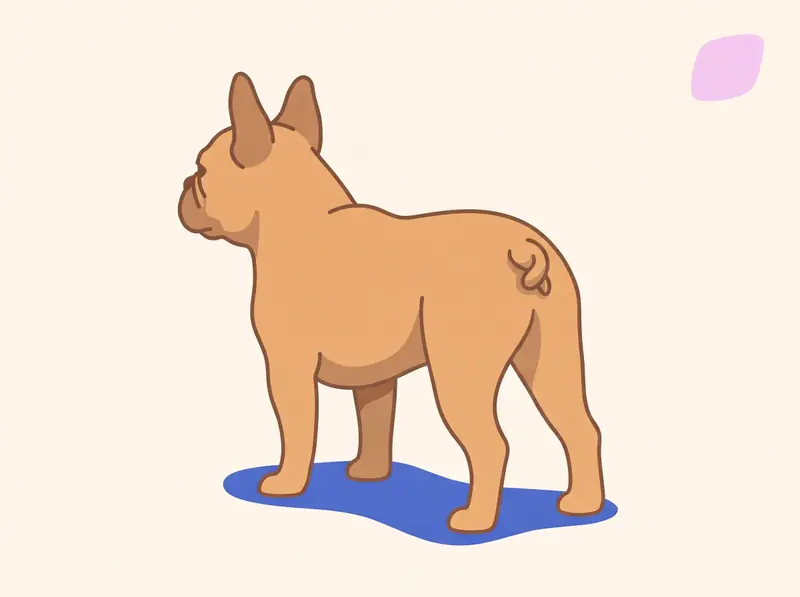
Screw tail
The short, twisted tail of bulldog breeds looks cute – but it is the visible end of a spinal malformation that often reaches into the back as well.
Learn more
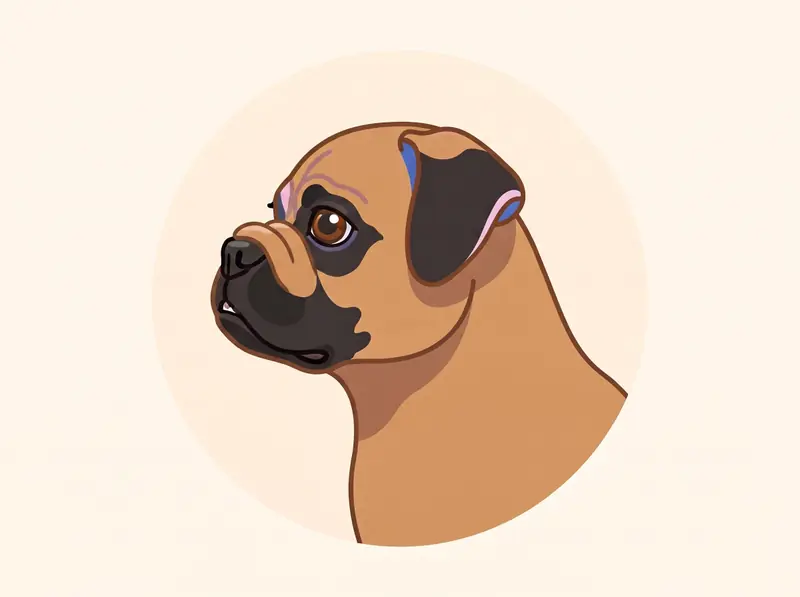
Flat face
A short muzzle looks endearing – but when the skull shrinks and the soft tissue inside it doesn't, the dog is left with too little room to breathe.
Learn more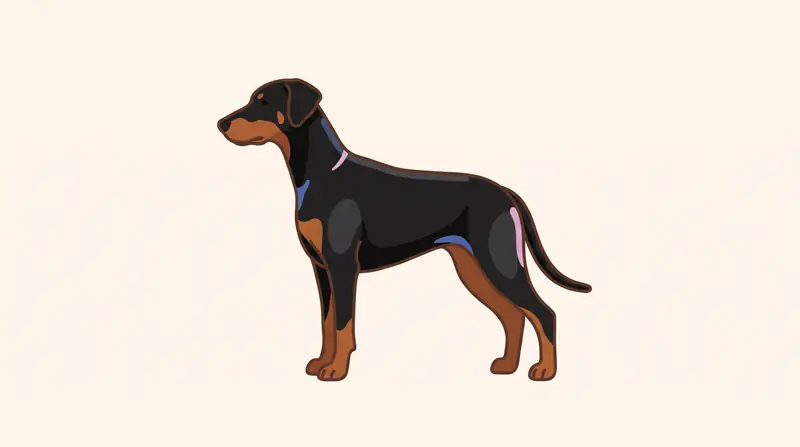
Colour dilution
Blue, grey and lilac dogs look striking – but the same gene variant that lightens their colour can, in some breeds, leave the coat permanently brittle.
Learn moreLooking to give a cropped dog a home?
Shelters also have cropped and docked dogs – adopting one is completely legal and gives the dog a second chance.