Screw Tail in Dogs: What the Corkscrew Tail Hides in the Spine
The short, twisted tail of bulldog breeds looks cute – but it is the visible end of a spinal malformation that often reaches into the back as well.
In short
A screw tail is a congenital malformation of the tail vertebrae: they are wedge-shaped, fused and too few, so the tail stays short and corkscrewed. In bulldog breeds it is linked to a DVL2 gene variant and often comes with hemivertebrae in the back. Because breeders select for it, German animal-welfare vets list it as an extreme-breeding trait (called Qualzucht in German law).
Bred for health or bred to the extreme?
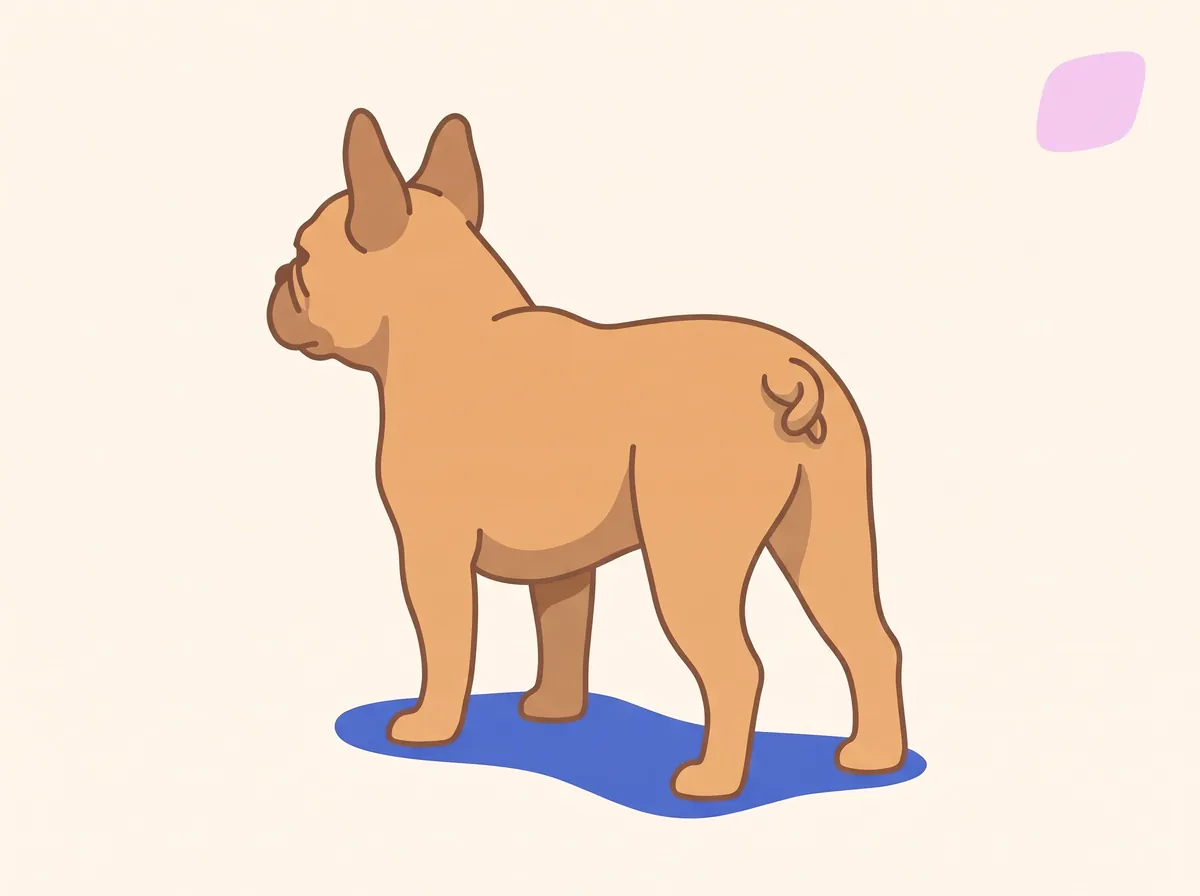
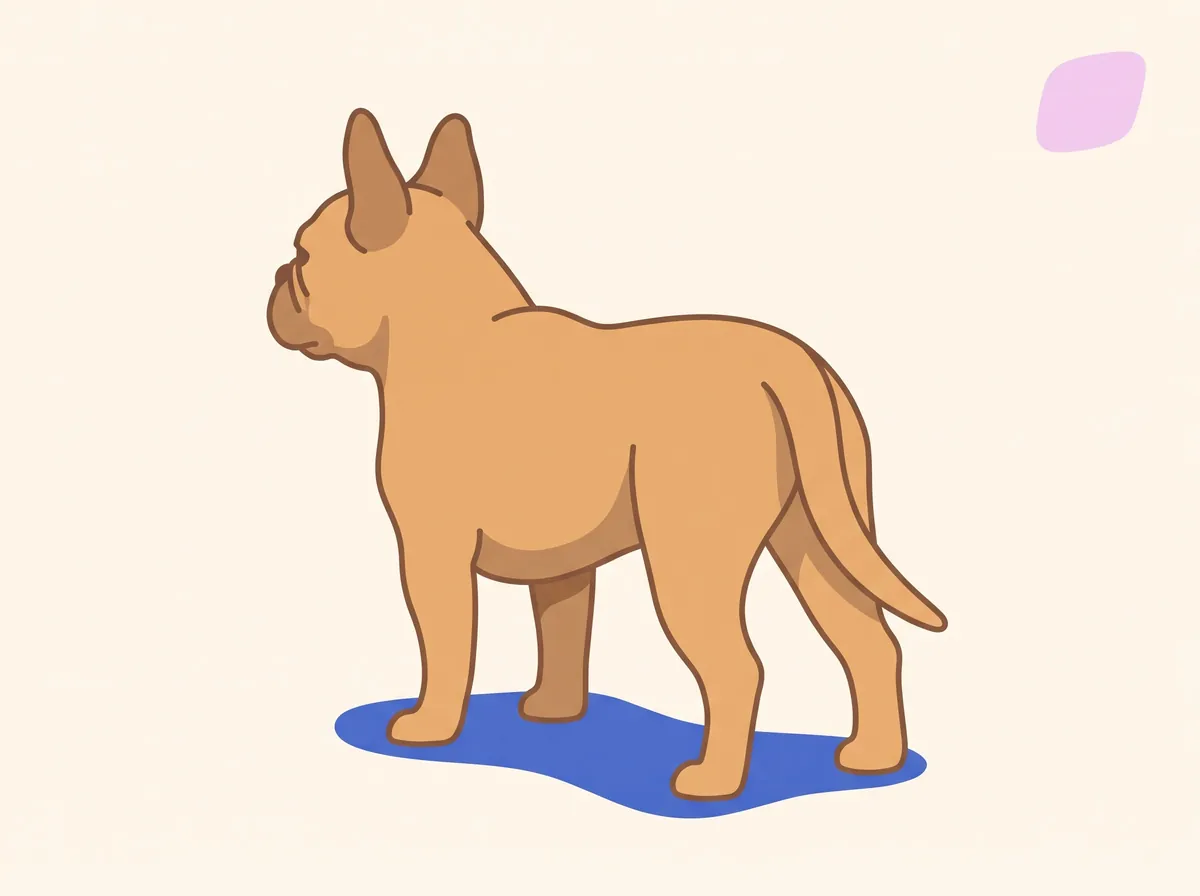
Look at the rump: on the left a straight, moderately long tail hangs down loosely; on the right there is only a short, tightly twisted stub pressed into a pocket of skin.
The illustrations are AI-generated and editorially reviewed. They do not show a real dog; they make the difference visible.
What is a screw tail, in simple terms?
A screw tail is a tail whose bones grew crooked before the puppy was born. That is why it is very short and looks like a little corkscrew stuck to the dog's bottom.
Picture the tail as a chain of small building blocks. In a healthy dog every block is straight and the same size, so the chain hangs loosely and can wag. In a screw tail many blocks are missing, and the rest are lopsided like slices of cake and glued together. A chain like that cannot hang straight – it twists.
The catch: the same lopsided blocks often sit further forward in the back too. Most dogs never notice. Sometimes, though, the back bends so sharply there that the nerves inside get squeezed and the hind legs turn wobbly.
And because the little stub sits in a fold of skin, that spot stays warm and damp – just what bacteria like, so the skin can get inflamed.
What a dog uses its tail for
- Talking to other dogs – wagging, tucking, holding it high
- Covering the anus and genitals
- Lifting it out of the way when going to the toilet
What happens in the spine of a screw-tailed dog?
The tail vertebrae form incorrectly in the embryo: instead of a chain of uniform, box-shaped vertebral bodies you get hemivertebrae, wedge vertebrae, butterfly vertebrae and block vertebrae that fuse together. On top of that, Mansour et al. (2018) describe bulldog-type tails as lacking roughly 8 to 15 caudal vertebrae. The result is a shortened, kinked or corkscrewed tail.
The most important known genetic factor in English Bulldogs, French Bulldogs and Boston Terriers is a frameshift deletion in DVL2 (Dishevelled 2, c.2044delC), part of the WNT signalling pathway that patterns the developing spine. In that study the variant was fixed in both bulldog breeds and had an allele frequency of 0.94 in Boston Terriers. Every homozygous dog had caudal malformations; thoracic malformations appeared in 45 to 100% depending on breed. Because similar mutations in DVL1 and DVL3 cause Robinow syndrome in people, the canine picture is called Robinow-like syndrome.
When wedge-shaped vertebrae sit in the thoracic spine, the column bends there – upwards (kyphosis), sideways (scoliosis) or downwards (lordosis). In a CT study of 171 neurologically normal bulldogs and Pugs, 80.7% had at least one vertebral malformation, and 93.5% of the French Bulldogs had hemivertebrae. Usually this stays silent. If the vertebral canal narrows, though, the spinal cord is compressed: wobbly gait, hind-limb weakness up to paralysis, and urinary or faecal incontinence can follow. Pugs had hemivertebrae less often, but they were more often clinically relevant.
On the outside, the stub often sits in a deep skin pocket. Moisture and sebum collect there, leading to skin-fold dermatitis (intertrigo) with bacteria and yeast; if the tail becomes ingrown, amputating it (caudectomy) may be necessary. In a case series of 17 dogs, signs resolved afterwards, with short-term complications in roughly one dog in eight. The German veterinary animal-welfare association (TVT) adds the functional loss: a screw-tailed dog can barely cover its anus and genitals, cannot lift the tail properly to defecate and can hardly use it to communicate.
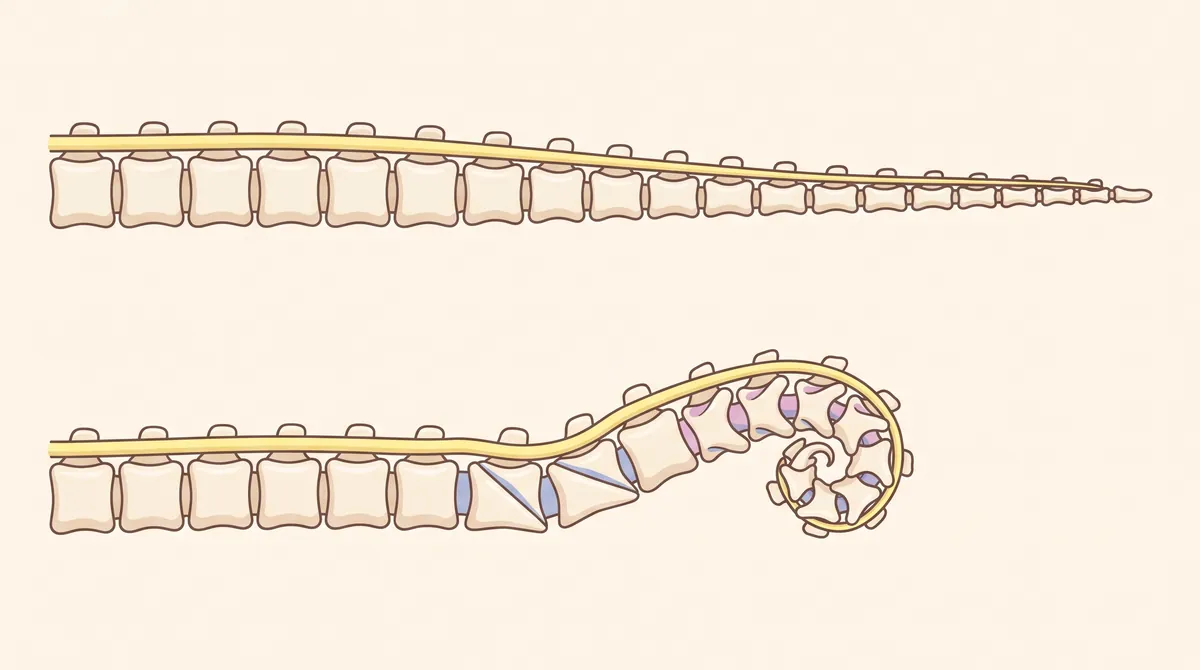 AI illustration
What the illustration shows
- 1Normal vertebral bodies – Even, rectangular vertebrae sit in a straight line, so the spinal cord above them has the same room everywhere.
- 2Long chain of tail vertebrae – Many small, individually mobile tail vertebrae make a straight tail the dog can wag and use to cover its anus and genitals.
- 3Wedge vertebrae – Two cake-slice-shaped vertebrae make the spine bend sharply. Often this causes no symptoms, but it can narrow the vertebral canal.
- 4Spinal cord at the kink – At the kink the spinal cord is stretched or compressed. Possible results: unsteady gait, weak hind legs, rarely incontinence.
- 5Fused tail vertebrae – A few fused, twisted tail vertebrae form the spiral. It sits in a skin pocket that easily becomes inflamed.
Which breeds are affected?
The true screw tail belongs mainly to French Bulldogs, English Bulldogs and Boston Terriers, where the DVL2 variant affects almost every dog. The natural bobtail of some herding and cattle breeds, such as the Pembroke Welsh Corgi or the Australian Shepherd, has a different genetic cause and a different risk: the individual dog is usually healthy, and the concern is mating two bobtailed dogs. The only bobtail breed listed here as typical of the type is the Australian Stumpy Tail Cattle Dog, whose standard requires the short tail.
Typical of the breed
- French Bulldog
The DVL2 variant is fixed in the breed, the FCI standard explicitly allows knotted and kinked tails, and hemivertebrae in the back are very common.
- Bulldog
The DVL2 variant is fixed in the English Bulldog too; the short, malformed tail is part of the breed look, and ingrown tails occur.
- Boston Terrier
The standard allows a short straight or screw-shaped tail; in the key study almost every Boston Terrier carried the DVL2 variant.
- Australian Stumpy Tail Cattle Dog
The standard demands the natural stumpy tail, which makes matings between two carriers of the T-box variant likely – with smaller litters as a result.
How can you tell whether a tail is healthy?
By a tail that works as a tail, and by an unremarkable spine on X-ray or CT. A straight, mobile tail that covers the anus is the visible sign; a report on the thoracic and lumbar spine shows what you cannot see from outside.
In bulldog breeds, length is worth a look: in French Bulldogs, dogs with more tail vertebrae had fewer and milder hemivertebrae, and the number of hemivertebrae is clearly heritable. Even the FCI standard describes the ideal tail as long enough to cover the anus and rather straight. A longer, straighter tail therefore goes with fewer and milder hemivertebrae.
To be honest about the limits: it does not remove the DVL2 variant. Where the variant is fixed in a breed, no dog within that breed is free of it – it can only disappear by crossing in dogs that do not carry it.
We do not list breeders for French Bulldogs or English Bulldogs. If you already share your life with one, these points are your yardstick at the vet.
What to look for
- Look at and gently feel the tail: straight, freely mobile, long enough to cover the anus.
- An X-ray or CT report of the spine, stating whether wedge, hemi- or block vertebrae were found. A vet judges this, not looks.
- No tail pocket with redness, moisture or odour.
- The dog moves without swaying, without scuffing the hind paws and without a conspicuous hunched back.
- Know the DVL2 genotype and what it means in the breed: in a breed where the variant is fixed, a homozygous result is the norm, not the exception.
- In bobtail breeds: is there a DNA test for the T-box variant (c.189C>G), and does one parent have a full-length tail?
Why are hemivertebrae a breeding problem if the dog has no symptoms?
Because one dog looking healthy tells you nothing about its puppies. Most hemivertebrae in bulldogs are found by chance – in the CT study by Ryan et al., four out of five neurologically normal dogs had at least one vertebral malformation. Silent does not mean harmless for the next generation.
In French Bulldogs the number of hemivertebrae is strongly heritable, with an estimated heritability of 0.58, and it is linked to tail length: fewer tail vertebrae, more hemivertebrae. The authors warn that prevalence could rise if dogs with shorter tails are preferred for breeding. Selecting for a short tail means selecting for the back as well.
On top of that, some dogs do develop neurological deficits, and then treatment is demanding. That is why the German expert opinion on extreme breeding relies on X-raying breeding dogs – before the puppies exist, not at the vet afterwards.
How is a natural bobtail different from a screw tail?
The natural bobtail of breeds such as the Pembroke Welsh Corgi or the Australian Shepherd comes from a different mutation: a variant in the T-box gene (T, c.189C>G). It is inherited dominantly – one copy is enough for a short tail. Two copies appear not to be survivable: a study across 23 breeds found not a single homozygous dog, and crossing data point to early death in the womb.
For breeding this means that when two bobtails are mated, about a quarter of the embryos are expected to be lost. In Swedish Vallhunds, such litters were on average 29% smaller than litters from long-tailed parents. The rule is therefore to pair a bobtail with a long-tailed dog, never two bobtails.
What to expect from each pairing
| Pairing | Share of born puppies with a long tail | Share of born puppies with a bobtail | Embryos lost |
|---|---|---|---|
| Bobtail × long tail | about 1/2 | about 1/2 | none |
| Bobtail × bobtail | about 1/3 | about 2/3 | about 1/4 of all embryos |
Is breeding for a screw tail illegal in Germany?
There is no ban that names the screw tail specifically – Section 11b of the German Animal Welfare Act (TierSchG) does not list individual traits. It prohibits breeding vertebrates where offspring can be expected to suffer hereditary pain, suffering or damage because body parts or organs are missing, unfit for their species-appropriate use, or altered.
The interpretation aid is the German agriculture ministry's expert opinion on Section 11b (“Gutachten zur Auslegung von § 11b des Tierschutzgesetzes”), usually dated 1999. It is not law, but it explicitly covers shortened or absent tails and crippled tail vertebrae (corkscrew and kinked tails), recommends X-ray screening, advises a breeding ban for animals that have vertebral defects elsewhere in the spine besides the tail malformation – and calls for breed standards to drop the corkscrew tail. The German veterinary animal-welfare association (TVT) treats even a too-short or missing tail as damage within the meaning of Section 11b.
Since 2022, dogs with inherited extreme-breeding traits may also no longer be shown in Germany at exhibitions or other events where dogs are judged (Section 10 of the Dog Welfare Ordinance). Owning a dog with a screw tail, on the other hand, is not prohibited – the ban covers breeding and exhibiting.
Related conditions
The medical details – symptoms, diagnosis, treatment – are on the pages for each condition.
This page explains; it does not replace a veterinary examination. Only a vet can judge whether an individual dog is affected.
Frequently asked questions
Does a screw tail hurt?
The malformation itself usually does not – many dogs live with it without problems. What can hurt are the consequences: an inflamed tail pocket, an ingrown tail, or hemivertebrae pressing on the spinal cord. If your dog licks its rear a lot, scoots, or the skin fold smells, have a vet take a look.
What are hemivertebrae in dogs?
Hemivertebrae are vertebrae that form only partly, often as a wedge like a slice of cake instead of a box shape. The spine bends at that point. It is often an incidental finding without symptoms, but it can narrow the spinal canal and cause gait problems.
Does the French Bulldog count as extreme breeding because of its tail?
The tail is one of several reasons. The DVL2 variant is fixed in the breed, and in a CT study 93.5% of the French Bulldogs examined had hemivertebrae. The German veterinary animal-welfare association (TVT) names the breed explicitly as an example of tail malformations – on top of the short nose. More on the breed in the French Bulldog breed profile.
Can a screw tail be treated with surgery?
Yes. If the tail pocket keeps getting infected or the tail grows inwards, the tail can be removed surgically (caudectomy). In one case series the skin problems resolved afterwards, and short-term complications affected only a small share of dogs. The operation does not fix hemivertebrae in the back – if they compress the spinal cord, that is a separate neurosurgical question.
How do I care for my dog's tail pocket?
The aim is to keep the skin fold clean and dry, because moisture encourages inflammation. Ask your vet practice to show you how often and with what to clean it. Redness, moisture, odour or pain when touched are reasons to book an appointment.
Is a natural bobtail in an Australian Shepherd extreme breeding?
An individual dog with a natural bobtail is usually healthy. The problem is mating two bobtails: homozygous embryos are not viable, so litters get smaller. At the same time a short or absent tail can only partly do its job, which is why German animal-welfare vets view shortened tails critically too. More on the breed in the Australian Shepherd breed profile.
Sources
- Mansour TA et al. (2018): Whole genome variant association across 100 dogs identifies a frame shift mutation in DISHEVELLED 2 which contributes to Robinow-like syndrome in Bulldogs and related screw tail dog breeds. PLoS Genetics 14(12): e1007850
- Ryan R et al. (2017): Prevalence of thoracic vertebral malformations in French bulldogs, Pugs and English bulldogs with and without associated neurological deficits. The Veterinary Journal 221: 25–29
- Schlensker E, Distl O (2016): Heritability of hemivertebrae in the French bulldog using an animal threshold model. The Veterinary Journal 207: 188–189
- Knight SM et al. (2013): Postoperative complications associated with caudectomy in brachycephalic dogs with ingrown tails. JAAHA 49(4): 237–242
- Hytönen MK et al. (2009): Ancestral T-box mutation is present in many, but not all, short-tailed dog breeds. Journal of Heredity 100(2): 236–240
- Haworth K et al. (2001): Canine homolog of the T-box transcription factor T; failure of the protein to bind to its DNA target leads to a short-tail phenotype. Mammalian Genome 12(3): 212–218
- TVT fact sheet no. 141: extreme breeding and hereditary diseases in pets, focus on dogs (December 2023, German)
- BMEL (expert group on animal welfare and pet breeding): expert opinion on the interpretation of Section 11b TierSchG, usually dated 1999 (German)
- Section 11b German Animal Welfare Act (TierSchG, German)
- Section 10 German Dog Welfare Ordinance (TierSchHuV, German)
Last reviewed on September 30, 2026 by Sufyan Osamah · what that means: Editorial standards
Related topics
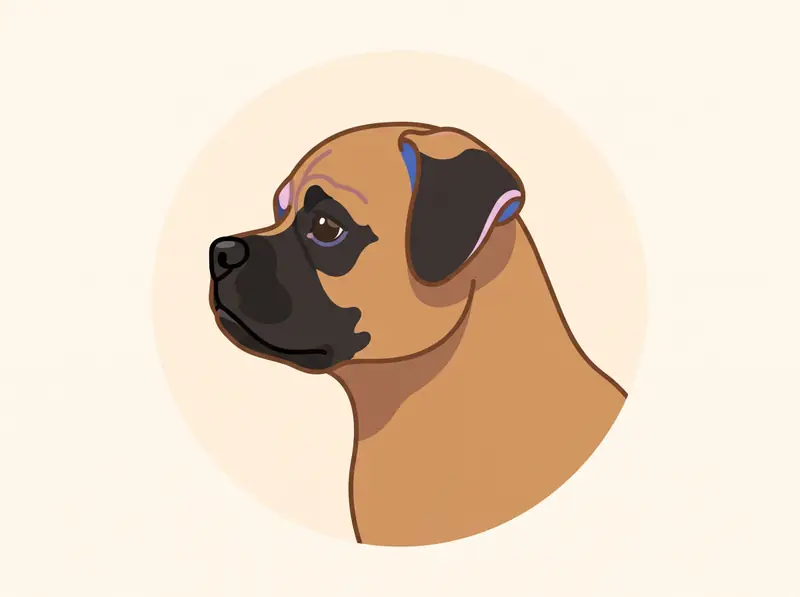
Flat face
A short muzzle looks endearing – but when the skull shrinks and the soft tissue inside it doesn't, the dog is left with too little room to breathe.
Learn more
Short legs
Dachshund, Corgi, Basset: the gene behind those short legs also makes the spinal discs age early – and yet not every Dachshund is the product of extreme breeding (called Qualzucht in German law).
Learn more
Ridge & dermoid sinus
The ridge of backward-growing hair is what makes a Ridgeback a Ridgeback – and the same mutation raises the risk of a skin tunnel that can reach the spinal cord.
Learn moreLooking for a dog without this burden?
Many wonderful dogs are waiting in shelters – and many breeds come without extreme-breeding traits.