Chondrodystrophy in Dogs: Short Legs and Fragile Discs
Dachshund, Corgi, Basset: the gene behind those short legs also makes the spinal discs age early – and yet not every Dachshund is the product of extreme breeding (called Qualzucht in German law).
In short
Chondrodystrophy is an inherited disorder of cartilage growth: the leg bones stay short and the spinal discs degenerate and calcify while the dog is young. The main cause is an extra FGF4 gene copy on chromosome 12. It sharply raises the risk of painful disc herniation and paralysis, so Germany's official expert opinion on extreme breeding advises breeding away from extreme short legs.
Bred for health or bred to the extreme?
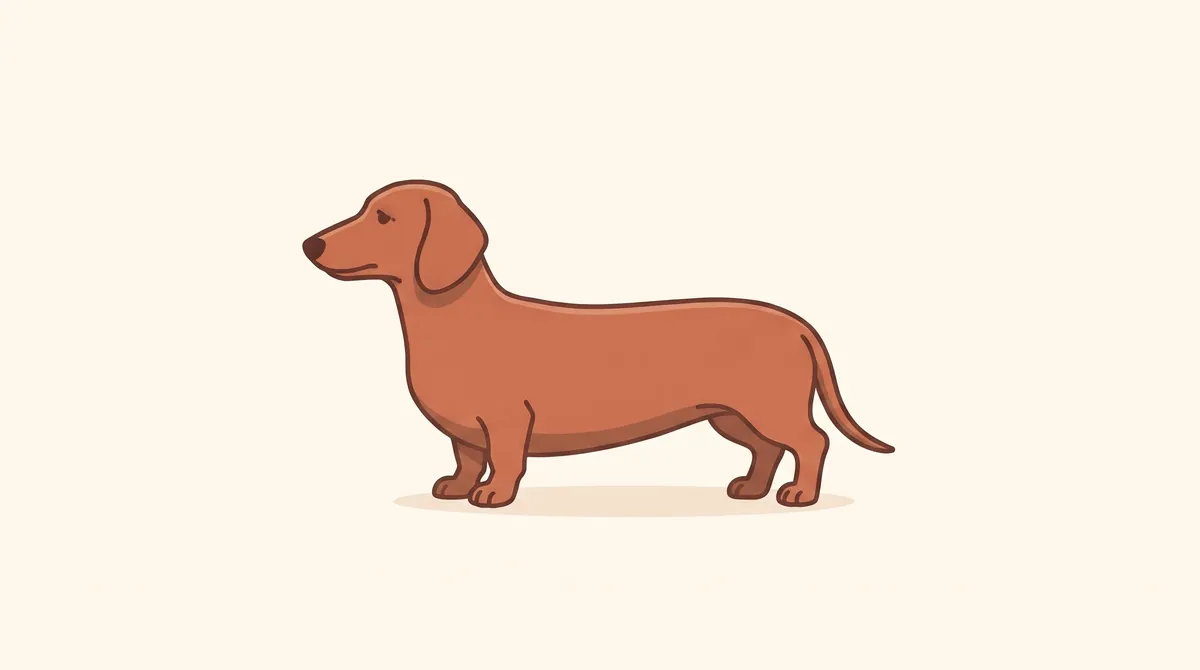
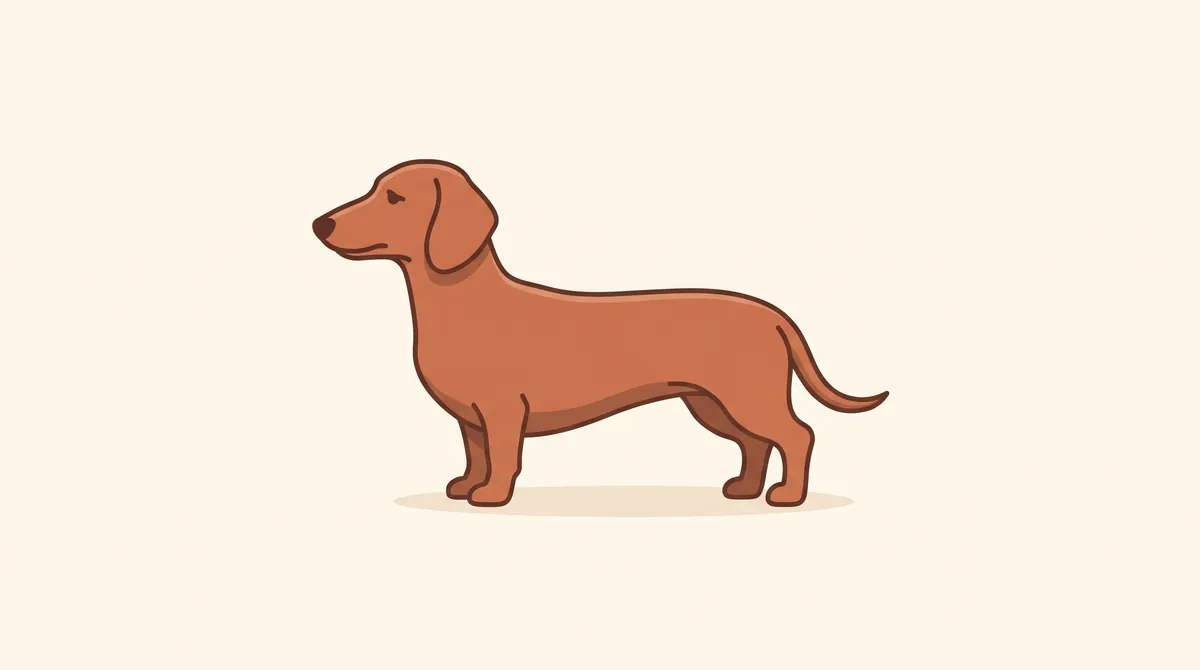
Look at the gap between chest and ground and at the length of the back: on the left about a third of the shoulder height stays clear; on the right the chest nearly touches the floor and the back is visibly longer.
The illustrations are AI-generated and editorially reviewed. They do not show a real dog; they make the difference visible.
What is chondrodystrophy, in simple terms?
Chondrodystrophy roughly means “cartilage growing the wrong way”. In affected dogs the leg bones stop growing in length early – that is why Dachshunds, Corgis and Bassets have such short legs. But the same gene also changes the discs, the little cushions between the bones of the spine.
Picture each disc as a rubber ring filled with jelly. In a healthy dog the jelly absorbs every jump. In a chondrodystrophic dog it turns hard and crumbly like old chalk while the dog is still young. At some point the ring tears and the crumbly material presses on the spinal cord – the cable that carries messages from the brain to the legs.
That hurts a lot, and sometimes the back legs stop working. Vets call it a slipped or herniated disc; in Germany owners know it as “Dackellähme”, Dachshund paralysis. How high the risk is depends on the genes, on the body shape and on how carefully the breeder chose the parents.
Worth remembering
- Short legs and fragile discs often come from the same gene.
- The longer and lower a dog is built, the higher its risk.
- Keeping the dog lean and fit helps its back.
- Sudden back pain or wobbly hind legs mean a trip to the vet – straight away.
What happens to bones and discs in chondrodystrophy?
Chondrodystrophy combines two findings: shortened, dysplastic long bones and premature degeneration and calcification of the intervertebral discs (Brown et al. 2017). The cause is retrogenes – extra copies of the growth-factor gene FGF4 inserted into the genome. The retrogene on chromosome 18 (CFA18) is associated with short legs (chondrodysplasia), a trait that defines at least 19 breeds including the Dachshund, Corgi and Basset Hound (Parker et al. 2009). The second retrogene, described in 2017 on chromosome 12 (CFA12), also shortens the legs – and is the key genetic risk factor for disc herniation.
An intervertebral disc consists of a gel-like core, the nucleus pulposus, surrounded by layered fibres, the annulus fibrosus. In chondrodystrophic dogs the core is replaced early by cartilage-like cells, undergoes chondroid degeneration and calcifies – not at one spot but along the whole spine (Brown et al. 2017). In Dachshunds the number of calcified discs visible on X-ray peaks at around 24 to 27 months; heritability is estimated at 0.6 to 0.87 (Bruun et al. 2020).
In a Hansen type I disc herniation, the calcified core can burst explosively through the weakened fibre ring into the spinal canal. The material compresses the spinal cord, causing inflammation and bleeding, severe pain and neurological deficits up to paralysis (Brown et al. 2017). In the DachsLife survey the causative disc was thought to lie in the thoracolumbar spine in 88% of cases (Packer et al. 2016).
The CFA12 retrogene acts dominantly: one copy is enough to raise the risk markedly. The original study reported an odds ratio of 51 for disc disease (Brown et al. 2017), and a follow-up found 18 in mixed-breed dogs (Batcher et al. 2019). Body shape adds to it: in a UK referral-hospital study risk rose with the ratio of back length to height at the withers, and being overweight or skeletally smaller increased it further (Packer et al. 2013).
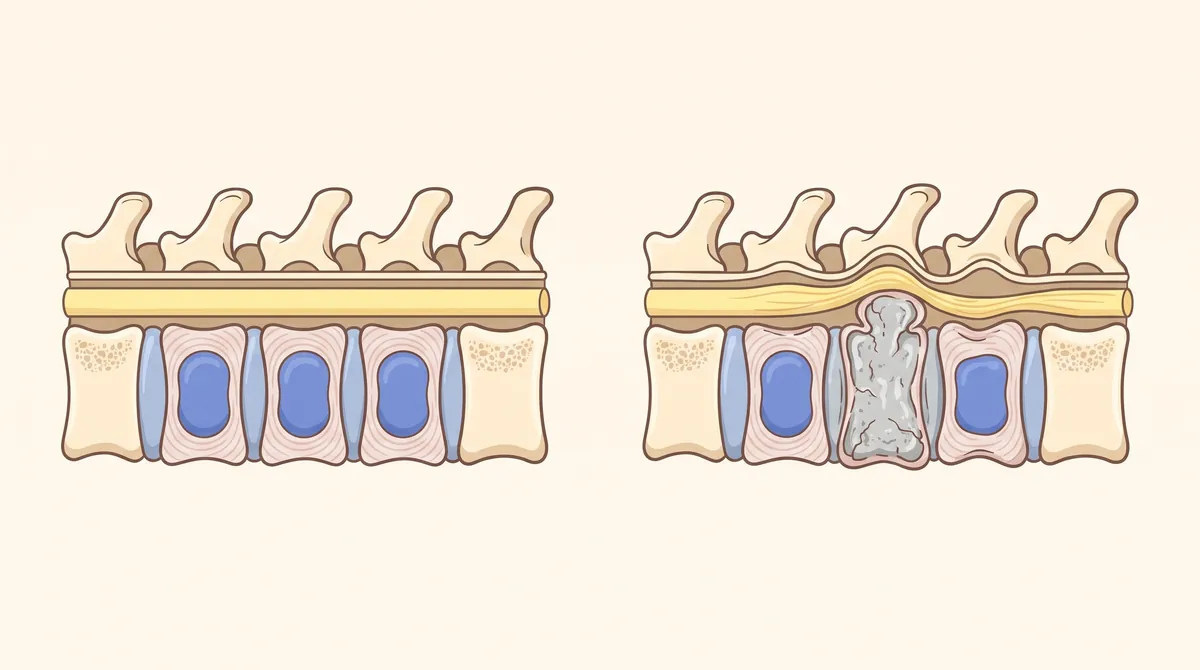 AI illustration
What the illustration shows
- 1Vertebral body – The bony building blocks of the spine. A disc sits between every two vertebral bodies.
- 2Healthy disc – A gel-like core (nucleus pulposus) inside a ring of fibres (annulus fibrosus). It absorbs shocks and keeps the spine flexible.
- 3Spinal cord – Runs through the spinal canal above the discs and carries signals from the brain to the legs, bladder and bowel.
- 4Calcified disc – In chondrodystrophic dogs the core degenerates early into cartilage-like, later chalky material. Calcifications show up on X-rays.
- 5Disc herniation (Hansen type I) – The calcified core breaks through the fibre ring into the spinal canal and compresses the spinal cord: pain, paralysis and, at worst, loss of bladder and bowel control.
Which breeds are affected?
Short legs caused by FGF4 retrogenes define many breeds, but the disc risk reaches further: the CFA12 retrogene also occurs in dogs without strikingly short legs, such as the Beagle. What matters is how extreme the breeding is and whether the parents have been screened.
Typical of the breed
- French Bulldog
Chondrodystrophic by breed type: among dogs operated on in a US hospital study the CFA12 retrogene was very common, and disc surgery came at a median age of just 3.7 years. Also brachycephalic.
Exaggerated lines only
- Dachshund
Smooth and long-haired Dachshunds almost all carry the CFA12 retrogene, and roughly one in six to one in five Dachshunds develops disc disease. Moderate proportions and X-ray screening of the parents help lower the risk.
- Miniature Dachshund
Miniaturisation adds to the problem: a smaller skeletal size was an additional risk factor for disc extrusion in a UK referral-hospital study.
- Wire-haired Dachshund
The variety with the lowest prevalence in the UK DachsLife survey (standard wire-haired 7.1%); in Denmark the difference from the other coat types was not significant.
- Basset Hound
Classically short-legged with both FGF4 retrogenes and at increased disc risk in hospital studies. “Long and low” is part of the type, which makes moderate build all the more important.
- Pembroke Welsh Corgi
Short legs caused by FGF4 retrogenes, with an increased risk of disc disease in hospital studies.
- Pekingese
Chondrodystrophic and brachycephalic at the same time; represented among disc cases in a US hospital study, though with only a few Pekingese operated on.
- Shih Tzu
Increased disc risk in hospital studies. Because not every Shih Tzu carries the CFA12 retrogene, a CDDY test of the parents is worth asking for.
- Dandie Dinmont Terrier
Almost all tested Dandie Dinmont Terriers carry both FGF4 retrogenes (allele frequency 88% on CFA12, 98% on CFA18; 28 dogs). “Long and low” is part of the type, which makes moderate proportions and CDDY-tested parents all the more important.
- Cardigan Welsh Corgi
Short legs caused by both FGF4 retrogenes (CFA18 and CFA12); the CFA12 retrogene is the key genetic risk factor for disc herniation. In a small sample its allele frequency was 79%.
- Clumber Spaniel
All six tested Clumber Spaniels carried the CFA12 retrogene that raises disc risk. The sample is small; a CDDY test of the parents gives clarity.
- Petit Basset Griffon Vendéen
The short legs here rest on the FGF4 retrogene on CFA18. Breed-specific data on disc risk are scarce; moderate proportions and a CDDY test of the parents still make sense.
- Lhasa Apso
Increased disc risk in hospital studies. Because not every Lhasa Apso carries the CFA12 retrogene, a CDDY test of the parents is worth asking for.
How do you recognise healthy lines in short-legged breeds?
By moderate proportions, by spinal X-ray results for both parents and by a family without back problems. You cannot see a puppy's discs – but you can see how the parents are built and ask to see their results in the original.
For the Dachshund, the FCI breed standard itself sets the direction: ground clearance should be about a third of the height at the withers, and a body trailing on the ground is a severe fault. Dogs built much lower and longer are not the ideal but an exaggeration of it.
We do not list breeders for the French Bulldog; for that breed, see the page on the short nose.
Checklist for short-legged breeds
- Spinal X-ray results for both parents, taken at 24 to 48 months, stating the number of calcified discs. The Danish Dachshund Club only accepts dogs with fewer than five calcifications for breeding.
- Visible ground clearance in mother and father: roughly a third of the height at the withers, with the chest not hanging near the floor.
- A compact back: for the Dachshund, the standard asks for a body length of about 1.7 to 1.8 times the height at the withers.
- Front legs as straight as possible – no strongly bowed legs or paws turning outward.
- An open answer when you ask about disc herniations in the parents, grandparents and puppies from earlier litters.
- In breeds where not every dog carries the CFA12 retrogene (e.g. Shih Tzu), a CDDY DNA test of the parents – as an addition to, not a replacement for, the X-ray. In Dachshunds, wire-haired ones included, X-ray screening tells you more than the DNA test.
- Lean, active parents and no push towards ever smaller “mini” versions.
How breeders make whole breeds healthier – tests, new genes and their limits
What does a DNA test for chondrodystrophy tell you?
It shows whether a dog carries the CFA12 retrogene – in no, one or two copies. Because the gene acts dominantly, even single-copy carriers have a raised disc risk. In breeds where not every dog carries it, breeders can use the test to deliberately lower the risk for their puppies.
The gene is not limited to Dachshunds: in a survey of 75 breeds it was found in 53% of them (Batcher et al. 2019). It was discovered in the Nova Scotia Duck Tolling Retriever, a medium-sized gundog, and Beagles and French Bulldogs carry it frequently even though they are not among the extremely short-legged breeds. In mixed-breed dogs it also raised the risk markedly. In other words, you cannot necessarily tell from the outside.
In Dachshunds the test on its own helps little: in Danish smooth- and long-haired Dachshunds the insertion is almost fixed, so nearly every dog carries it. Breeding on the DNA test alone would mean excluding almost the entire breed. The researchers therefore recommend spinal X-ray screening for calcified discs as the more reliable breeding tool. Even in wire-haired Dachshunds, where the gene still varies, the test alone was not a useful risk marker: most dogs with few calcifications carried the insertion too (Bruun et al. 2020).
How do you protect a short-legged dog day to day – and when is it an emergency?
With a lean body weight, daily exercise and fast action at the first warning signs. Being overweight increased the risk of disc extrusion in a UK referral-hospital study (Packer et al. 2013). In the DachsLife survey of 2,031 Dachshunds, dogs exercised for less than 30 minutes a day were more often diagnosed with disc disease, and dogs exercised for more than an hour less often (Packer et al. 2016).
Stairs and sofas are less clear-cut than many people think: in the same survey, Dachshunds that used stairs daily or were allowed to jump on and off furniture were actually diagnosed less often than dogs that were not. That may partly be because owners forbid it after an episode – the authors stress that these associations do not prove cause and effect. Neutered Dachshunds were also affected more often; whether and when to neuter is best discussed with your vet.
A disc herniation can start gradually or suddenly – in the DachsLife survey, signs developed within less than 24 hours in 42% of dogs. If your dog can no longer move its hind legs, it is an emergency for a clinic with neurology or surgery.
Warning signs that mean a vet visit
- Back pain: stiff posture, hunched back, crying out when picked up.
- Sudden reluctance to jump or use stairs that used to be no problem.
- A wobbly, swaying gait, dragging or knuckling paws.
- Your dog cannot get up or cannot move its hind legs.
- It loses control of bladder or bowels.
Is breeding short-legged dogs banned in Germany?
Not across the board – the law does not name specific breeds. Section 11b of the German Animal Welfare Act (TierSchG) prohibits breeding dogs where the offspring can be expected to suffer pain, suffering or harm because body parts or organs are hereditarily missing, unfit for use or altered. Whether a case counts as extreme breeding is assessed individually, based on the animal's traits; under paragraph 2 the competent authority can order animals to be neutered. Owning a short-legged dog is not prohibited – the ban covers breeding.
The provision is interpreted with the help of the “Gutachten zur Auslegung von § 11b des Tierschutzgesetzes (Verbot von Qualzüchtungen)”, usually dated 1999 and written by an expert group appointed by the Federal Ministry of Agriculture. It lists chondrodysplasia with the Dachshund as an example, describes these breeds' tendency to disc herniation and recommends breeding away from very long backs and pronounced short legs to counter exaggerated type. It does not impose a breeding ban for this trait.
Related conditions
The medical details – symptoms, diagnosis, treatment – are on the pages for each condition.
This page explains; it does not replace a veterinary examination. Only a vet can judge whether an individual dog is affected.
Frequently asked questions
Does the Dachshund count as extreme breeding?
Not as such. Dachshunds carry the genes for short legs and early disc degeneration, and roughly one in five to six develops disc disease. But Germany's official expert opinion on extreme breeding does not call for abolishing the breed – it recommends breeding away from very long backs and pronounced short legs – and Section 11b of the Animal Welfare Act targets expected suffering, not breed names. The problem is extreme lines; moderately built, X-ray-screened parents are the route to healthier Dachshunds. More on the breed's health in the Dachshund breed profile.
What is the CDDY test?
CDDY stands for chondrodystrophy. The DNA test detects the FGF4 retrogene on chromosome 12 and shows whether a dog carries no, one or two copies; a single copy already raises disc risk. It is most useful in breeds where not every dog carries the gene. In Dachshunds, spinal X-ray screening for calcified discs is more informative – wire-haired ones included, where the test barely told dogs with few and many calcifications apart in a Danish study.
Can Dachshunds use stairs and jump on the sofa?
The evidence does not support a blanket ban: in the DachsLife survey of more than 2,000 Dachshunds, dogs that used stairs daily or jumped on furniture were actually diagnosed with disc disease less often. That does not prove cause and effect. A lean weight and daily exercise matter more; after a disc episode, follow your vet's advice.
Are wire-haired Dachshunds healthier than smooth-haired ones?
In the UK DachsLife survey, yes: standard wire-haired Dachshunds had the lowest prevalence at 7.1% and standard smooth-haired the highest at 24.4%. A Danish study, however, found no significant difference between coat types (16 to 22%). So don't rely on the coat – rely on the results of the actual parents.
Can a slipped disc in a dog be treated with surgery?
Yes. When there are clear neurological deficits, the spinal cord is usually decompressed with a hemilaminectomy. According to the American College of Veterinary Internal Medicine consensus, about 93% of paralysed dogs that still felt deep pain walked again after surgery, and about 61% of those without deep pain. Milder cases can also be managed conservatively with restricted activity and pain relief.
Do dogs with normal-length legs share this disc risk?
Yes. The CFA12 retrogene occurs in many breeds, including the Beagle, the French Bulldog and the medium-sized Nova Scotia Duck Tolling Retriever, and in mixed breeds too. You can't always see it – which is why the DNA test is most worthwhile where not every dog carries the gene.
At what age do Dachshunds get disc disease?
Usually in middle age: in the DachsLife survey the average age at diagnosis was about 5.4 years. But the degeneration starts much earlier – calcified discs are visible on X-rays in young dogs, and their number peaks at around two years of age.
Sources
- Dickinson PJ, Bannasch DL (2020): Current Understanding of the Genetics of Intervertebral Disc Degeneration. Front Vet Sci 7
- Parker HG et al. (2009): An expressed fgf4 retrogene is associated with breed-defining chondrodysplasia in domestic dogs. Science 325
- Brown EA et al. (2017): FGF4 retrogene on CFA12 is responsible for chondrodystrophy and intervertebral disc disease in dogs. PNAS 114
- Batcher K et al. (2019): Phenotypic effects of FGF4 retrogenes on intervertebral disc disease in dogs. Genes 10
- Packer RMA et al. (2013): How long and low can you go? Effect of conformation on the risk of thoracolumbar intervertebral disc extrusion in domestic dogs. PLoS ONE 8
- Packer RMA et al. (2016): DachsLife 2015 – lifestyle associations with the risk of intervertebral disc disease in Dachshunds. Canine Genetics and Epidemiology 3
- Bruun CS et al. (2020): Breeding schemes for intervertebral disc disease in dachshunds – disc calcification score vs. FGF4 genotyping. Canine Medicine and Genetics 7
- Olby NJ et al. (2022): ACVIM consensus statement on diagnosis and management of acute canine thoracolumbar intervertebral disc extrusion. J Vet Intern Med 36
- FCI Standard No. 148: Dachshund (2022)
- BMEL (expert group on animal welfare and pet breeding): expert opinion on the interpretation of Section 11b TierSchG, usually dated 1999 (German)
- Section 11b German Animal Welfare Act (TierSchG, German)
Last reviewed on September 30, 2026 by Sufyan Osamah · what that means: Editorial standards
Related topics
Flat face
A short muzzle looks endearing – but when the skull shrinks and the soft tissue inside it doesn't, the dog is left with too little room to breathe.
Learn more
Screw tail
The short, twisted tail of bulldog breeds looks cute – but it is the visible end of a spinal malformation that often reaches into the back as well.
Learn more
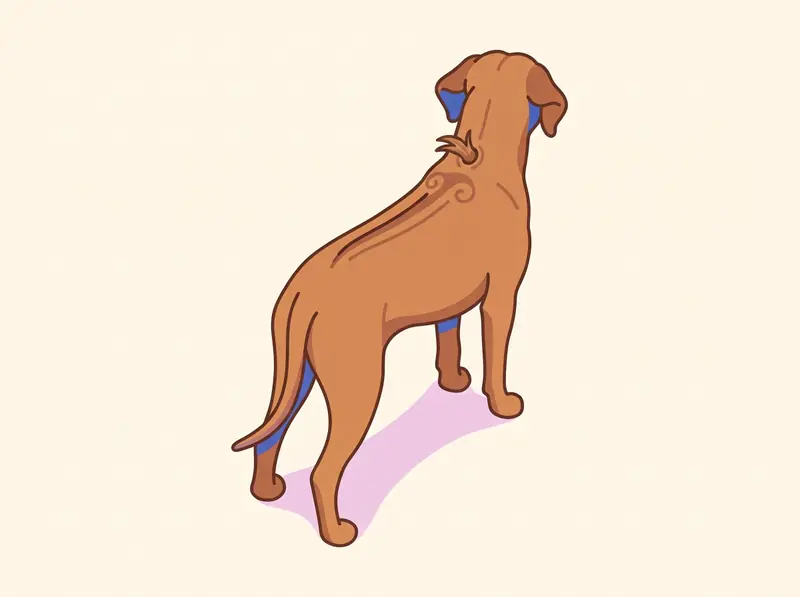
Ridge & dermoid sinus
The ridge of backward-growing hair is what makes a Ridgeback a Ridgeback – and the same mutation raises the risk of a skin tunnel that can reach the spinal cord.
Learn moreLooking for a dog without this burden?
Many wonderful dogs are waiting in shelters – and many breeds come without extreme-breeding traits.