White Dogs and Deafness: When White Becomes a Risk
Not every white dog is at risk – but where pigment cells are missing from the head, they are often missing from the inner ear too, and a puppy can go deaf in its first weeks of life.
In short
Pigment-associated deafness is congenital inner-ear deafness in dogs with a lot of white, mainly from extreme white spotting (S locus, MITF) or merle. Without pigment cells in the inner ear, its supporting tissue degenerates and the hearing cells die in the first weeks of life. Because breeding for white heads raises this risk, vets list it as an extreme-breeding trait (called Qualzucht in German law).
Bred for health or bred to the extreme?
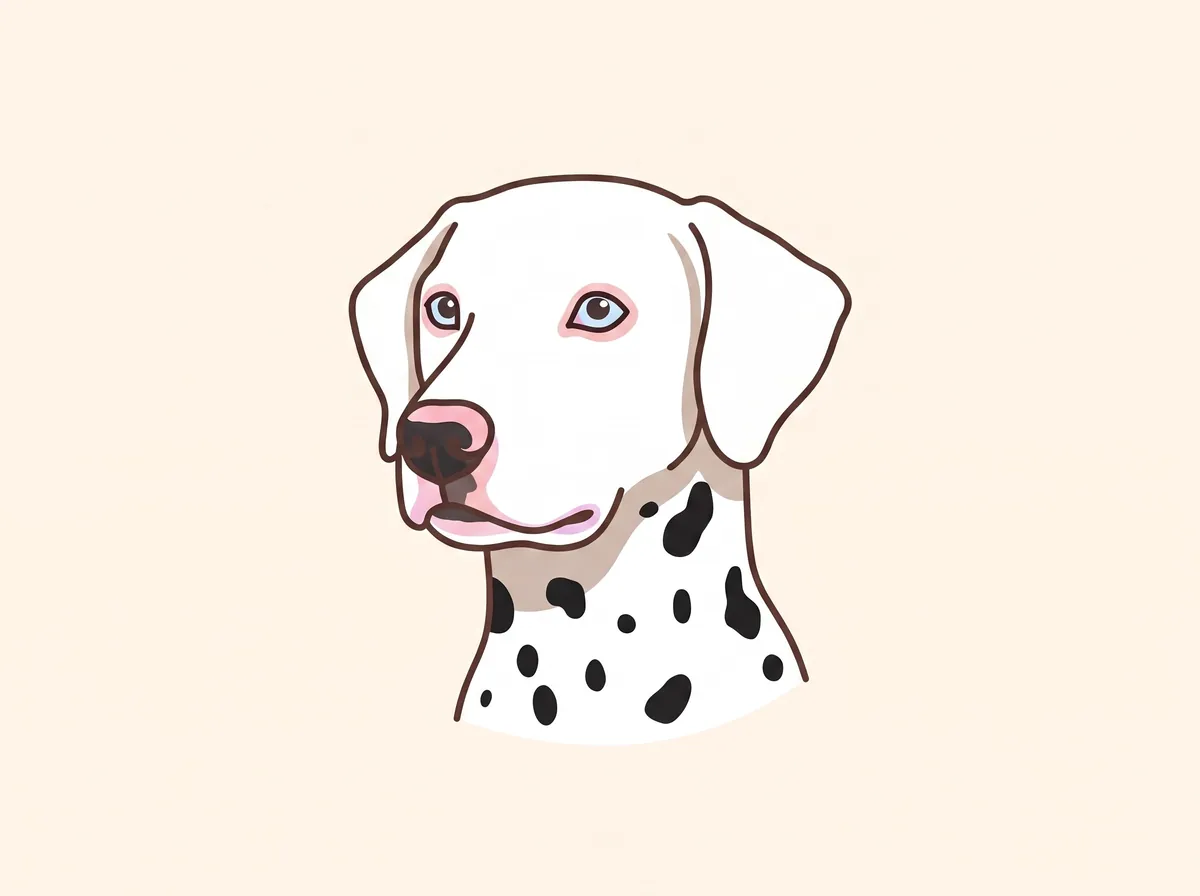
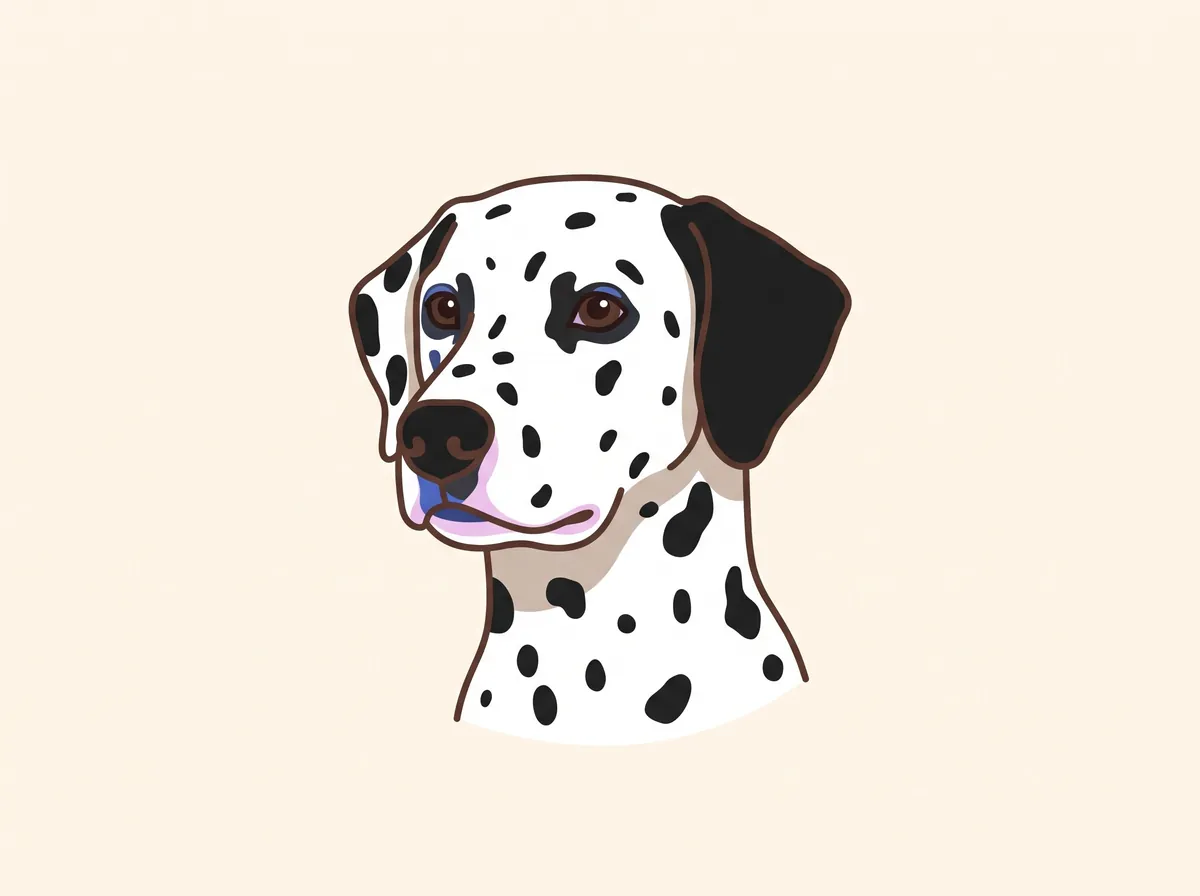
Look at the ears, eyes and eye rims: on the left a black ear, dark eyes and black eye rims; on the right an almost white head with no ear patch, pale blue eyes and pink eye rims. Blue eyes and a head without pigment are statistically linked to more deafness.
The illustrations are AI-generated and editorially reviewed. They do not show a real dog; they make the difference visible.
Why can white dogs be deaf?
Because the same cells that colour the coat and skin are also needed inside the ear. Before birth, pigment cells travel from the embryo's back to the whole body – the skin, the eyes and the inner ear. In some dogs they don't arrive everywhere. Where they are missing, the coat stays white. If they are missing in the ear as well, the dog can become deaf.
Think of the inner ear as a tiny aquarium in which delicate hairs feel sound waves. The pigment cells are part of the pump that keeps the water just right. Without the pump the water goes bad and the hairs die – a few weeks after birth, and for good.
The key point: not all white is the same. A West Highland White Terrier or a White Swiss Shepherd has pigment cells – they just make very pale pigment. You can tell by the black nose, dark eyes and dark eye rims. The risky kind of white is the one where the pigment cells are missing altogether, such as the white ground under a Dalmatian's spots.
Signs that raise the risk
- Blue or partly blue eyes – in heavily spotted breeds such as the Dalmatian, these dogs are statistically more often deaf.
- An all-white head with no coloured patch – a patch present at birth lowers the risk.
- Still, only a hearing test (BAER) gives you certainty: dark-eyed dogs with an ear patch can be deaf too.
What happens in the inner ear of a white dog born deaf?
The sensory hair cells die because the stria vascularis – the blood-vessel-rich tissue on the outer wall of the cochlear duct – degenerates without melanocytes. The technical term is congenital sensorineural deafness of the cochleosaccular type. In Dalmatians, hearing develops normally until about three weeks of age; then the stria degenerates and the hair cells rapidly lose function. Mammals cannot regrow hair cells, so the loss is permanent.
The stria keeps the endolymph in the cochlear duct rich in potassium and generates the endocochlear potential of roughly +80 to +100 mV that the hair cells in the organ of Corti depend on. Strial melanocytes are essential for this. Without them the potential collapses, the hair cells die and Reissner's membrane collapses. The name cochleosaccular reflects that the saccule can be affected as well as the cochlea.
Why are the melanocytes missing? Their precursors (melanoblasts) migrate from the neural crest to the skin, hair follicles, eye and stria vascularis during embryonic development. The recessive alleles of the white-spotting locus S – Irish spotting (si), piebald (sp) and extreme white piebald (sw) – are linked to variants near the MITF gene on chromosome 20 and disrupt the migration, proliferation or survival of these cells. Dalmatians are homozygous for sw. When migration from the head portion of the neural crest stops, the head and inner ear stay unpigmented.
Blue eyes (no iris pigment) and a missing tapetal pigment point to strong expression of the spotting gene and go with more deafness; a coloured patch present at birth points to weak expression and goes with less. In 8,955 British Dalmatians, the genetic correlation between deafness and blue irises was +0.6, and with a head patch −0.86. Inheritance is not simple: matings of two bilaterally deaf Dalmatians have also produced hearing puppies. That is why there is still no DNA test that predicts this deafness.
Merle is a second, separate route to the same damage: an insertion in the PMEL gene lightens the coat, and homozygous merle dogs are often deaf and/or blind – covered on the merle and double-merle page. Albinism is different: the melanocytes are present but make no melanin, and albino dogs do not show hereditary deafness.
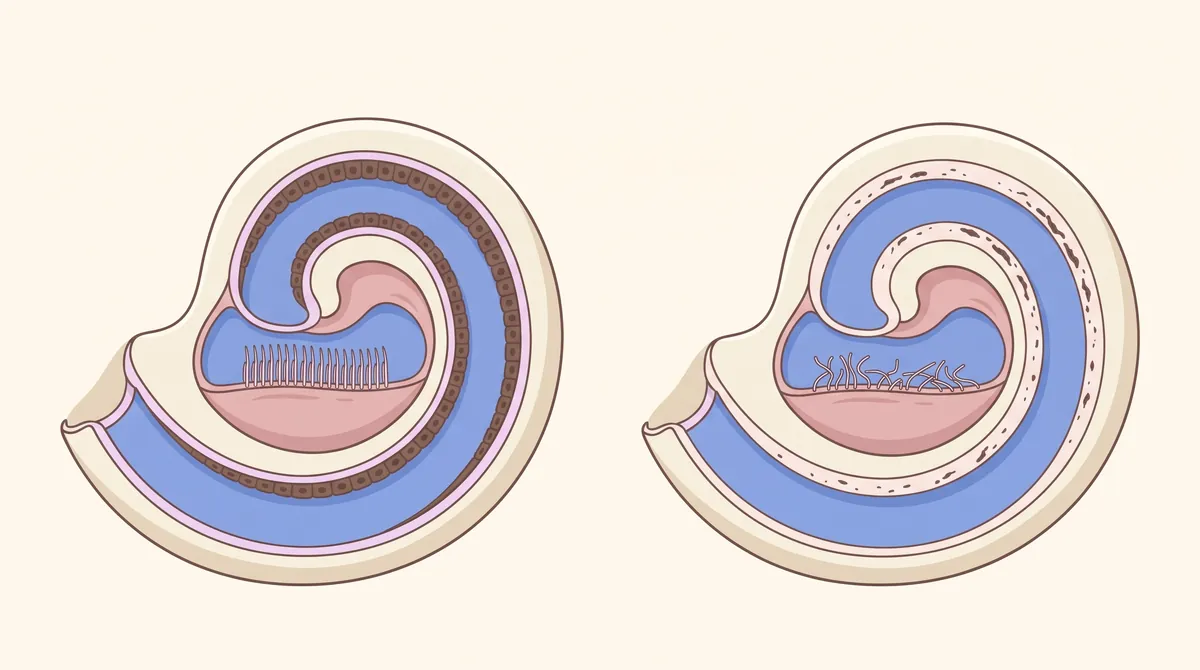 AI illustration
What the illustration shows
- 1Cochlea – The snail-shaped, bony part of the inner ear. Inside its duct, sensory cells turn sound vibrations into nerve signals.
- 2Stria vascularis with pigment cells – The dark band on the outer wall: here melanocytes maintain the potassium-rich endolymph and the endocochlear potential.
- 3Upright hair cells – The sensory cells of the organ of Corti only work while the stria keeps their environment right.
- 4Pale, degenerated stria – Without melanocytes the band stays thin and patchy. The endocochlear potential collapses – in Dalmatians from about three weeks of age.
- 5Collapsed hair cells – The hair cells die, and mammals cannot replace them. The ear stays deaf for life.
Which breeds are affected?
Affected breeds are those whose standard asks for a lot of white, plus breeds in which white varieties are bred. The figures come from BAER hearing-test series and vary by country and breeding practice – they are lower where the breed standard does not allow blue eyes. The TVT also names near-white French Bulldogs and Parson Russell Terriers in this context.
Typical of the breed
- Dalmatian
The standard demands a pure white ground (extreme white spotting); in a German study (BAER data 1986 to 1999), 19.6% of 1,899 tested Dalmatians were deaf in one or both ears, and 17.8% in a more recent UK study.
- Dogo Argentino
Deliberately bred for an almost pure white coat; in George Strain's US data, just over a quarter of 736 tested Dogos were deaf in one or both ears.
- English Setter
The belton flecking sits on extensive white; 12.4% of dogs were deaf in US testing and 4.5% in a UK study.
- Australian Cattle Dog
Puppies are born white and the speckling later hides the spotting; 10.8% were deaf in Australia, and masks or body patches lower the risk.
- Jack Russell Terrier
The standard asks for predominantly white; in a US study of 1,009 dogs, about 4% were deaf in one or both ears.
Certain colours only
- Bull Terrier
Only the white variety stands out: 20.4% of white but just 1.3% of coloured Bull Terriers were deaf in Strain's hearing tests.
- Miniature Bull Terrier
Bred in white as well as colours, like the Bull Terrier; the same pigment principle applies to white dogs, but large breed-specific hearing studies are missing.
- Boxer
White Boxers are born when both parents carry genes for extensive white; congenital deafness is clearly more common in them than in coloured Boxers.
How do you recognise healthy lines in white dogs?
By the written BAER result – not by looks. A responsible breeder of an affected breed has every puppy in the litter tested and shows you the original results for the puppies and both parents. Outward signs such as eye colour and patches only shift the odds.
What to look for
- A BAER result for your puppy, both ears assessed separately, done at about five weeks or later – as the original document.
- BAER results for both parents: hearing in both ears. Dogs deaf in one ear should not be bred either, because they pass on the predisposition just the same.
- Ask about hearing results from earlier litters of the same parents and line. Litters with several deaf puppies are a warning sign.
- Dark eyes without blue in breeds whose standard does not include blue eyes – in the Dalmatian, for example, blue eyes are a disqualifying fault under the FCI standard.
- Pigment on the head: an ear patch or head patch lowers the risk – the German veterinary animal-welfare association (TVT) advises looking for it in white-spotted dogs, even where the standard doesn't (yet) ask for it.
- Adverts praising “pure white” or “blue-eyed” Dalmatians, Dogos, Boxers or Bull Terriers are a red flag.
- In merle breeds: a merle DNA test for both parents, and never merle × merle (see the merle page).
How breeders make whole breeds healthier – tests, new genes and their limits
Are all white dogs at risk?
No. What matters is not the coat colour but whether pigment cells are missing from the inner ear. A white coat arises in dogs in at least two ways: either the melanocytes are absent from skin and hair (white spotting), or they are present but make almost no pigment. Only the first route is linked to pigment-associated deafness.
Many solid white or cream breeds – such as the West Highland White Terrier, White Swiss Shepherd or Bichon – are homozygous e/e at the MC1R gene, so they only make pheomelanin, which is also extremely diluted (partly through a variant in the MFSD12 gene). These dogs are not albinos and keep pigment on the nose, eye rims, lips and pads – their pigment cells are there. No colour-related increase in deafness risk has been described for this route, although congenital deafness can in principle occur in any breed. Some breeds also carry white-spotting alleles – if in doubt, a BAER test settles it.
Which white carries which risk?
| Type of white | Cause | Pigment cells in the inner ear | Deafness risk |
|---|---|---|---|
| Extreme white spotting (Dalmatian, Dogo, white Bull Terrier) | White-spotting locus S, MITF: melanocytes fail to migrate | often missing | raised |
| Double merle (M/M) | PMEL insertion present twice | often missing | high – see merle page |
| Recessive white/cream (Westie, White Swiss Shepherd) | e/e at MC1R plus pheomelanin dilution | present | no link described |
| Albinism (rare in dogs) | Melanocytes make no melanin | present | not described |
What is life with a deaf dog like?
Good – with some adjustments. Dogs deaf in one ear live practically normal lives and seem to hear normally day to day. Dogs deaf in both ears learn reliably through hand signals, respond to light signals and vibrating collars, and take cues from other animals in the household.
What matters most: a deaf dog can't hear cars or your recall, so it belongs on a lead outside secure areas. It can also startle badly when touched unexpectedly. Approach within its line of sight and wake it gently – for example by tapping the floor or touching the same spot every time.
Practical help
- Fixed hand signals for come, sit, down, stay, good dog and no – the whole family uses the same ones.
- A vibrating collar as a recall cue (vibration, never electric shock), built up with positive associations first.
- A light signal in the evening, such as switching the porch light on and off, for “come inside”.
- An “I am deaf” tag on the collar or harness helps strangers respond the right way.
Is breeding white dogs with a deafness risk illegal?
No colour or breed is banned as such – German law does not name specific breeds. But Section 11b of the Animal Welfare Act prohibits breeding dogs where the offspring can be expected to suffer inherited pain, suffering or harm because body parts or organs are missing, unfit or altered. Whether a case counts is assessed individually, based on the animal's traits. The expert opinion on interpreting Section 11b, usually dated 1999, serves as an interpretation aid. It names hearing damage “linked with white, as in the Dalmatian” and recommends a breeding ban for affected animals and known carriers; the simple recessive inheritance it assumes is now considered outdated. The Bavarian state office (LGL) considers the opinion outdated, so authorities also rely on TVT fact sheet no. 141, which explicitly names deliberate selection for extreme white spotting and white heads (for example in Dalmatians and Dogo Argentinos) as a trait relevant under Section 11b. A statutory list of symptoms planned in 2024, which would have named “deafness” explicitly, has not come into force.
Since 2022, dogs with inherited extreme-breeding traits may no longer be shown in Germany at exhibitions or other events where dogs are judged (Section 10 of the Dog Welfare Ordinance). Owning such a dog is not prohibited – the ban covers breeding and exhibiting.
In Austria, Section 5(2)(1) of the Animal Welfare Act names “deafness” explicitly as a symptom of extreme breeding. Since 2025 it has also been illegal there to import, acquire, broker or pass on animals with extreme-breeding symptoms or visible extreme-breeding traits – with exceptions, for example for animal shelters, and a transitional rule for animals lawfully bred or imported before that date.
Related conditions
The medical details – symptoms, diagnosis, treatment – are on the pages for each condition.
This page explains; it does not replace a veterinary examination. Only a vet can judge whether an individual dog is affected.
Frequently asked questions
Are white dogs always deaf?
No. Most white dogs hear normally. The risk mainly affects dogs whose white comes from extreme white spotting or double merle, because they can lack pigment cells in the inner ear. White dogs with recessive white, such as Westies or White Swiss Shepherds, do have these pigment cells – no colour-related increase in risk has been described for them.
What is a BAER test?
The BAER (brainstem auditory evoked response) measures whether clicks in the ear trigger an electrical response in the auditory nerve and brainstem. Fine needle electrodes are placed under the scalp, each ear is tested separately, usually without sedation, and it takes 10 to 15 minutes. A deaf ear shows a flat line. Testing is done from about five weeks of age, because the deafness only develops at three to four weeks.
Does the Dalmatian count as extreme breeding?
The Dalmatian is not banned – German law does not name breeds. But its standard demands a pure white ground, meaning the extreme white spotting that carries the deafness risk: in a German study (BAER data 1986 to 1999), about one in five tested Dalmatians was deaf in one or both ears. The TVT therefore lists breeding for this white ground as an extreme-breeding trait and criticises the FCI standard for excluding head patches, even though they would lower the risk. In the UK, where Dalmatian puppies have been BAER-tested since the 1990s, selection for hearing dogs has measurably lowered deafness rates. More on the breed in the Dalmatian breed profile.
Are blue-eyed dogs more likely to be deaf?
In breeds with a lot of white, yes: missing iris pigment signals strong expression of the spotting gene, and blue-eyed Dalmatians are statistically more often deaf than brown-eyed ones. But blue eyes are not proof – many blue-eyed dogs hear, and brown-eyed dogs can be deaf.
Can congenital deafness in dogs be treated?
No. The hair cells in the inner ear have died, and mammals cannot regrow them, so the deafness is permanent. What helps is an adapted daily routine: hand signals, safety on the lead and people who adjust how they communicate.
Can a dog deaf in one ear be bred?
No. A dog deaf in one ear carries the predisposition just like a dog deaf in both ears and can pass it on to its puppies. As a pet, however, it lives an almost normal life.
Sources
- Strain GM (2015): The Genetics of Deafness in Domestic Animals. Frontiers in Veterinary Science 2:29
- Strain GM, Louisiana State University: Breed-Specific Deafness Prevalence in Dogs
- Strain GM, Louisiana State University: Congenital Deafness and Its Recognition
- Lewis T, Freeman J, De Risio L (2020): Decline in prevalence of congenital sensorineural deafness in Dalmatian dogs in the United Kingdom. J Vet Intern Med 34:1524–1531
- Juraschko K et al. (2003): A regressive model analysis of congenital sensorineural deafness in German Dalmatian dogs. Mammalian Genome 14:547–554
- Hédan B et al. (2019): Identification of a Missense Variant in MFSD12 Involved in Dilution of Phaeomelanin Leading to White or Cream Coat Color in Dogs. Genes 10:386
- BMEL (expert group on animal welfare and pet breeding): expert opinion on the interpretation of Section 11b TierSchG, usually dated 1999, section 2.1.1.1.8 g (hearing damage, German)
- TVT fact sheet no. 141: extreme breeding and hereditary diseases in pets – focus on dogs (12/2023, German)
- FCI Standard No. 153: Dalmatian (30.05.2011)
- Section 11b German Animal Welfare Act (TierSchG) – ban on extreme breeding
- Section 10 German Dog Welfare Ordinance (TierSchHuV) – exhibition ban
- Austria: Animal Welfare Act (Tierschutzgesetz), Section 5(2)(1) and Section 8(2) (RIS)
Last reviewed on September 30, 2026 by Sufyan Osamah · what that means: Editorial standards
Related topics


Merle & double merle
One merle parent gives the marbled coat many people love; two merle parents can produce puppies born deaf or with malformed eyes.
Learn more

Colour dilution
Blue, grey and lilac dogs look striking – but the same gene variant that lightens their colour can, in some breeds, leave the coat permanently brittle.
Learn more

Flat face
A short muzzle looks endearing – but when the skull shrinks and the soft tissue inside it doesn't, the dog is left with too little room to breathe.
Learn moreLooking for a dog without this burden?
Many wonderful dogs are waiting in shelters – and many breeds come without extreme-breeding traits.