Merle and Double Merle: Why Merle × Merle Breeding Harms Dogs
One merle parent gives the marbled coat many people love; two merle parents can produce puppies born deaf or with malformed eyes.
In short
Merle is a coat pattern caused by a small DNA insertion in the pigment gene PMEL that patchily dilutes dark pigment. One copy gives the marbled coat. A puppy with two copies becomes a double merle: usually mostly white, with a much higher risk of deafness and eye defects. That is why merle × merle breeding counts as extreme breeding (called Qualzucht in German law).
Bred for health or bred to the extreme?
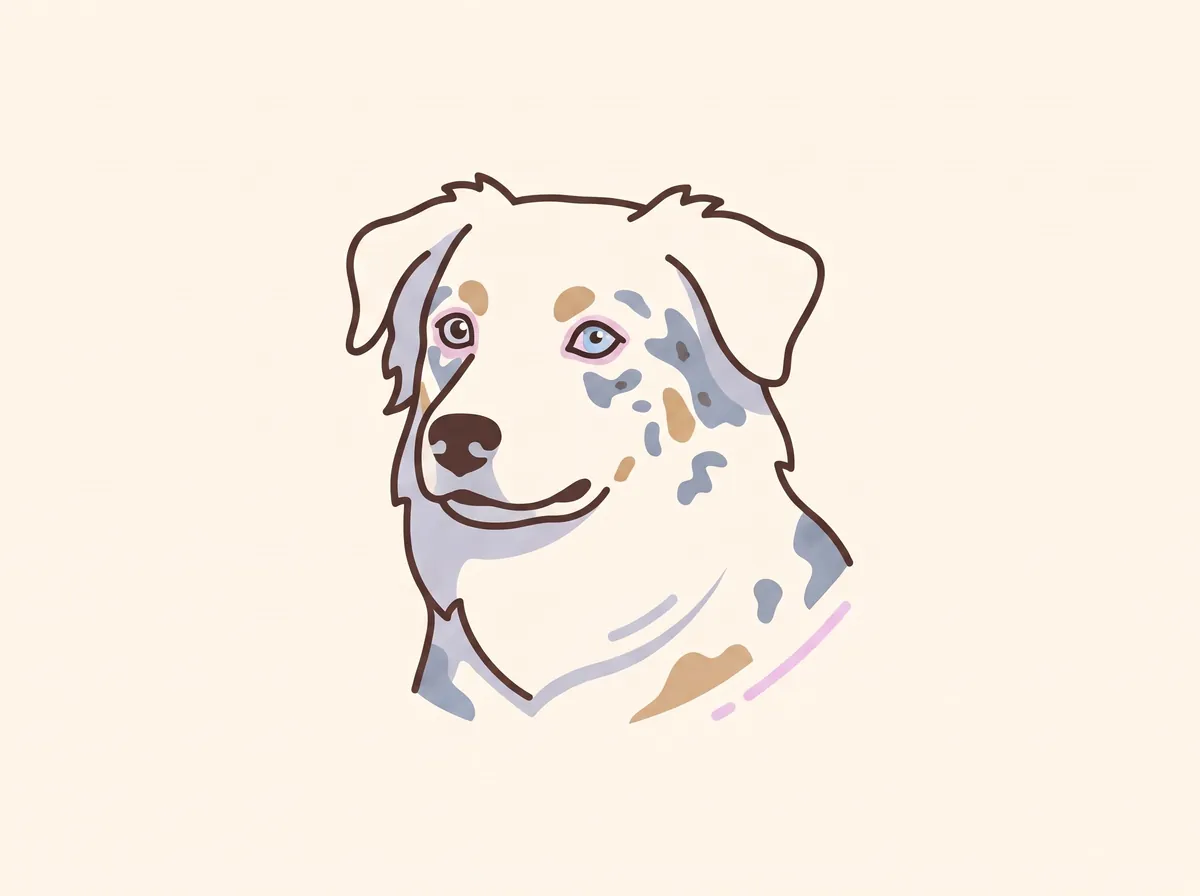
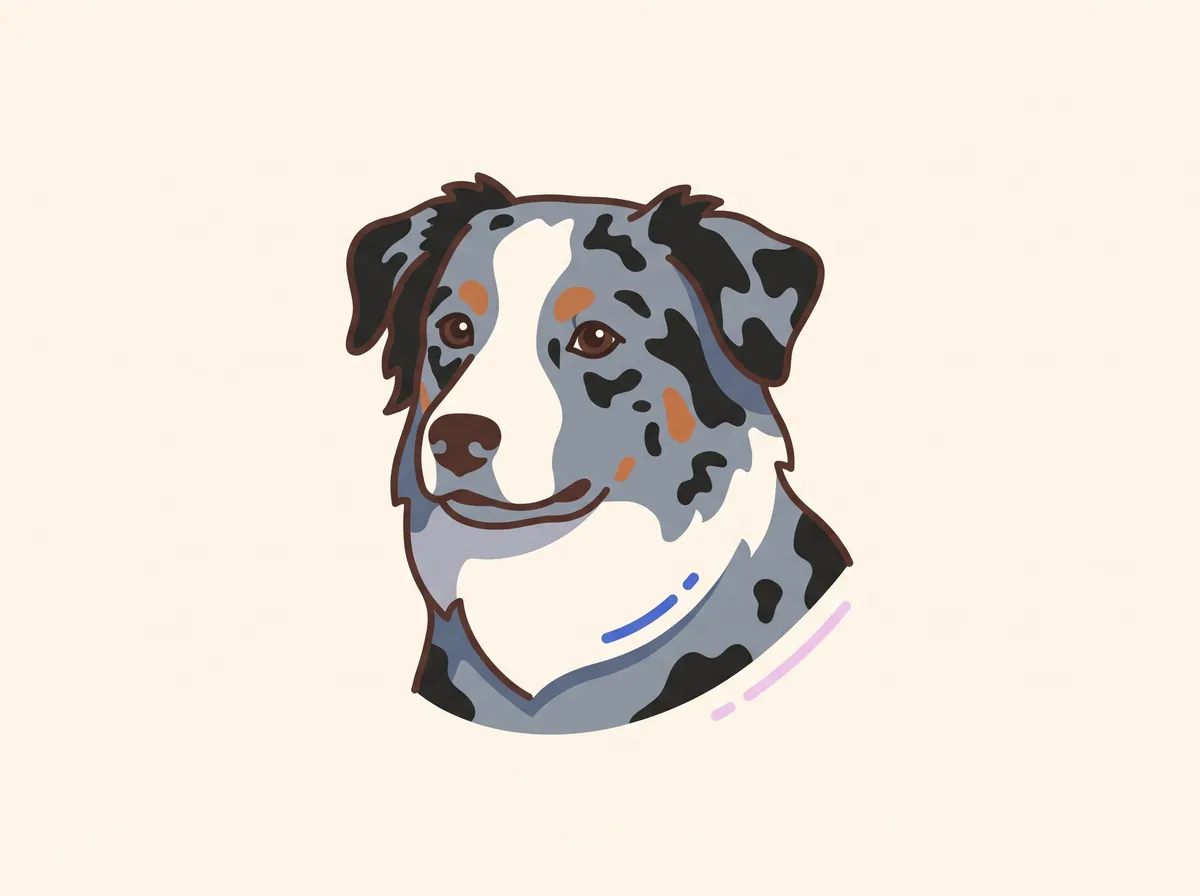
Look at the head and eyes: the double merle's head is almost entirely white, and the eyes are smaller, pale and irregularly shaped.
The illustrations are AI-generated and editorially reviewed. They do not show a real dog; they make the difference visible.
What is merle, in plain words?
Merle is a coat pattern that looks marbled: dark patches scattered over a lighter grey-blue or reddish base. It comes from a small change in a gene that helps the body colour the hair. A dog with a single copy of this change looks striking and is usually perfectly healthy.
Think of the gene as a paint bucket with a hole in it. With one leaky bucket and one intact bucket you can still paint a lovely spotted picture. But if a puppy gets a leaky bucket from both mum and dad, colour is missing almost everywhere, and the dog turns out mostly white.
The catch: the merle gene doesn't only affect the coat. With two copies, the ears and eyes often don't develop properly either, and a dog can be born deaf or with small, malformed eyes. That is why two merle dogs should never be bred together.
The key points
- One merle copy: a marbled coat and, as a rule, a healthy dog.
- Two merle copies (double merle): usually lots of white and a high risk of deafness and eye damage.
- You can't always see whether a dog carries merle; only a DNA test tells you for sure.
What goes wrong in a double merle's body?
In a double merle (genotype M/M), large areas of the coat lack pigment, and malformations of the inner ear and eye appear alongside, with a clear gene-dose effect. The cause is a short SINE element inserted in reverse at the intron 10/exon 11 boundary of the PMEL gene (formerly SILV), which Clark and colleagues identified as the cause of merle in 2006.
As currently understood, PMEL builds the fibrous scaffold of the eumelanosomes where dark eumelanin pigment is deposited. The longer the insertion's poly(A) tail, the more often the gene is spliced at the wrong site and the less working PMEL is made. Because the tail length can change spontaneously in individual pigment cells, patches of full colour sit next to diluted areas. Red and yellow pigment (phaeomelanin) is not affected.
In the inner ear, degenerative changes have been described in merle dogs that reduce hearing in one or both ears. In a study of 153 merle dogs tested with BAER hearing tests (only a few of them double merles), 2.7% of single merles (Mm) were deaf in one ear and 0.9% in both. Among double merles (MM) the figures were 10% and 15%.
In the eye, double merles have been described with microphthalmia (an undersized eyeball), microcornea, a narrowed or off-centre pupil (corectopia), cataract and colobomas – gaps in the tissue that look like a keyhole in the iris. In an experimental dachshund colony, all eleven double merles examined had severe eye malformations of varying form. Milder findings, such as a missing tapetum lucidum or a poorly pigmented retina, were also seen in some single merles.
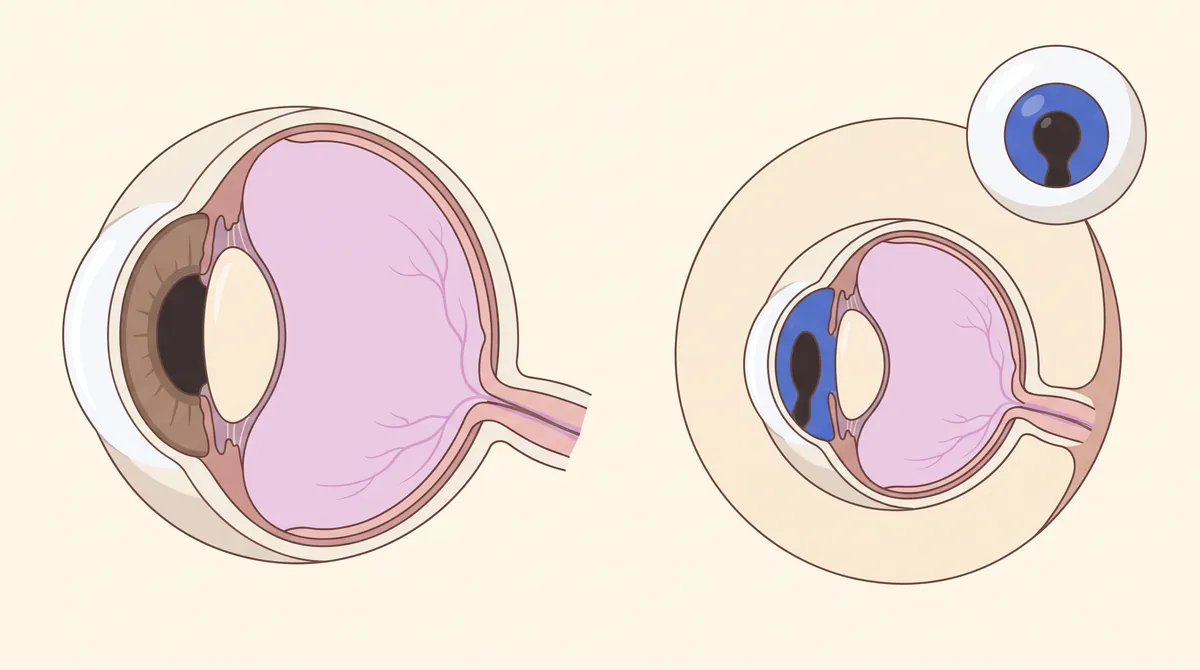 AI illustration
What the illustration shows
- 1Complete iris – The iris forms a closed ring with the pupil in the centre. This is a normally developed eye, as seen in the vast majority of single merles too.
- 2Retina – The retina lines the back of the eye. Poorly pigmented retinas and a missing tapetum lucidum have been described in merle dogs.
- 3Undersized eyeball – Microphthalmia: the eyeball is congenitally too small and doesn't fill the normal-sized socket. This can markedly reduce vision.
- 4Iris coloboma – A congenital gap at the bottom of the iris that looks like a keyhole.
- 5Off-centre pupil – Corectopia: the pupil isn't centred in the iris. It is one of the findings typical of double merles.
Which breeds are affected?
Merle occurs mainly in herding breeds and in the Dachshund. What matters is the mating, not the breed: the risk only arises when both parents carry merle.
Certain colours only
- Australian Shepherd
Blue merle and red merle are standard colours; the breeding rules of the German Australian Shepherd club CASD explicitly ban merle × merle.
- Rough Collie
Blue merle is one of the three standard colours; the German Collie Club explicitly bans blue merle × blue merle.
- Smooth Collie
Same colour range as the Rough Collie, blue merle included, and the same German Collie Club breeding rules.
- Shetland Sheepdog
Blue merle is a recognised standard colour; blue or blue-flecked eyes are explicitly allowed in merles.
- Dachshund
Dapple (“Tigerdackel”) is a traditional standard pattern; the German Dachshund Club forbids dapple × dapple and requires the mate to be merle-tested.
- Border Collie
The standard allows many colours, merle included; the risk only concerns matings where both parents carry merle.
- Great Dane
The black-and-white “harlequin” colour rests on one merle copy plus a variant in the PSMB7 gene; only this colour variety is affected.
- Catahoula Leopard Dog
The breed's signature leopard pattern is merle, which makes it all the more important never to mate two merle dogs.
- Chihuahua
The FCI standard allows every colour except merle, so merle Chihuahuas come from breeding outside those rules.
- French Bulldog
Merle is not an accepted colour in the FCI standard; merle Frenchies add a second risk on top of the short muzzle.
- Miniature American Shepherd
Blue merle and red merle are standard colours; the AKC advises against mating two merles because double-merle puppies often have sight and hearing defects.
- Mudi
The FCI standard allows merle (“cifra”) on all base colours; the Mudi Club advises against mating merle dogs together. Yellow Mudis can carry merle without showing it, so a genetic test of the parents matters.
- Koolie
Merle is common in Koolies; the Koolie Club advises against merle × merle because double-merle puppies carry a real risk of sight and hearing problems. A genetic test of the parents also reveals hidden merle carriers.
- Pyrenean Shepherd
The FCI standard allows “blue with black mottling” (harlequin or slate blue) and explicitly accepts wall eyes in these colours; only this colour carries the merle risk, and two merle parents should never be mated.
- Pyrenean Shepherd (Smooth-faced)
The smooth-faced variety shares the colour range of the long-haired one, harlequin (merle) included; the risk only concerns matings where both parents carry merle.
- Beauceron
The harlequin colour in the Beauceron is merle; harlequin × harlequin is regarded as unacceptable because of severe defects in puppies, and the French breed club (Club Les Amis du Beauceron) prohibits mating two merle carriers. Only this colour variety is affected.
- Cardigan Welsh Corgi
Blue merle is a recognised standard colour (blue eyes are permitted only in merles); only merle lines are affected, and two merle parents should never be mated.
How do you recognise healthy merle lines?
Both parents' merle status is documented by DNA test, and at most one of them carries merle. A single merle from merle × non-merle is, as a rule, a healthy dog; the risk comes almost entirely from merle × merle.
Some German breed clubs put this in writing: the German Dachshund Club forbids dapple × dapple and requires a dapple's mate to be merle-tested, the German Collie Club bans blue merle × blue merle, and the VDH breeding rules forbid any colour mating that is risky on welfare grounds.
We do not list breeders for the French Bulldog; for that breed, see the page on the short nose.
Your checklist
- Ask to see both parents' original merle DNA results, including the allele (m, Mc, Mc+, Ma, Ma+, M, Mh), not just “merle positive”.
- At least one parent must test m/m. If it's merle × merle, the conversation is over.
- Solid, red, yellow or sable parents in merle breeds need testing too: merle is often invisible on light pigment.
- With cryptic or atypical results, ask how the breeder handles them, and for popular stud dogs, whether mosaicism was ruled out.
- Ask for a BAER hearing test of the puppies and an eye examination by a specialist vet.
- A mostly white puppy with a white head and small or unusual eyes from merle parents is a warning sign of a double merle.
- Be wary of merle in breeds whose standard doesn't include it, such as the Chihuahua, French Bulldog or Pomeranian. Where the merle gene came from is usually unclear.
- A good breeder explains merle genetics to you unprompted, both in conversation and in writing.
How breeders make whole breeds healthier – tests, new genes and their limits
How is merle inherited?
Merle is autosomal and incompletely dominant: one copy (Mm) is enough for the pattern, while two copies (MM) strengthen the effect considerably. The share of each type of puppy follows Mendel's rules on average, not in every single litter.
The table shows why merle × non-merle is fine and merle × merle is not: double merles only arise when both parents can pass on a merle copy. The breeding side – mating plans and DNA tests – is covered in our breeder guide on colour inheritance and merle.
Expected share of puppies per mating
Classic merle (M) and non-merle (m), averages
| Mating | Non-merle | Merle | Double merle |
|---|---|---|---|
| Non-merle × non-merle | 100% | 0% | 0% |
| Merle × non-merle | 50% | 50% | 0% |
| Merle × merle | 25% | 50% | 25% |
What are cryptic, atypical and harlequin merle?
They are versions of the same merle insertion that differ in length. The shorter it is, the weaker its effect: a cryptic merle (Mc) carries merle but looks solid-coloured. The longer it is, the more pigment is lost, up to harlequin merle (Mh), where areas of the coat turn fully white.
In 2018 Langevin and colleagues distinguished six merle alleles by length. The cut-offs are guidelines: labs measure differently, and another study grouped the same range into four categories (cryptic, dilute, standard, harlequin).
Three points matter for you. First, merle can be invisible: as a cryptic merle, or as “hidden merle” in red and yellow dogs whose coat barely shows it. Second, the length can change from one generation to the next, in 4.6% of dogs in one study. Third, mosaicism is common; Langevin found it in 16.6% of the dogs tested.
The Great Dane's harlequin is related but not the same as harlequin merle: it arises from one classic merle copy plus a second gene variant (PSMB7).
Merle alleles after Langevin et al. (2018)
| Allele | Insertion length | Typical coat |
|---|---|---|
| m (non-merle) | no insertion | No merle, solid |
| Mc (cryptic) | 200–230 bp | No visible merle |
| Mc+ (cryptic+) | 231–246 bp | No visible merle |
| Ma (atypical) | 247–254 bp | No merle pattern, coat tends to look diluted or brownish |
| Ma+ (atypical+) | 255–264 bp | Muted, blurry merle, often diluted |
| M (classic) | 265–268 bp | Classic merle |
| Mh (harlequin) | 269–280 bp | Minimal merle, areas diluted to white |
Is merle × merle breeding illegal in Germany?
Not explicitly, but Section 11b of the German Animal Welfare Act (TierSchG) can be applied to it: merle is not named in the statute itself, yet the rule prohibits breeding vertebrates when offspring are expected to suffer hereditary pain, suffering or damage because body parts or organs are missing, unfit or altered. The authorities can also order animals to be sterilised if their offspring are expected to show such defects.
How Section 11b should be applied is set out in the “Expert opinion on the interpretation of Section 11b of the Animal Welfare Act (ban on extreme breeding)”, usually dated 1999, which authorities use as their reference. It is an expert interpretation aid, not law, and predates today's merle DNA tests. It lists the merle syndrome as a specific example and recommends a breeding ban for double merles and for merle × merle matings (Mm × Mm). Because sensory changes have also been described in single merles, it goes further and advises against breeding with the merle gene at all. Breeding rules such as those of the German Dachshund and Collie clubs still allow merle × non-merle.
Since 1 January 2022, Section 10 of the German Dog Welfare Ordinance (Tierschutz-Hundeverordnung) has also banned showing dogs with such hereditary traits at exhibitions and other events where dogs are judged. Whether an individual dog falls under it is assessed case by case. Owning a double merle is not prohibited; the bans cover breeding and exhibiting.
Switzerland is more specific: under Art. 9 of the federal breeding ordinance (TSchZV), matings in which a loss of the senses, namely blindness or deafness, cannot be ruled out are banned. The rule can be read as covering merle × merle, although merle is not named in it and cases are assessed individually.
Related conditions
The medical details – symptoms, diagnosis, treatment – are on the pages for each condition.
This page explains; it does not replace a veterinary examination. Only a vet can judge whether an individual dog is affected.
Frequently asked questions
What happens when you breed merle to merle?
On average a quarter of the puppies inherit a merle copy from each parent and become double merles. These dogs are usually mostly white and at sharply increased risk of deafness and eye malformations such as microphthalmia or colobomas. In one study, 25% of double merles were deaf in one or both ears.
Is merle extreme breeding?
The merle pattern itself isn't automatically extreme breeding, but merle × merle breeding is: Germany's expert opinion on extreme breeding recommends banning it, and the German veterinary animal-welfare association (TVT) places it squarely under Section 11b. The expert opinion even advises against breeding merle at all, because single merles can also have ear and eye findings, though far less often.
What is a cryptic merle?
A dog with a heavily shortened merle insertion (Mc) that produces no visible pattern. It looks solid-coloured but genetically carries merle. Because the length can change across generations and mosaics occur, even a seemingly solid dog in a merle breed should be tested before breeding.
Are merle dogs more often deaf?
Single merles rarely, double merles far more often. In a study of 153 dogs, 3.6% of single merles and 25% of double merles were deaf in one or both ears. A BAER hearing test reliably shows whether a puppy can hear.
Does the dapple Dachshund count as extreme breeding?
A dapple Dachshund is a single merle and a traditional Dachshund pattern. It becomes extreme breeding with dapple × dapple matings, which the German Dachshund Club forbids; the club also requires a dapple's mate to be merle-tested. More on the breed in the Dachshund breed profile.
How can I tell if a dog is a double merle?
Often by a lot of white in the coat, a white or nearly white head and small, pale or irregularly shaped eyes. Only a DNA test is certain, as some double merles have more colour than you'd expect. If both parents are merle, always ask.
What should I do if my dog is a double merle?
Have its hearing (BAER test) and eyes checked by a vet so you know what your dog is living with. You can then adapt training and daily life to its senses, for example hand signals instead of calling for a deaf dog. Responsibility for the risk lies with the mating, not with you or your dog.
Sources
- American Kennel Club: Merle in Dogs – The Science Behind This Unique Coat Pattern
- Clark LA et al. (2006): Retrotransposon insertion in SILV is responsible for merle patterning of the domestic dog. PNAS 103(5)
- Strain GM et al. (2009): Prevalence of deafness in dogs heterozygous or homozygous for the merle allele. J Vet Intern Med 23(2)
- Langevin M et al. (2018): Merle phenotypes in dogs – SILV SINE insertions from Mc to Mh. PLoS One 13(9)
- Murphy SC et al. (2018): Length variations within the Merle retrotransposon of canine PMEL. Mobile DNA 9:26
- Dausch D et al. (1978): Eye changes in the merle syndrome in the dog. Graefes Arch Clin Exp Ophthalmol 206(2)
- Clark LA et al. (2011): A missense mutation in the 20S proteasome β2 subunit of Great Danes having harlequin coat patterning. Genomics 97(4)
- BMEL (expert group on animal welfare and pet breeding): expert opinion on the interpretation of Section 11b TierSchG, usually dated 1999, section on merle syndrome (German)
- TVT fact sheet no. 141: extreme breeding and hereditary diseases in pets, focus on dogs (2023, German)
- Section 11b German Animal Welfare Act (TierSchG, German)
- Switzerland: FSVO Ordinance on Animal Welfare in Breeding (TSchZV, SR 455.102.4), Art. 9 (German)
- FCI Standard No. 238: Mudi
- FCI Standard No. 141: Berger des Pyrénées à poil long
- FCI Standard No. 138: Berger des Pyrénées à face rase
- FCI Standard No. 44: Berger de Beauce
- Club Les Amis du Beauceron: Le mariage entre deux sujets porteurs du gène merle est interdit
- Mudi Club UK: Mudipedia – standardised colours
- Koolie Club of Australia: Choosing a puppy
- American Kennel Club: Official Standard of the Miniature American Shepherd
- American Kennel Club: Official Standard of the Cardigan Welsh Corgi
Last reviewed on September 30, 2026 by Sufyan Osamah · what that means: Editorial standards
Related topics
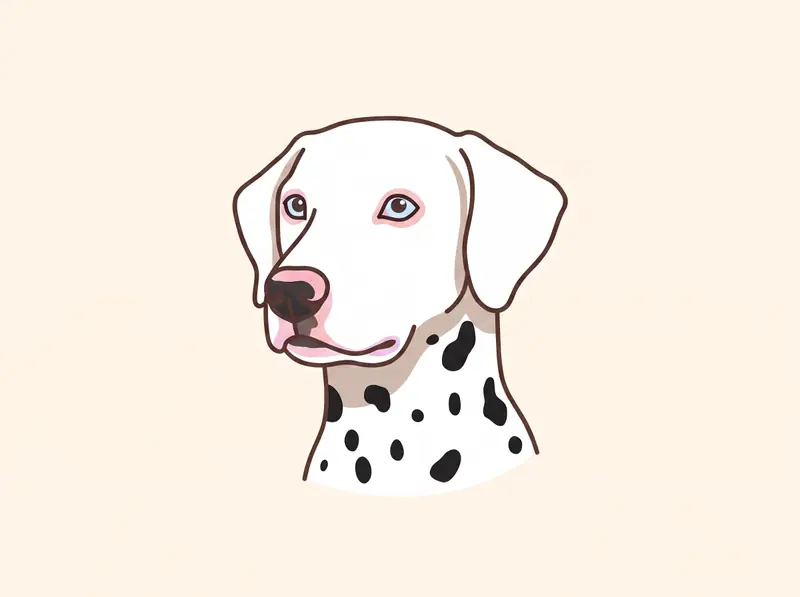
White & deafness
Not every white dog is at risk – but where pigment cells are missing from the head, they are often missing from the inner ear too, and a puppy can go deaf in its first weeks of life.
Learn more
Colour dilution
Blue, grey and lilac dogs look striking – but the same gene variant that lightens their colour can, in some breeds, leave the coat permanently brittle.
Learn more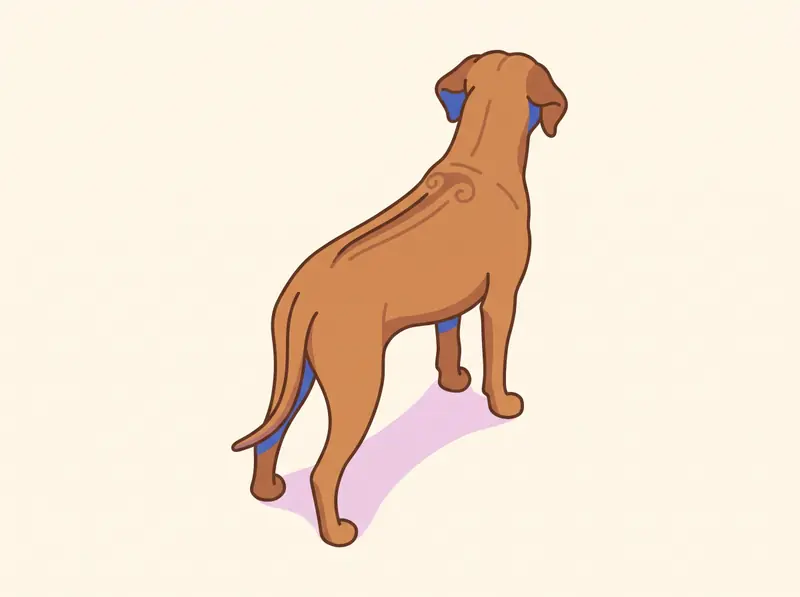
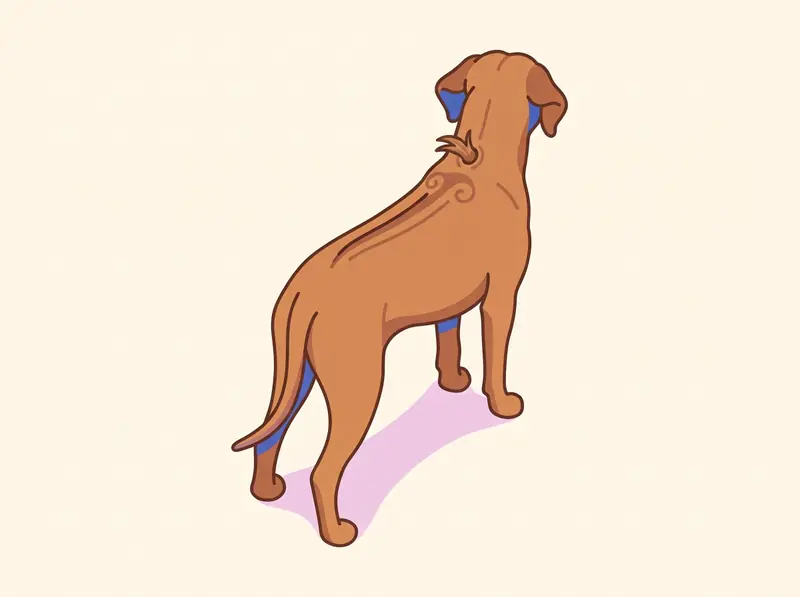
Ridge & dermoid sinus
The ridge of backward-growing hair is what makes a Ridgeback a Ridgeback – and the same mutation raises the risk of a skin tunnel that can reach the spinal cord.
Learn moreLooking for a dog without this burden?
Many wonderful dogs are waiting in shelters – and many breeds come without extreme-breeding traits.